
Zen blog post in Russian
https://dzen.ru/a/agCHFxUVayfxwHAD
Thermometer for the country: why people don't believe salaries from the news.
It's a creepy story because it's about each of us. Prepared for those who prefer the truth in their pocket to the numbers in the headlines.
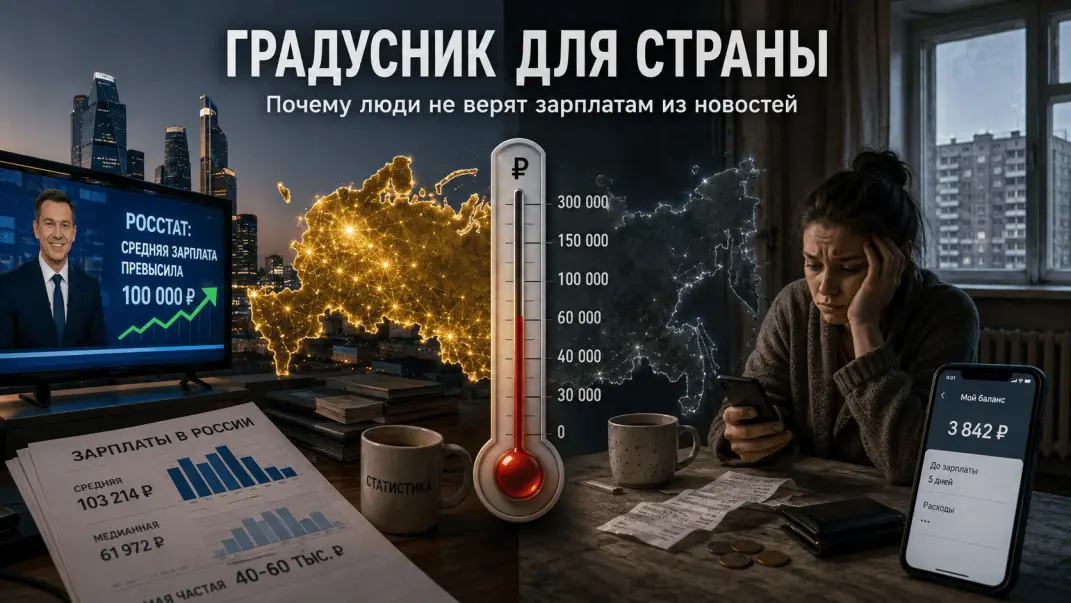
It wasn't the alarm clock that woke me up at seven forty-seven in the morning.
Aunt Zina was banging on the radiator from below as if she was trying to get through to the government itself.
— Alice! She shouted through the pipes. — Turn on the news! We're rich!
I opened my eyes.
Outside, February was chewing gray snow. The room smelled of yesterday's coffee and batteries, which were heated so lazily, as if they had long since stopped paying for motivation.
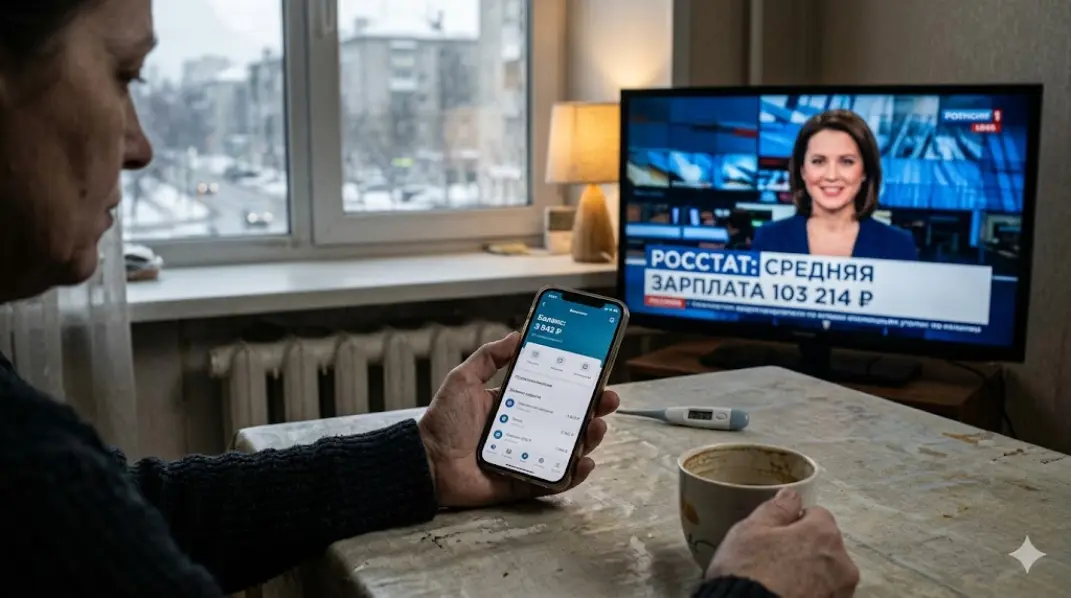
The TV didn't turn on immediately. The screen blinked, rippled, and then the announcer with a perfect plastic smile said:
— According to Rosstat, the average accrued salary in the country has exceeded one hundred thousand rubles…
He spoke in the voice that usually announces the launch of a spaceship or the victory over a disease.
I automatically reached for the phone.
There were 3,842 rubles left on the card.
Payday is five days away.
I looked first at the TV screen, then at the banking app. Then back to the TV.
Somewhere between these two devices, an entire country is clearly lost.
And that's when I first decided to find the damn "hundred thousand." Not in reports or graphs. But in real life.
I worked as an analyst at the Archive of Social Statistics, a huge concrete building without windows where human destinies were turned into tables.
It always smelled of dust, cheap coffee, and overheated servers.
There was a slogan at the entrance: "A FIGURE IS MORE OBJECTIVE THAN MEMORY."
It used to seem true to me. Then I started to grow up.
At nine o'clock in the morning, I received a file with red markings. Such documents were not sent to ordinary employees.
"THE DISCREPANCY BETWEEN THE PERCEPTION OF THE POPULATION AND OFFICIAL INDICATORS."
I opened it. A map of the country flashed on the screen.
Moscow shone with gold.
The northern regions are rich in oil amber.
The rest of the area looked like someone had forgotten to turn on the electricity.
Below were the numbers:
The average salary is 103,214 rubles.
Nicely. Almost solemnly.
And then I scrolled down.
The median salary is 61,972 rubles.
The most frequent is 40-60 thousand.
And suddenly the whole thing started to crack in my head. Because this is the first time I have seen a country that is not politically divided. But statistically split.
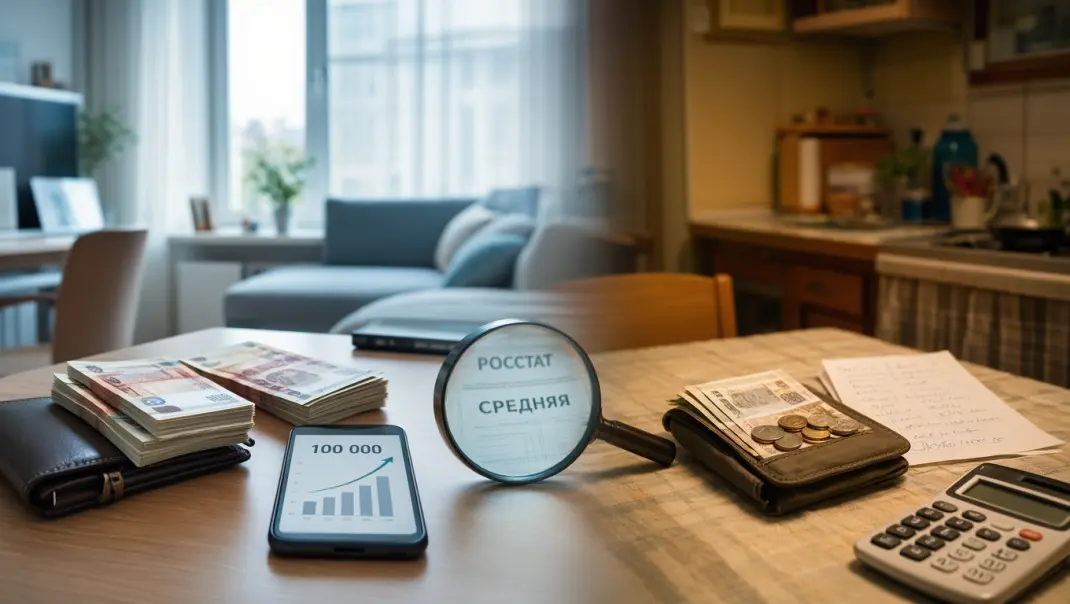
One room is enough to understand the scale of the focus. Nine people receive forty thousand rubles each. One to five million. Statistics enters, clicks the calculator and happily announces:
— Congratulations! The average salary in the room is more than five hundred thousand!
On paper, everyone is suddenly rich. In reality, nine people are still counting the days until the advance payment. It's not a lie. This is arithmetic. It's just that sometimes mathematics can be colder than cheating. The average value honestly adds up everyone in a row, but does not know how to feel the difference between the cashier and the owner of the oil company at all.
And while Moscow, the northern oil regions, financiers and the IT sector are earning their real 200-300 thousand, the average figure continues to fly up like a balloon untethered from the ground.
And there are people down there. Those with mortgages. Communal apartment. A refrigerator loan. Pharmacy. School fees. Thirty days until the next paycheck.
In the evening, I went to the Lower Sector. That's what the old districts behind the Third Ring were called in the city. There were no glass towers. There are only shawarma stalls, dim pharmacies, and snow the color of old bandages.
At the subway, a man in an orange courier jacket was drinking coffee from a paper cup.
"A hundred thousand?" — he grinned when he heard the news from the speaker. "I'd take two."
A history teacher stood nearby. Tired, with his hands red from the cold.
"I have forty—two after all the allowances," he said calmly. — Thirty years of experience.
And at that moment, the entire economy of the country suddenly fit between the two of them.
A courier who gets more money because the market needs speed more than knowledge. And a teacher who realized a long time ago that respect doesn't translate into money.
I was alone in the archive at night. The servers were buzzing behind the wall like a huge mechanical beehive. I opened the salary map by region.
Sakhalin — more than 300 thousand.
Yamal is under 150.
The Moscow financial sector is even higher.
And then Ivanovo. Bryansk. Kostroma. Regions where official salaries were hanging around thirty thousand, as if the system wasn't even trying to be shy about it.
The country looked like an organism with one half of its body living in the 21st century, and the other half trying to make it to paycheck without delinquency on a loan.
The whole country looks like a huge hospital from an old joke. Where the average temperature of the patients is 36.6. Although half of the wards are burning with fever.
And the scariest thing was that no one was formally lying. Rosstat really thought it was fair. The total salary fund was divided by the number of employees. The math was perfect. Unfair, but perfect.
That was the first time I realized the difference between the average salary and the median. The average is needed by the state. It shows the temperature of the entire economy. A person needs the median. It shows the temperature of life.
And when they talk about the "average hundred thousand" on TV, most people aren't angry because they don't understand statistics. Conversely. People understand their own refrigerator too well. They understand the price of eggs. For rent. For medicines. For winter boots for a child. They understand how much remains after all write-offs.
That is why the figure in the news does not cause joy, but the feeling that they are trying to sell you a beautiful decoration instead of a normal life again.
I finished my report later in the morning. The cursor was blinking in the final window. I looked at it for a long time, then I wrote:
"There is no contradiction between statistics and citizens' feelings. Different indicators describe different levels of the same economic reality."
I reread the sentence. And suddenly I realized how scary she was. Because a country where people live in different statistical dimensions is gradually ceasing to be one country at all.
Some people buy apartments in glass towers. Others — buckwheat for the promotion. Some are discussing investments. Others are how to make it to the advance payment. And it's not envy that's growing between them. There is a void and a gap between them.
I came out of the archive this morning. The city was lit up with advertisements again. On the huge screen above the avenue, the same announcer was smiling at the country.:
— The average salary continues to grow…
People passed by without looking up. Because we learned a long time ago not to check the economy by headlines. And by the sound of the refrigerator at night. According to the balance on the card. By whether it's enough until the end of the month. I stopped at the window, took out my phone and looked at the balance again.
3,842 rubles.
It was still not enough until the end of the week.
But for the first time in a long time, I didn't want to get mad. Because I finally realized the main thing: the problem is not that Rosstat is lying. The problem is that the average temperature has long been more important than the patients.
And when the government starts loving numbers more than people, one day people disappear from all reports completely.
Only beautiful statistics remain.
And it's a very cold country.
Prepared on the basis of data from Rosstat, Sberindex and industry reviews for 2025-2026.
Statistics are the corpse of truth, bandaged with beautiful numbers. And life is when you wake up with an empty wallet, but with a clear head.
And while statistics are basking in the rays of the "average temperature", we can only look at the median and trust our wallet more than the TV. After all, at the end of the month we go to the store with real money, not with arithmetic averages.
The Dark Art of Dystopia by Violetta Wennman
PARSING, SYMBOLS, MEANINGS.
WE ANALYZE, COMPARE, AND UNDERSTAND.
Welcome to a world where the future is already written.
I write and shoot. Join me
Author's video content
https://www.youtube.com/c/ViolettaWennman
Political trash
https://www.youtube.com/@Ship-Shard
I invite you to the telegram channel
https://t.me/shipshard
Highly Social on Zen
https://dzen.ru/shipshard
For goodies
https://dzen.ru/shipshard?donate=true
My hobbies are history, philosophy, psychology, music, economics, politics, and sociology. I write about this and much more. Professional model. She has performed at international music festivals (vocals, dancing, imitation of vocalists). I am studying at the Academy of Arts - the film and art industry, I am a producer and the owner of a video studio.
I am glad to see all of you in my blogs.

You won't lose me here. https://t.me/shipshard






