
Zen blog post in Russian
https://dzen.ru/a/adlVQVFRBx1V4vU4
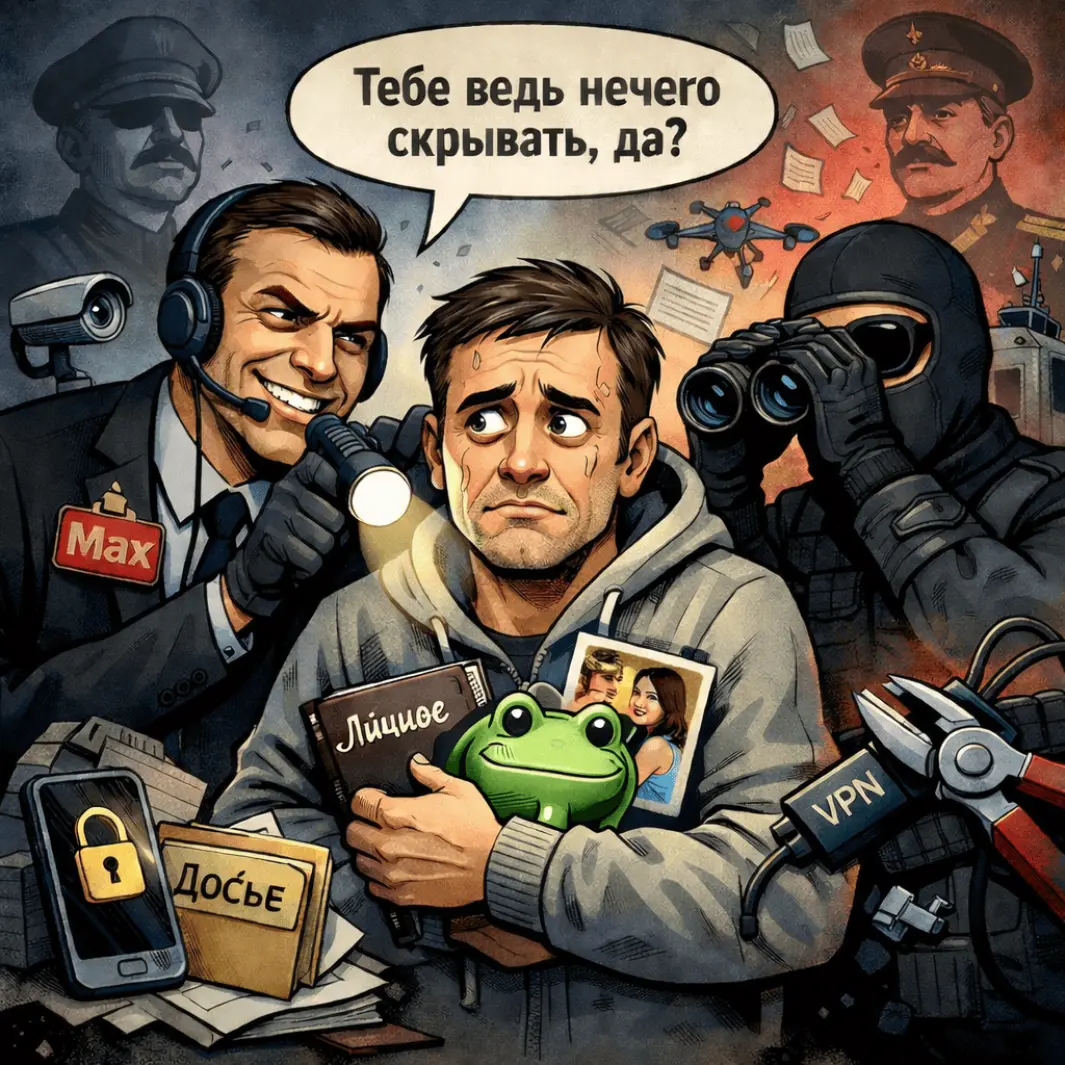
Every time a topic with Max comes out, there is always an argument: "Well, what if you have nothing to hide — what are you afraid of?"
It sounds logical. It's even convenient. But in fact, this is one of the most primitive manipulations. The idea is embedded in this phrase: "if you're hiding something, it means you're doing something bad," but it's just not true. You're hiding: personal correspondence, health, money, relationships, your views. And that's okay. You're not closing the door of your house because you're a criminal. And you don't put a password on your phone because you're violating something. Privacy does not mean guilt. The "nothing to hide" argument works because it simplifies everything to the point where either you're clean or you have something to hide. And it's easier for a person to agree than to think about boundaries, control, and consequences. If you accept this logic, you are actually saying: OK, the state can watch everything; ok, privacy is not a principle; ok, rights are needed only by the "suspicious". And the most important thing is that so far everything is fine with you, you're just lucky. Max raises questions because it is not just a messenger "like everyone else", but because it works within the framework of data access (Yarovaya's law, access to correspondence at the request of the security forces is technically possible and legalized), can potentially send correspondence on request, collects a lot of information from the device. And then a convenient narrative appears: "relax, if you are normal, you have nothing to fear." The phrase "nothing to hide, nothing to fear" is not about security. It's about you agreeing to control yourself. Privacy is not a reward for good behavior. This is a basic right. And the question is not whether you are hiding something or not, but whether you are ready to live in a system where your personal space is not yours. To simplify it to one thought: everyone has something they don't want to make public, and that's okay. So phrases like "if there is nothing to hide from the authorities, then there is nothing to be afraid of" when installing the Max messenger is a manipulative argument designed to normalize total control over correspondence and reduce people's resistance. This is a classic logical trap that is used to justify data collection. The phrase "the only reason to conceal information is illegal activity" is actually a substitution of concepts. Information can be hidden for a thousand reasons: personal correspondence with a doctor, the financial situation of a family, medical diagnoses, relationships with loved ones, political views, religious beliefs. None of these reasons is illegal.
People who had nothing to “hide” became victims anyway —when the interpretation, political course, or personal sympathies of those in power changed. Historically, this phrase has been used by Hitler to justify surveillance of citizens, Stalin for repression, Mao for whistleblowing, and the intelligence services to justify mass surveillance programs. This phrase has long proved its inconsistency. The right to privacy is not a privilege. Privacy is a fundamental human right, enshrined in: 1) the Universal Declaration of Human Rights (article 12), 2) the European Convention on Human Rights (Article 8), 3) the constitutions of most democratic countries. If you have not committed a crime, but the authorities have access to your data, this is not a matter of guilt, but of right. When you agree with this thesis, you agree that: anyone who values privacy is a potential criminal; the state has the right to unlimited access to your life; as long as you are “clean”, you do not need rights. Privacy is not something that needs to be earned by “innocence.” This is a right that exists to protect a person from any arbitrariness, including state arbitrariness.
The main difference between Max and the usual messengers is its architecture and the purpose of its creation. This is a government platform, which is essentially a management and control tool. Lack of end-to-end encryption. Data collection and surveillance (when installing the application, the user actually agrees to monitor their actions. It is reported that Max can track not only correspondence and calls, but also user reactions to publications (for example, the use of "dislikes" under posts about the war), as well as check the use of a VPN. Cooperation with special services (the application was created in order to share data with the authorities. According to officials, any messenger is "absolutely transparent to the security services." However, in the case of Max, this transparency is its main function).
"Nothing to hide" is a dangerous illusion. Risk of leaks and fraud: The paradox is that Max, advertised as safe, turned out to be extremely vulnerable to fraudsters. Due to the lack of encryption and high user trust, the platform has become a "gift" for intruders. There have been cases of account hacking, data theft, and the use of a phishing app. Your personal data may be stolen not by "enemies of the state", but by ordinary criminals. Mistakes and abuses: Systems based on big data collection often make mistakes. Algorithms can mistake harmless text messages or tattoos for threats. There is already a case when a resident of the Krasnodar Territory received a fine for tattooing on an avatar in Maks, which the security forces considered to be symbols of a banned organization. Even if you are "clean", someone may decide otherwise. The problem of the future: Today's government may seem quite reasonable to you. But what if the political course changes? The data that you voluntarily gave away today may be used against you in the future if you become part of an "unreliable" group. History knows many examples where information about private life has been used to harass people. This is a matter of right, not guilt.: As one user aptly noted in a discussion about privacy: "The desire to preserve privacy is NOT equal to the desire to hide something." The right to privacy is a fundamental human right. It exists not to protect criminals, but so that each of us can remain ourselves without fear of constant control.
The phrase "nothing to hide, nothing to fear" in the context of the "Max" installation is not an argument in favor of security, but an invitation to give up your privacy in exchange for imaginary peace. It ignores the real risks, from trivial fraud to long—term threats from the state.
Edward Snowden, who exposed the scale of surveillance, gave this phrase a great answer: "Saying that you don't care about the right to privacy because you have nothing to hide is no different from saying that you don't care about freedom of speech because you have nothing to say." Your data is not just about what you do, it's about your personality, environment, and habits. And it's up to you to decide if you're ready to reveal it all completely.
I write and shoot. Join me
Author's video content
https://www.youtube.com/c/ViolettaWennman
Political trash
https://www.youtube.com/@Ship-Shard
I invite you to the telegram channel
https://t.me/shipshard
Highly Social on Zen
https://dzen.ru/shipshard
For goodies
https://dzen.ru/shipshard?donate=true
My hobbies are history, philosophy, psychology, music, economics, politics, and sociology. I write about this and much more. Professional model. She has performed at international music festivals (vocals, dancing, imitation of vocalists). I am studying at the Academy of Arts - the film and art industry, I am a producer and the owner of a video studio.
I am glad to see all of you in my blogs.

You won't lose me here. https://t.me/shipshard






