
realDonaldTrump is President Trump's Twitter account and successfully talks to 80.4 million people.
On Monday, the social platform founded by Jack Dorsey, for the first time, denounced a message from the president, accompanying him to corrections from the CNN TV network, from the Washington Post from The Hill magazine, and the event angered Trump, unleashing the crowds online, mobilized experts and lawyers, relaunching the possible retaliation of a "Parliamentary Commission on the control of new media".
The platforms, Google (3.5 billion searches per day, 90% of online searches), Facebook (2.6 billion users) and Twitter (330 million accounts) have always denied being "publishers" responsible for the content , calling themselves neutral channels, without control. The misinformation that has plagued the US and Brexit 2016 elections, the ongoing campaign on the coronavirus, according to Copasir and viralent Datalab Luiss analysis also in Italy, are changing the cards.
Can social media ignore Russian, Chinese and semi-clandestine lobbies active against democracies?
Or guys like "Ettore Maiore" who tweets from the @EttoreMaiore account, has as profile picture an Italian tricolor, before showing the fake photo of a manager, taken at random from the net? The University of Copenhagen scholar Yevgenij Golovchenko identified "Maiore" as bot, fake news account, during his campaign against La Stampa reports from Russia, but "Ettore" has just 61 followers and therefore he is not cared for as of Trump. After long hesitations, Google and Twitter have regulated the political spots with greater severity and Facebook has hired legions of "fact checkers" to amend the most pernicious lies. Everyone has followed, or at least declared to follow, the European Code of Conduct.
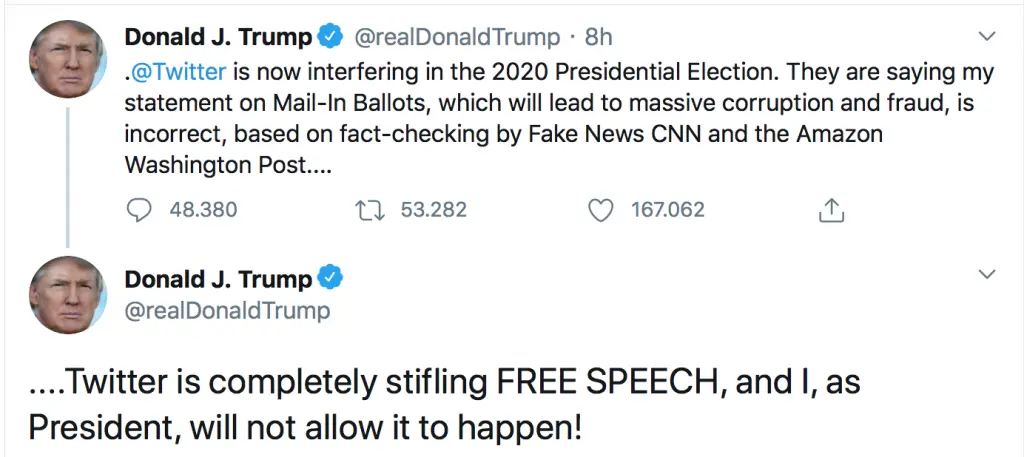
But publicly denying the American president is a dramatic step, which breaks the hypocrisy: Trump has argued that the vote by mail, discussed in view of the November 3 elections for the White House against the Democrat Joe Biden, will lead to fraud, Twitter has denied, there is no credible evidence. The Covid-19 epidemic makes mass access to seats problematic and remote voting is useful, but Trump fears, not without reason, that it will be used mostly by democratic voters, putting at risk the thin margin that allowed him to beat Clinton. Trump took it to Trump, announcing, on Twitter and where not?, Retaliation against social media, to reduce its autonomy. The idea is that social media has a bias against conservatives, which is true by looking at company cadres, Facebook workers donated only $ 5,171 to Trump's campaign in 2016, against 1.1 million given to Clinton.
One in three companies in Silicon Valley was founded by emigrants, the general philosophy is liberal. But Trump knows very well that the public is divided in half, like the nation, and therefore tries to intimidate the three giants, with the threat of a "Congress Control Commission".
There are reservations, too, among Democrats, and Senator Elizabeth Warren says she wants to "break Facebook's monopoly." Andrew Napolitano, known as "Il Giudice", popular leader of the right-wing Fox network on legal issues, disappoints left and right, explaining rightly that the First Amendment to the Constitution, sacred to freedom of speech, thought and religion, does not allow any retaliation against social media. The question is vital: platforms can no longer hide behind a fictitious neutrality, attentive to profits less than truth. They can't even act as a censor against ideas and in America even a lie about vaccines or political murders is legal, save for the "unbridled bad faith" of the citizens, only hesitation admitted by the historic Supreme Court ruling "The New York Times versus Sullivan" of 1964 in defense of the free press. The courageous choice of Twitter opens the discussion and it is good: even the leaders know that they are required to adhere to the facts.






