The siskin or lucarinus, also known as the common siskin or Eurasian siskin is a passerine bird of the Fringillidae family.
The scientific name of the species, spinus, is a tautonym, as it is a repetition of the name of the genus: this is because when Mathurin Jacques Brisson classified these birds he placed them in the genus Carduelis, choosing for them the name spinus, in reference to an unidentified bird mentioned. several times in Greek literature.
Dimensions
It measures 11–12 cm in length, weighs 10–18.5 g and has a wingspan of 20–23 cm.
Appearance
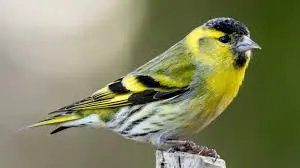
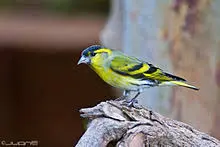
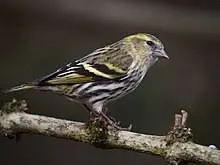
These are small birds with a slender but massive appearance, with a square-looking head, conical beak, pointed wings and slightly forked tail. Sexual dimorphism is evident. The males have an olive green nape and rump, which fades into greenish-yellow on the face, chest and rump, while the undertail is whitish and the sides are of the same color, with the presence of sparse gray-blackish streaks: the appearance is rendered unmistakable by the presence of black forehead, cap and goatee, while wings and tail are also black with the presence of yellow and white mirrors. The females, on the other hand, completely lack cephalic black and show a much reduced presence of yellow lipochrome, showing mostly olive green plumage. The young are similar to the females and assume the typical adult color when the moult is complete. In both sexes, beak and legs are blackish-gray, while the eyes are dark brown.
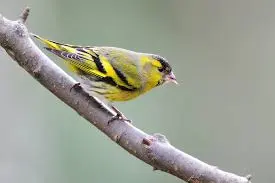
The siskin is a very lively and cheerful bird although rather shy, which tends, outside the reproductive season, to gather in flocks even quite substantial numerically, sometimes in association with other species, especially in correspondence with abundant food sources. The groups spend most of the day in the branches or in the tall grass in search of food, and then return in the evening to trees-perches where they can spend the night. Within the flocks there is a precise hierarchical order, sanctioned by the fact that the subordinate specimens regurgitate part of the food to give it to the dominant specimens of the same sex, often recognizable by their more vivid color.
These are birds with a distinctly granivorous diet: during the colder months, the siskins feed mostly on seeds of birch, alder, elm and poplar, while in late spring and summer their diet consists mostly of herbaceous plants, and in spring they are assiduous frequenters of the pine forests, especially those with a prevalence of fir, spruce and larch, from which they obtain the energy necessary to face the reproductive season in the best possible way. Not infrequently, during the cold season the siskin can visit the cultivated areas to find food, proving that they are not afraid of humans even though they are rather shy. These birds can also feed on leaves, shoots, berries and fruits, while rather sporadically they eat insects and small invertebrates.
Reproduction
These are strictly monogamous birds, whose breeding season runs from the end of February to August. Couples are formed during the winter period, with males competing for females even in an aggressive manner, launching into singing competitions, ritual flights and chases: the actual courtship sees the male persistently following the female with ruffled feathers and the tail unfolded, thus showing her the yellow of the rump and at the same time trilling and singing. During the mating period, the couples tend to isolate themselves from the flocks, gathering in small reproductive colonies of a dozen or more specimens.
The siskin nest has the classic cup shape and is built in the terminal part of the branch of a conifer: its construction is completely the responsibility of the female, who uses dried vegetable fibers to build it, lining the inside with soft material such as musk and down. The eggs, between two and six, measure about 16.5 x 12 mm and are whitish in color, with the presence of sparse and minute brown punctuation: their hatching is the exclusive prerogative of the female, with the male remaining on guard near the nest. and takes care of finding food for himself and for his partner. The nestlings, initially blind and featherless, hatch 10-14 days after laying: they are fed by both parents with seeds and small regurgitated invertebrates, thus becoming ready for fledging around two weeks after hatching. However, they tend not to leave the nest definitively before the month of life, asking their parents for cues more and more sporadically, before dispersing.
The siskin is a Palearctic species that occupies a rather vast but discontinuous range: it is resident all year round in the British Isles, in the southern coastal area of Fennoscandia, in Central Europe from Germany to the Alps and east to southern Ukraine. -east and European Russia, as well as in the mountainous areas of southern Europe and the Balkan peninsula, the Carpathians, the Caucasus, northern Turkey and northwestern Iran. In the interior of the Scandinavian peninsula and Finland and in Russia up to the upper reaches of the Ob and the Enisej, the siskin is only a summer visitor, while during the winter the populations of the cold areas migrate to southern Europe, to the Levant, towards the Nile delta and in the Maghreb from the north of Tunisia to the Atlantic coast Morocco: the Asian populations of siskin are always migratory, choosing for reproduction the Russian Far East between Lake Baikal, the Jablonovyj Mountains, the Sea of Okhotsk and the north of Manchuria and Mongolia, while during the cold season they winter in Korea, Japan, central and eastern China and Taiwan.
The migratory patterns appear rather irregular, with the same populations that can suddenly abandon the classic wintering sites to go further south, perhaps in relation to the abundance of resources and the number of specimens. During the dispersal of the young or the migratory movements, it happens that some isolated specimens reach Iceland, the Canaries, New England or the Aleutian islands. The favorite habitat of these birds are the pine forests, especially the humid foothills or hills with a prevalence of larch and spruce, from which it obtains food during the winter and shelter for the offspring during the summer: however, the siskin rather adaptable, occupying without problems also mixed wooded areas, Mediterranean scrub, grassland areas on the edge of alpine woods, taiga and cultivated areas.





