The Neapolitan mastiff is a dog breed that derives from the rustic molossoids, widespread in the countryside of the southern Italian regions. The breed is a direct descendant of the large Assyro-Babylonian molosses, then spread by the Romans throughout Europe.
Average life: 8–10 years
Origin: Italy
Weight: Male: 60–70 kg, Female: 50–60 kg
Temperament: Stubborn, Obedient, Courageous, Trainable, Protective, Dominant
Height: Male: 63–77 cm, Female: 58–70 cm
Colors: Black, Tiger coat, Isabella, Blue, Mahogany

The Neapolitan mastiff is a dog breed that derives from the rustic molossoids, widespread in the countryside of the southern Italian regions.
The breed is a direct descendant of the large Assyro-Babylonian molosses, then spread by the Romans throughout Europe. Given its strong historicity, the Neapolitan mastiff represents a real "living monument" of modern dog lovers.
During the Bourbon reign, known as "Dog 'and taken", it was used as a guard dog and later, during the time of brigandage, it was used as a "soldier" against the Savoy army. It has a maxillary power of about 80 kg.
Endangered at the beginning of the twentieth century, the breed was rediscovered during the post-war period in the Neapolitan and Avellino countryside, from which the current name of "Neapolitan mastiff" originated.
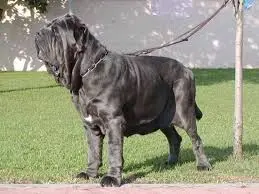
The first evidence of the existence of a Molossian in the company of man is an Assyrian bas-relief dating back to the 9th century BC. and preserved today in the British Museum in London, which depicts a large-sized dog with powerful limbs and a leonine structure with skin that collects in folds and folds on the neck and head. The dog, about 80cm tall as it exceeds the handler's belt in height, is held by a man holding a stick, most likely to make the viewer aware of the animal's character.
The most reliable hypothesis has it that even before the Romans it was the Phoenicians who spread the breed throughout the Mediterranean. However, there are no similar types of dog from Roman times, and especially in Julius Caesar's De bello gallico, in which although the island is described in detail, no mention is made of the dogs of Britain. Another hypothesis is that the direct offspring is that of the Roman war dog, the canis pugnax, introduced into Britain by the legions, from which the current English molossoids such as the Mastiff and the Bulldog also descend. The pugnax Britanniae was brought to Italy and was famous for its size and strength but it was not at all superior to the canis pugnax in the military, so much so that the legions never adopted it. In fact, these English dogs were sent to fight in circuses against men and animals, as was also the case for war elephants captured in other areas and which were not served militarily. Analyzing the Roman conquests, we can see how the canes pugnaces, following the legions, gave birth to all the European molossoids, such as the Spanish gripping dogs, today's French Dogue de Bordeaux, the English Mastiff and Bulldog, the now extinct Belgian mastiffs , the molossian ones from beyond the Alps such as the Swiss Great Mountain Dog, the German Rottweiler, Bullenbeisser and Saupacker and so on.
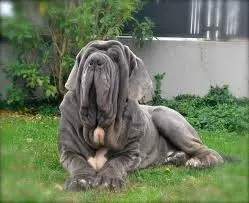
The first written information relating to the breed dates back to Roman times and the same are to be found in the citations of the heavy Canis Pugnax, the ancient Roman molossus used in arenas against beasts and in guarding country villas. A light variant was used but only exceptionally by the legions as a dog of war, since the Romans generally did not use them at all in battle but for guarding military posts. As for the use in battle, only the canes pugnaces used to track down the rebels in Sardinia in the III century BC are known. The canis pugnax was however a versatile animal, used in its light variant also in hunting large game, in the management of herds and for personal defense. At the beginning, the mastiffs were also used in the fighting in the arenas and in the hunting lodges; over the centuries, the Italian Molossian has maintained its "job" alongside herdsmen, carters, hunters and even brigands (famous are its representations in Bartolomeo Pinelli's eighteenth-century paintings).
During the time of brigandage, the Neapolitan Mastiff (at the time called "Dog 'and taken"), together with the Cane Corso, the latter dog called "cousin" to the mastiff, was used by brigands during the revolts against the army Savoy and to guard the refuges. After the defeat of Gaeta, the pure mastiff became almost completely extinct, leaving only a few specimens that gave birth to the farm mastiff.
Lost its traces for many years, during the mid-twentieth century, bred mainly in the Neapolitan and Avellinese countryside, thanks to Piero Scanziani the mastiff was rediscovered by the official dog world in a "heavier" version than the ancient one.

It is worth mentioning the words with which Scanziani recalls his meeting with Guaglione, the progenitor of our mastiff's genealogical books:
"I recognized him instantly: he was one of the hundred that Paolo Emilio the Macedonian had brought to Rome in his triumph. He was the great dog of Epirus, son of the Assyrians, nephew of the Tibetans, he was the Molossus. Guaglione from the height of his centuries, stared at me imperturbably, eyes not hostile and unkind, gaze that does not give and does not ask: look. He looked at Arno, kept on my leash. I backed away remembering D’Annunzio: Molosso ready to bite without barking. Guaglione became patriarch. "
Initially the denominations "cane 'and taken", "molosso italiano", "cane masino", "cane corso" were kept, then around the mid-1960s, the denomination of "Neapolitan mastiff" was established.
The breed was subsequently perfected by the breeder Mario Querci, with the historical breeding affix "di Ponzano", who managed to select a type of dog that reflects today's Mastiff.
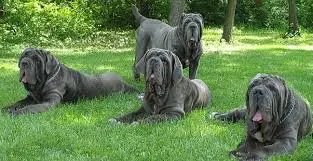
The Neapolitan Mastiff is perhaps one of the most famous breeds in the world. A colossus that has become a true iconic dog lover. It is notoriously classified in the molossoid section within the Pinscher and Schnauzer group. It has a glorious history behind it, but it has not always been known with today's name.
In fact, the name Neapolitan Mastiff came into use from the 1960s. Before, instead, we referred to this breed with the dialectal term of "dog 'and socket", dialectal, or with expressions such as "molosso Italian" or "mastiff dog".
It goes without saying that - as the name suggests - the Neapolitan Mastiff is a "Made in Italy" dog and in this case a typical breed from the South. Let's find out more about its origins.
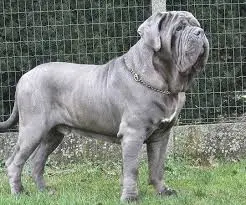
In all likelihood the "ancestors" of the Neapolitan Mastiff were the great Assyrian-Babylonian molosses: from these ancestors this breed then spread widely throughout the Roman civilization, arriving to count specimens throughout Europe.
By virtue of its size, the Neapolitan Mastiff was obviously often used as a watchdog or "soldier" dog (by brigands against Savoy troops). We are facing a dog with a strong genetic makeup, which however risked extinction at least once, in the early twentieth century.
Its definitive rebirth and - if we can call it this - "consecration" occurred above all in the Campania countryside, between Naples and Avellino. So here we are celebrating the Neapolitan Mastiff as a kind of "Lion of Southern Italy"!
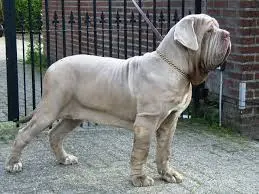
But what relationship does this Neapolitan giant have with the human being? What are the peculiar traits of the character of the Neapolitan Mastiff? We are faced with the classic example for which appearance is deceiving. The Neapolitan Mastiff is in fact a good giant.
Certainly he is very protective of his home and his "acquired family", and has such a size as to inspire fear of any opponent. However, there are rarely episodes of free aggression and - in principle and with exceptions - this breed can be defined as very loyal.
The appearance among other things also deceives as regards the ability to move, understood as a mix of agility and speed: the Neapolitan Mastiff in fact - although certainly not having the shot of a Greyhound - is not at all clumsy nor particularly slow. Furthermore, he is not even lazy or sedentary as his "peaceful" appearance and his "eyelid drooping" eye can somehow suggest.
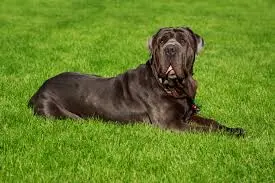
How is your relationship with the "human cubs" instead? The Neapolitan Mastiff has an excellent relationship with children. A good dose of patience, however, does not eliminate kg from its massive build, so you have to do more than pay attention that it does not inadvertently crush small children.
Of course it is good to specify that it is not even a "simple" breed. In fact, in the Neapolitan Mastiff there is no aggression but certainly the dog in question has a strong and decisive character.
He has a big heart but also a dominant nature: therefore a master who has a firm hand in managing training dynamics is needed. It can also be quite important to make him familiar with other dogs as a child, otherwise he may tend to struggle to relate to his four-legged friends.
Attention to another recurring characteristic, certainly not dangerous but which could be annoying: the Neapolitan Mastiff is not a champion of bon ton, let's say. He tends to spread food while eating, drooling and snoring regularly, as well as having flatulence problems. All things that can be forgiven to a faithful four-legged friend with an elephantine size!
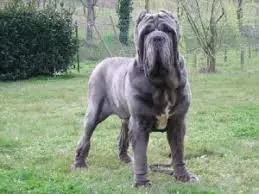
And from a strictly aesthetic point of view? What are the characteristics of this colossus? We start from weight and size: the male goes from 65 to 75 cm at the withers and reaches up to 75 kg in weight (therefore it is part of the giant dogs by right). The female settles roughly on slightly lower weight / dimensions.
For the rest, the Neapolitan Mastiff obviously has a physiognomy related to its size: large head, large and slightly flattened nose with large nostrils. The most evident and characteristic peculiarity is that of wrinkles / folds, which give the breed a funny and good-natured knowledge (be careful, however, because this aspect does not always correspond to the actual nature of the dog!).
His eyes - small and well spaced - often have a bluish tinge in the iris, so much so that the dog has earned the nickname "ice eyes". The bite and dentition are powerful. The tail has a vaguely stocky base but then takes on a more tapered shape.
The pace then is quite particular: when he walks in step he looks like a bear, but when he trottes he has a good reach and becomes a kind of fighting panzer (however he almost never gallops). The color tends to vary in shades of gray, with shades of lead, petrol and fawn.
How much can it cost to bring home a Neapolitan Mastiff? What is the right price for a breeding dog? In general, the price ranges between 600 and 1000 euros, turning to a certified breeding (an option that we obviously recommend).
Keep in mind that a dog of this size and with this nature will be a not indifferent commitment to manage. The Neapolitan Mastiff requires a lot of energy and attention, also because it must be said that it cannot be defined as an apartment dog: in fact, it loves to be outdoors although it does not stand particularly in the cold.
In short, a demanding dog but also trusted and loyal. An adventurer companion, apparently a little clumsy but active and courageous. Perfect if you have a house proportionate to its size!





