The dogue de Bordeaux is a "dogue" molossoid dog breed originating in France recognized by the FCI. It is a docile dog with the owner, discreet and unobtrusive. Like all molossoids, it barks only when necessary. If possible, he loves spending most of his time with his master.
Average life: 5–8 years
Origin: France
Temperament: Faithful, Loyal, Sociable, Watchful, Balanced, Courageous Temperament
Weight: Male: 54–65 kg, Female: 54–65 kg
Height: Male: 60–67 cm, Female: 57–65 cm
Colors: Light fawn, Mahogany, Red

The Dogue de Bordeaux is one of the "canine" symbols of France, and according to studies it would derive from the Great Danes (not the "modern" Great Danes, but the dogs that accompanied the Indo-European population of Great Danes in the Old Continent during their migration, driven by the Huns ).
The molosses of the Alani were then crossed in Aquitaine giving life to specimens such as the Dogue de Bordeaux, as well as the Dogo de Burgos, well of a similar origin in northern Spain. These specimens excelled as guard dogs at European courts, but were also used for other purposes given their physical characteristics.
The butchers of the Bordeaux regions in fact attached carts to these dogs who were responsible for transporting the quarters of meat from the slaughterhouse to the owner's store. The Dogue de Bordeaux was also a gladiator dog and a catch during the bull races. Also for his peculiar and nice aspect, the beautiful Dogue de Bordeaux has often been a protagonist on television or in the cinema: for example he is the co-protagonist of Turner and the casinaro with Tom Hanks and the American TV series Tequila and Bonetti.
Impossible not to be conquered by the "wrinkles" of the beautiful Dogue de Bordeaux, a molossoid that has become very popular in Italy in recent years. It is a dog of great strength, very muscular, who in his past has done a little bit of everything, from pulling carts to hunting wild boars or guarding the flock: perhaps his historical role was, however, that of a tireless defender of the castles of the European nobility.

It is not a very tall dog but it is massive and well balanced, rather low on the ground, with a minimum weight of at least 45 kilos for females and 50 kilos for males. Its most obvious feature is the head, which according to some is the largest in the canine world if compared to the rest of the body: its circumference is roughly equal to the height of the Dogue de Bordeaux shoulder. The varieties of this splendid dog breed are distinguished by the color of the mask, which can be black or red.

The Dogue de Bordeaux is a dog capable of intimidating, given its size, its weight, its excellent qualities as a guard dog and the past also as a fighting dog. Today, however, the character of Dogue de Bordeaux has been made less and less aggressive and this species is docile and balanced, very fond of the owner and very patient with children. As always, to be sure of his character, the best thing is to train the Dogue de Bordeaux from a puppy, to make him the perfect guardian.
It is in fact a dog with a strong sense of territoriality, which however should not be mortified without ever letting the dog out of the property: it needs continuous stimuli. Calm, a little sedentary, lazy and friendly with every member of the family, the Dogue de Bordeaux can be very fierce and fearless against strangers.
To be sure that there is the right relationship between the dog and the owner, it is good to affirm your leadership early enough, always with gentleness and without ever resorting to abrupt ways.

The Dogue de Bordeaux is a dog of a certain size and as such must be treated, with daily exercise and running, beneficial not only from the physical aspect but also as regards the psychological one. In its territory it should be left free, possibly with a fenced area for times of need.
The Dogue de Bordeaux is an excellent guard dog, although it is still possible to train it to make it less wary of strangers. With his physique and disposition he is perfect to protect his owners' house and family: having one means feeling very safe and calm in his presence, but it is good to be careful that the dog does not become too suspicious of all the other dogs and strangers.
The Dogue de Bordeaux is however also an excellent "indoor" dog and even if it does not have a gigantic space at its disposal, it can adapt without particular problems. In essence, the important thing for one of these Molossians is to spend as much time as possible with your owner, even in a limited space, rather than having hectares of land at your disposal but basically spending time alone.
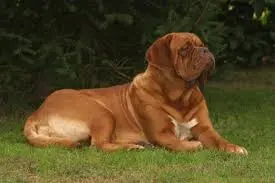
Like all large dogs, even the Dogue de Bordeaux does not have a life expectancy comparable to that of a toy or another medium-small size dog, and if these dogs can even reach 10-12 years the their average life is around 7-8 years. Among the pathologies, given its brachycephalic head, there are breathing problems, and a possible poor tolerance of heat.
The conformation of the head can also be a factor for ectropion, an external turning of the lower eyelid, which can lead to conjunctivitis and bacterial infections. Hip dysplasia is also a well-known problem, also considering its physical conformation and structure.
As for nutrition, it is certainly not an appetizing dog, and especially for the first years of life it is good to give it a lot of meat to help it grow and ensure that its skeleton does not develop with deficiencies. Once an adult, he should eat about a kilo of food between 650 grams of meat and 350 of boiled rice, or any other balanced diet suggested by the veterinarian according to the specific needs of the animal. Be careful because the dog, especially if he does not make the necessary movement, may tend to gain weight.
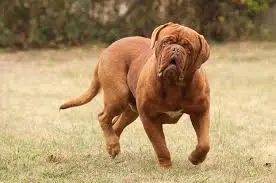
The ideal owner of the Dogue de Bordeaux knows how to be respected because this dog tends to be dominant: he must therefore be strong, decisive, determined, confident and with great nervous balance. Like all molossoids, it is not a really "easy" dog and should not be the first dog of a beginner, but it can give great satisfaction.
The main concerns with a dog of this type concern its potential great physical strength, which if not properly addressed can give rise to problems, but it is still a dog with a rather calm disposition.
The Dogue de Bordeaux must have as its owner one who knows how to keep an animal over 50 kilograms and all muscles without difficulty, and above all he must want to spend a lot of time with him because for this breed of dog the relationship with his leader is essential, who in return will be overwhelmed with love and dedication.

The relationship with children by the Dogue de Bordeaux is excellent for a dog of its size, and almost always behaves towards them as a guardian and protector. However, one must be careful that it is a large-sized dog, with a strength of which it is not always fully aware, and therefore it is not advisable to keep it close to very young children.
If he has been trained with care he should not have suspicious or hostile attitudes towards children he does not know, but in the case it is better to always keep him on a leash in the presence of too many people so as not to shake him.

With other dogs, the Dogue de Bordeaux shows different behaviors depending on his character profile, but if he is trained well he will not show aggression, unless he undergoes it in turn. It is not difficult to start a cohabitation with another dog in the same house, but since it is traditionally a dominant and territorial animal it is good to follow the precautions, introducing the new "family member" when he is still a puppy.
In the event that there are two males of breeds with a tendency to dominate, it is essential that the owner is always very present to quell any tensions in the bud. In particular, if the Dogue de Bordeaux or the other dog have had negative experiences in their past it could be completely impossible, unfortunately, a peaceful coexistence.

Dogue de Bordeaux is a rather popular dog and in Italy there is no lack of ENCI certified farms and dedicated to this specimen Campania, in Emilia Romagna, in Lazio, in Liguria, in Lombardy, in the Marches, in Piedmont, in Sardinia, in Sicily , in Tuscany, Umbria and Veneto.
Enrollments by Dogue de Bordeaux according to ENCI are fairly stable and are around 700-800 units each year. As for the price of Dogue De Bordeaux at a certified farm and with all the documents in order, this usually ranges from 700 to 1000 euros.
Dogue de Bordeaux is a large dog with powerful musculature and a splendid coat with a soft and silky consistency. Its large head is its most peculiar feature, on which the generally clear eyes stand out, of a beautiful golden hazelnut. Selected over the millennia as a fighting and guard dog, used in some of the most famous wars of antiquity, it is today mainly used for guarding and protection. It has a demanding character: very self-confident, stubborn and dominant, it is not suitable for beginners, those who have no pulse or distracted owners. He needs an undisputed leader, otherwise he can take his place and believe himself the leader of the pack. If he is well trained, however, he is obedient, meek, and incredibly sweet and loving with his family and children, although he will always remain wary of strangers.





