The Dobermann Pinscher, or more simply Dobermann, is a canine breed of German origin recognized by the FCI. The name derives from its creator, the German Friedrich Louis Dobermann, who created the breed in 1890. Traditionally, the ears are cut and the tail amputated; the practice is illegal in some states.
Average life: 10–13 years
Origin: Germany
Temperament: Obedient, Courageous, Intelligent, Energetic, Alert, Loyal, Confident
Height: Male: 66–72 cm, Female: 61–68 cm
Weight: Male: 40–45 kg, Female: 32–35 kg
Colors: White, Black, Light fawn, Red, Black and tan, Blue & Rust, Blue, Fawn & Rust, Red & Rust
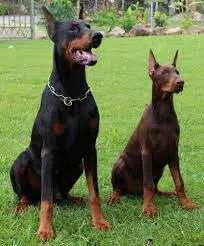
The Dobermann is recent and its origins were formed in the time span from 1850 to 1870 in Apolda, in present-day Thuringia, Germany. The creator of the breed, Friedrich Louis Dobermann, took care of various tasks in this city, including the municipal messenger and tax collector, dangerous jobs for those times. Frequent of dog shows where animals selected for their best qualities were exhibited, he felt the need to select a breed where courage, temperament and visceral love for the owner stood out. He created a dog that, in times of need, turns into the best defender you could wish to have at your side.
The breeds used for the selection of the Dobermann are varied and are not all known with certainty. The starting point was the pinscher and the stoppelhopser, the ancestor of the current German shepherd dog, rottweiler used as a cowherd, the greyhound greyhound, the beauceron, the blue great dane and the Weimar hound were introduced.
The Dobermann breed was officially recognized in 1898, four years after the death of its creator. The main merit of the establishment of a herd book on the breed goes to Otto Göller, judge in German exhibitions, friend of Karl Friedrich and breeder and scholar of the same. Göller raised with the suffix "Von Turingen" and the first Dobermanns to enter the German book of origins were his Graaf Belling V. Gronland and Gerthilde V. Gronland.
Dobermann intact black and tan color
During the First World War, the Dobermanns were employed in the German army to carry orders to the front, search for wounded and missing persons and to guard prisoners or deposits. Today it is used by many associations of public utility as a search and rescue dog and by various armies as a defense dog or as a search for drugs and explosives. In the USA it is used by the marines, who nickname it "devil dog", due to the particular similarity with the horns that the ears assume when they are cut.
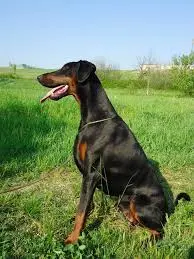
Contrary to how he is described, the Dobermann is not an aggressive and violent dog.
Energetic and very curious. Classified as a defense dog, it has an excellent level of trainability and desire to learn. Very close to the family in which he lives, he needs constant contact with his master who venerates and defends until death. It shows great delicacy, concern and attention to children. He is an excellent playmate, always cheerful, very patient and tolerant. Of course it is essential that children are educated to respect the dog and that an adult is present during the game (but this applies to every type of animal).
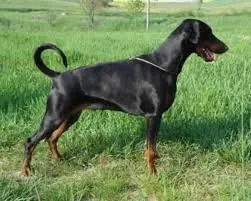
Medium-large, athletic and slender dog, it presents itself with great elegance. Muscular but overall light, it must never give the impression of heaviness. Straight back line. The tail is thin, of medium length and with always satin hair. Strong skull and in harmony with the whole of the dog, parallel skull-facial axes, well developed and wide stop, medium-sized and oval eyes, the ears are of medium length and hang adjacent to the cheeks, slender neck, muscular and elegant. Long and black nails.
The hair is always satin and shiny. The most common color is black and tan, but tan is also admitted by the standard; other colors not recognized by the FCI standard are tan blue, isabella and albino. As for the blue coat and Isabella, since 1995 they are no longer accepted and reproduction of individuals of that type was no longer allowed, as it turned out that the gene that attributed the color of the coat was the same that then caused the dog a form of alopecia (hair loss on the whole body with the formation of crusts tending to infection) called "of the color mutant". This pathology, also called CDA (Color Dilution Alopecia) or Blue Dobermann syndrome, leads to hair loss, the presence of scaly skin and pustules located mainly on the neck and trunk (tail, head and limbs are spared). It generally occurs from 4 months onwards and then worsens (after 20 months). It is a chronic disease difficult to cure.
A recent statistic (2000) conducted in the United States, where the AKC-DPCA standard recognizes all four colors, showed that 93% of blue Dobermanns and 75% of Isabella ones suffer from CDA.
It should be noted that no reference was ever made to the white coat. This color made its first documented appearance in Dobermann Padula's Queen Shebah, born in November 1976 and registered by the AKC. The parents were Rasputin VI and Dynamo Humm (dogs with normal coloring). All the other white Dobermanns that appeared later in the United States descend from Shebah (a special list, called the z-list, has been created to keep track of it). The color is due to a gene, called the masking factor, with a different locus from those examined so far.
A coupling was observed between white Dobermann and isabella which produced a litter of black and tan subjects. Given the genotype that determines the isabella color, it was deduced that the dominant genes B and D must have been supplied by the parent with white coat.
In addition, pairings between white Dobermann and the other four colors that have produced black, brown, blue and isabella puppies are documented, so the masking factor must be homozygous for ipsoiva in order to manifest itself.
The masking factor (W no masking, w masking) operates independently of the previous genes: if a dog has the pair ww it will be white / cream otherwise its color will normally be determined. A dog with the pair Ww is a `` recessive white '' and can bring the masking factor to his offspring. Most Dobermanns have the WW pair.
The white Dobermann is considered a partial albino, has blue eyes, cream-colored coat with light brown spots; suffers from photophobia (does not tolerate light and often tends to narrow your eyes); the character is extremely shy. These characteristics mean that no standard admits the white coat (the AKC modified, in 1982, its standard to explicitly exclude white Dobermanns).
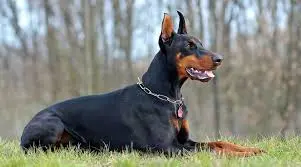
The Dobermann is extremely balanced and faithful to humans. He is capable of quickly realizing the situation that lies ahead, making the most appropriate decision. Many factors contribute to the character of the dog, and almost always depend on the type of education imparted to him, on the use that the owner wants to make of the specimen, suitable for any type of request / circumstance; however, it must be remembered that there is talk of a deeply affectionate, curious and loyal race with the owner, which tends to link excessively with the subject he recognizes as such, but also with his family. A good socialization and an owner with a consistent behavior, who knows how to impart a firm education, give the opportunity to enjoy a dog with qualities and intelligence certainly out of the ordinary.
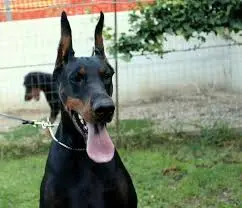
The Dobermann is a good-sized, elegant and muscular dog with a graceful appearance. Its very affectionate character towards the family but also very protective, is ideal for making it a very faithful defense dog. The Dobermann is basically self-confident and affectionate. We are looking for a medium temperament and medium aggression, just like an average reaction threshold. Easy to educate and zealous for the job, the Dobermann must be efficient, courageous and of medium strength. Since he is very attentive to everything that is going on around him, you want him to be confident and fearless. Equipped with inexhaustible energies, he constantly applies them to check that everything is in its place around the house and loved ones. He can be dominant, and therefore requires an owner capable of acting as an undisputed leader who provides him with constant education and socialization. It is a generous and affectionate dog.
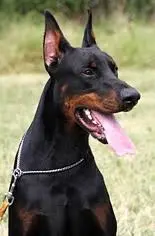
DOBERMANN IN BRIEF
ENCI / FCI standard
Group 2: Pinscher, Schnauzer, Molossian and Swiss cattle dogs, Sect. 1A
Height from 63 to 72 cm
Weight from 32 to 45 kg
Longevity from 10 to 14 years
APPEARANCE AND ATTRIBUTES
The Dobermann is described in the Standard as a medium-sized dog although the maximum size at the withers is 72 cm. It is of strong construction and well muscled. For its elegant lines, its proud prowess, its well-tempered character and its resolute expression, it corresponds to the ideal image of the dog. It features a truncated cone-shaped skull, rather characteristic when viewed from above. It has a little accentuated stop. Equipped with a dry and muscular neck, it is harmonious with the body. It has a rather short and dry back, with very strong front and rear legs. The only colors accepted are black and tan. The tan markings are rusty red.
Physical characteristics allowed by the standard:
Colors: black, brown
Hair: dense, rough, short
Coat: masked, markings
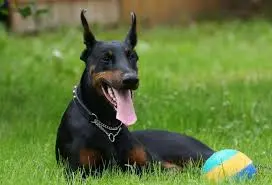
PRICES AND MAINTENANCE
The price of a Dobermann puppy is in the medium-high range. The price of a Dobermann puppy, tested and equipped with pedigree stands between 1,200 and 1,800 euros. Low prices indicate less serious sellers. So better not try to save. The purchase is advisable only from breeders of proven experience who test their breeders for hereditary diseases and who know how to grow healthy puppies both physically and mentally. Aside from the initial cost, the Dobermann is generally healthy and does not require professional grooming. The expense for quality food for an adult Dobermann is around 70 euros per month. General costs should include the cost of enrolling in a labor camp for education and possible training.





