The bull terrier is a canine breed originating in Great Britain recognized by the FCI.
Average life: 10–14 years
Weight: Male: 22 - 38 kg
Height at the withers: There are no height limits
Type: Bull type terrier
Temperament: Smart, Placid, Active, Trainable, Protective
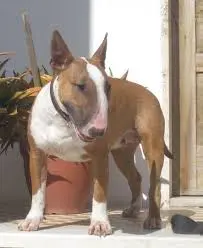
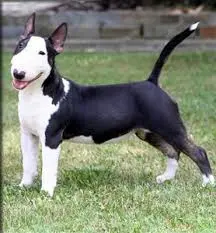
Colors: White, Tricolor, White and brindle, Fawn and white, Red-white, Pied black and white
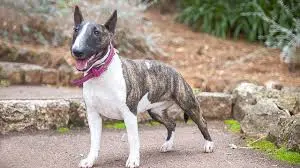
The bull terrier originates from England and owes its name to the ancient work of its progenitor: fighting bulls. From origins to characteristics, all about the bull terrier.
Never, as in the case of the bull terrier, is the socialization and the firm pulse of the owner essential to obtain a docile dog and, above all, suitable for social life. The current breed derives from the crosses of the Old English bulldog (now extinct) with various terrier breeds. The bull terrier was selected to control the territory from the infestations of mice and other small rodents - and moreover this has always been a prerogative of terriers - and, unfortunately, to fight against other dogs or animals, a sport very popular at era in England.
The initial selection of the bull terrier combined the specifics of the terriers such as speed and dexterity, with the tenacity and powerful bite of the bulldog used to fight against bears or bulls tied to a pole. Over time the breed diversified further giving rise to two distinct and smaller species: the Bull terrier proper and the Staffordshire bull terrier. Around 1850 an English breeder - James Hinks - began to select the breed as we know it today, making further crosses between the bulldog and another now extinct terrier, the English White terrier. In 1887 the first breed club was founded, but official recognition took place only in 1933.
The bull terrier is known as the "gladiator" of the dog breeds, precisely for his temperament as a tireless fighter. However, he is also a dog who loves to stay at home, he is calm and not led to destructiveness or excess. However, he needs a lot of physical exercise to vent his innate energy and active spirit. Very important, for a dog of this type, the socialization that must take place without fail from the first months of life. Getting the bull terrier accustomed to contact with other animals, with his fellow humans, with people and with strangers in general, is fundamental for the correct development of the qualities of this dog selected to fight and excel.

The separation from the mother of the small bull terrier must occur without fail after two months. Dogs separated early from mothers can bring with them character problems that are not easy to correct later. It is good to remember that the puppy can sleep a lot: basically the bull terrier is a dog that barks little and never out of turn. When it comes to choosing a breed of this type, however, it is essential not only to know it thoroughly, but also to be able to count on a remarkable experience with dogs - it is not advisable if you are on the first four-legged, choose a bull terrier - that it can be used to give educational bases to the little one and to shape its future character.

Without doubt powerful, muscular and without major hereditary diseases, the bull terrier does not present particular genetic / hereditary diseases. Explains veterinarian Cinzia Cortelezzi: "Despite this, dogs of this breed with an entirely white coat are often more delicate and sensitive to allergies and dermatitis". Be careful, too, of insect bites that can cause allergic reactions on the delicate skin of the bull terrier with widespread inflammation, swelling and itchy skin. It is, however, an energetic and active dog that requires a daily physical exercise of at least an hour. "An Attic lifestyle - continues the expert - combined with a healthy diet helps keep it healthy both physically and behaviorally".

The coat of dogs of this breed does not require special care: a weekly brushing or a cloth moistened in vinegar if the four-legged has got dirty after a trip or a run in the mud, will be enough. It is good to remember that the skin of the bull terrier is sensitive. Brushing it with a short-haired dog brush will also help eliminate dust or dirt that could, in the long run, cause skin irritation. Nails and fingertips should be checked periodically to ward off foot problems. Attention to weight also applies to the bull terrier: a dog of this obese breed or with a few extra pounds could, in the long run, face pathologies that are generally unknown to the gladiator of dog breeds, known for centuries for his robustness and its resistance.
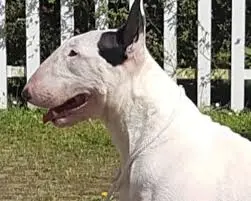
The Bull Terrier needs physical exercise (at least an hour a day), but despite this he is also quite a lazy dog. He loves to sleep. He is an expressive and very faithful dog. He is very attached to the family he lives with and can become possessive.
Very good with children, with whom he loves to play, but it is always good that there is adult supervision, especially with young children, because during the game it can become a little brisk.
The Bull Terrier is however a dog that needs a determined and confident owner who can make him understand who commands and gives him firm rules. Also because, especially as a puppy, he tends to nibble and destroy everything that happens to him. He also needs to be used to socializing. If well educated he gets along with others and, although he remains on who goes there, with strangers he is never aggressive.
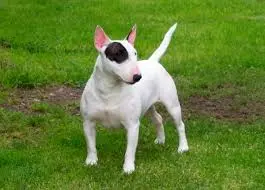
The Bull Terrier is a dog breed native to Great Britain. This breed was developed to meet the needs of fighting nocino animals, such as rats, and for fighting animals.
The current Bull Terrier is descended from the Bull and Terrier selected in 19th-century Britain by crossing the Old English Bulldog with other Terrier breeds. Due to the lack of standards of the Bull and Terrier breed, it split into two smaller breeds: the Bull terrier and the Staffordshire Bull Terrier.
The Bull Terrier is currently recognized by the FCI (standard 11). Around 1850 a breeder named James Hinks began to select the breed of Bull Terrier by crossing it with Bulldogs and English White Terriers (a breed that is now extinct).
In 1962 what we can call the first true Bull Terrier, a female named Puss, was born. From the first presentation made by Hinks the breed was successful and the breeding continued by crossing the Bull Terrier with other breeds to increase its elegance and agility. The first official recognition of the breed took place in 1933.
The original breed was completely white (not surprisingly it was also called the "white knight") but the specimens generally presented health problems. Ted Lyon then began to introduce the colored variant in the 20th century thanks to crossbreeding with the Staffordshire Bull Terriers.
Bull Terriers of different colors (especially in the brindle version) were recognized as a distinct variety by the AKC in 1936, while they only became part of the breed in the 1950s.
In addition to the physical conformation, character specificities were also pursued. Although Bull Terriers were often enrolled in fighting matches, Hinks himself wanted a companion dog more than anything else. Later the breed expanded with the addition of the "miniature" variant, which was recognized in 1939.
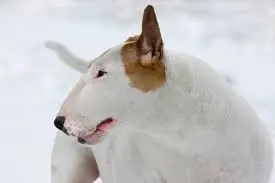
The Bull Terrier is a medium-sized dog breed. He has a muscular, solid and strong build. The neck is long while the trunk is rounded. The back is short and the nose large and black. A characteristic feature of this breed is the oval and full head, which gives it a fierce but also very intelligent appearance.
The eyes are small and triangular. The tail is short and low. The ears are small, fine and erect but without pointing forward. The hair is short, rough and very thick. We can find the Bull Terrier in four color variations: white, brindle, colored (where black or brown dominate over white), tricolor (where black and brown dominate over white).
As for the weight, the standard does not give any limitations but this is around 28-30 kg for the male and 22-24 kg for the female. There are two types of this breed, based on its size:
Normal size English Bull Terrier (which is what we are seeing here)
Miniature English Bull Terrier (his miniature version)
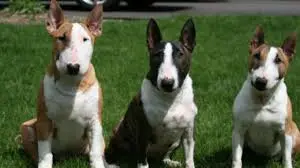
The Bull Terrier has a life expectancy of around 10-12 years, but if the dog is healthy it can go even further. It is a robust dog that usually does not present particular health problems. Puppies should however be checked to rule out congenital deafness that affects about 1.3% of dogs of this breed (in the case of albino Bull Terriers the percentage rises to 20%).
Despite being a generally healthy dog, it should be noted that the Bull Terrier with a completely white coat is often more delicate and sensitive to allergies and dermatitis. Being a short-haired dog without an undercoat, it is not exactly suitable for outdoor living, especially in cold seasons. He would risk getting sick frequently.
Usually it has a price that is between 800 and 1500 euros, but it can also reach 2,500 euros.





