
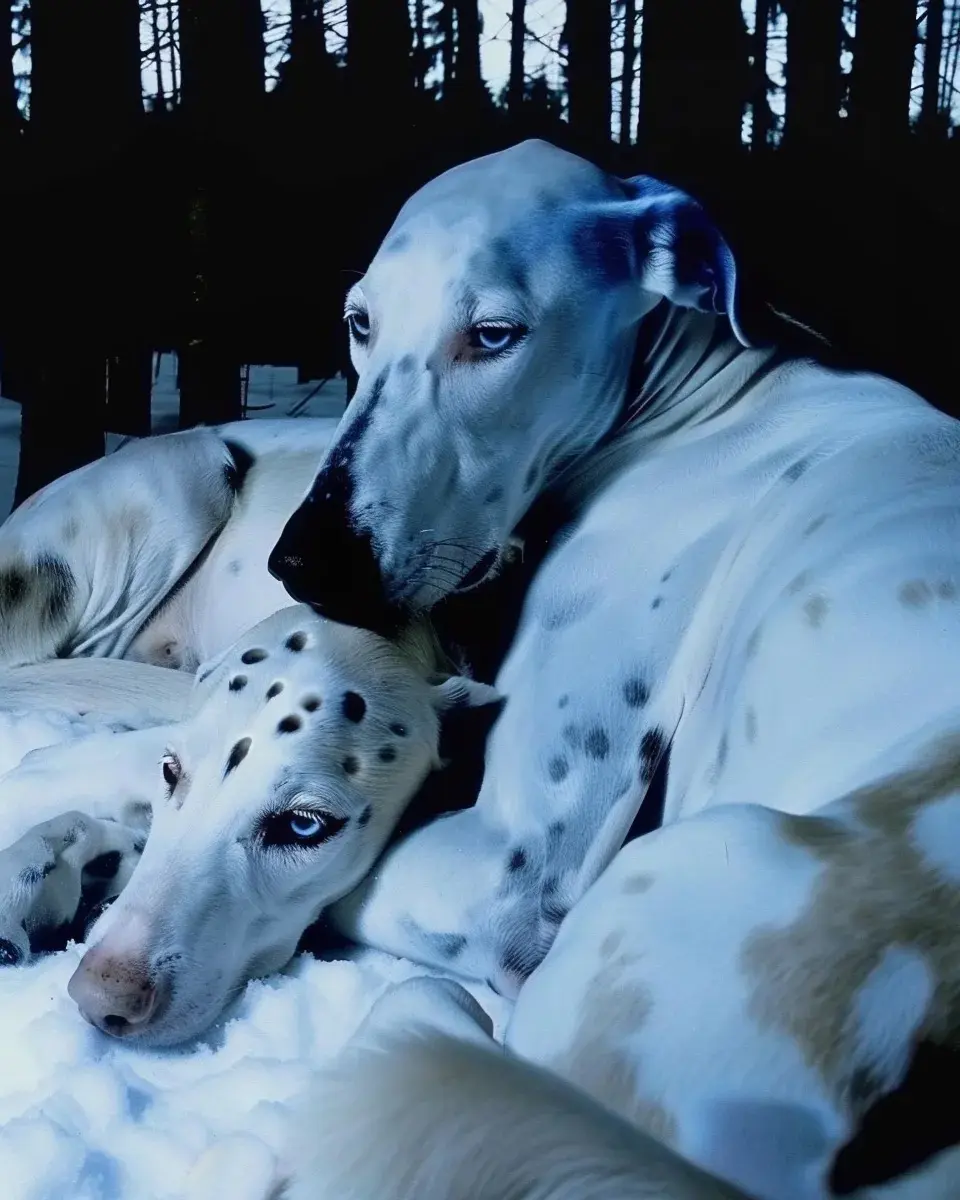
There's a particular quality to twilight that photographers call "the blue hour"—that liminal space between day and night when the world softens into shades of cobalt and indigo. It's neither one thing nor another, suspended in transition, and perhaps that's why it feels so honest. In that brief window, shadows lose their hard edges and everything becomes a little more forgiving.
I didn't plan to witness what I did that evening. I was simply there, camera in hand, when two souls decided to remind me of something I'd forgotten: that the deepest forms of understanding require no translation.
They were resting in that peculiar way that suggests both exhaustion and contentment—bodies folded into each other not out of necessity, but choice. One had rested their spotted chin against the other's back, and in that simple gesture lived an entire vocabulary. Trust. Presence. The unspoken promise that says, "I am here, and you are not alone."
What struck me wasn't just their proximity, but the quality of their stillness. In a world that worships motion and mistakes busyness for purpose, there they were—perfectly, profoundly still. Not waiting for anything. Not performing for anyone. Just being, in the fullest sense of that word.
The forest behind them blurred into abstract shapes, dark sentinels bearing witness to this small ceremony of companionship. And I realized, standing there with my finger hovering over the shutter, that I wasn't just documenting a moment—I was being entrusted with something sacred.
The Grammar of Presence
We live in an age of constant connection, yet chronic loneliness. We speak thousands of words each day, yet struggle to say what we mean. We're surrounded by people, yet feel profoundly unseen.
But these two beings, illuminated in that dying light, understood something we've collectively forgotten: presence is not about filling silence, it's about sharing it.
Look at how they occupy the same space. There's no tension in their posture, no guardedness. One doesn't dominate the other's territory; they've dissolved those boundaries entirely. Their breathing has probably synchronized—a phenomenon scientists call "physiological coherence," where hearts and rhythms align between those who feel safe together.
This is the opposite of loneliness. Not constant stimulation or endless chatter, but this: the profound peace of being fully yourself in the company of another who asks nothing of you except your authentic presence.
I've spent years behind a camera, chasing what I thought were "perfect moments"—golden sunsets, dramatic landscapes, technically flawless compositions. But perfection, I'm learning, is overrated. What moves us isn't polish; it's truth. And the truth is often found in quiet corners, in spaces we almost overlook, between beings who've learned the art of simply being with.
What the Blue Hour Teaches
There's a reason I chose to render this scene in these particular tones—this deep, encompassing blue that seems to emanate from within the subjects themselves rather than merely falling upon them. Blue is the color of transition, of depth, of that threshold space where our defenses naturally lower.
In the harsh light of noon, everything is exposed, defined, separate. But in the blue hour, boundaries soften. We become part of the larger landscape. The forest, the sky, the earth—it all becomes one continuous breath.
That's what these two taught me: connection isn't about erasing our individual shapes, but about allowing ourselves to blur at the edges. To let our borders become permeable. To risk the vulnerability of being truly seen, truly held, truly known.
Their eyes—have you noticed their eyes?—carry that particular quality of beings who've chosen to stop performing. There's no performance anxiety here, no social mask. Just the raw, undefended presence that only emerges when we feel completely safe.
And isn't that what we're all searching for? Not someone to complete us (we are already whole), but someone in whose presence we can finally exhale. Someone who makes the world feel a little less sharp, a little more forgiving. Someone who reminds us that we don't have to carry everything alone.
The Courage of Softness
We often mistake vulnerability for weakness. We build walls, maintain distance, protect ourselves from the possibility of hurt. And in doing so, we also protect ourselves from the possibility of genuine connection.
These two—with their dappled coats catching that strange, beautiful light—have surrendered to something braver than armor: the courage to be soft.
See how they rest against each other, bearing weight, offering support. Neither is diminished by needing the other. Neither is weakened by being needed. This is interdependence in its purest form—not codependency, but conscious choice. "I am strong enough to stand alone, but I choose to stand with you."
There's profound wisdom in knowing when to let your guard down. The forest around them is full of potential threats, yet they've assessed their moment and decided: here, now, with this being, I am safe. I can rest. I can be undefended.
How many of us go through life never allowing ourselves that freedom? Always vigilant, always performing, always "on." Never trusting the moment enough to simply be.
Beyond Species, Beyond Words
I've learned something profound through my years of working with visual storytelling: the most powerful images transcend their specific subjects. Yes, these are two beautiful animals in a particular place at a particular time. But that's not what you're really seeing.
You're seeing trust manifested. You're seeing chosen family. You're seeing the universal language of "I've got you, and you've got me."
It doesn't matter if you've never shared space with these particular beings. You've felt this. Or you've longed for it. That moment when someone's presence makes you feel more yourself, not less. When you can drop the performance and just breathe. When you're reminded that the weight you carry doesn't have to be carried alone.
This is why art matters. Not because it shows us beautiful things, but because it shows us true things. It holds up a mirror to aspects of our experience we struggle to name. It says, "Yes, this matters. This yearning you feel—it's real. It's valid. You're not alone in wanting this."
What Remains
That evening has stayed with me long after the blue hour faded into full night. I've returned to these images countless times, and each time they teach me something new.
Sometimes they remind me to slow down, to value presence over productivity. Sometimes they challenge me to lower my own defenses, to risk being truly seen. Sometimes they simply offer comfort—a visual reminder that connection is possible, that trust is real, that we're not as alone as we sometimes feel.
I think about the moment just before this image was captured. What led them to this spot? What journey brought them together? And I think about the moment just after—did they stay like this until darkness fell completely? Did they dream in that position, their breaths mingling, their warmth shared?
We'll never know the full story. But perhaps that's not the point. Perhaps the point is simply this: in a world that often feels cold and disconnected, they found each other. They chose each other. And in doing so, they reminded me—reminded us—of what's possible when we're brave enough to be vulnerable, present enough to truly see, and wise enough to cherish the connections that make us whole.
An Invitation
So I leave you with this question: When was the last time you allowed yourself to be truly present with another being? When did you last lower your guard enough to rest against someone, to be held, to trust the moment completely?
The blue hour comes every day, that liminal space between light and dark. But we so rarely notice it. We're too busy rushing toward the next thing, checking the next notification, planning the next move.
What if, just once, we stopped? What if we let ourselves blur at the edges, soften our boundaries, and remember that we were never meant to walk through this world alone?
The invitation is there, every evening, painted in shades of cobalt and indigo. All we have to do is choose to see it.
And in that seeing, perhaps we glimpse what these two already know: that connection isn't something we achieve or attain—it's something we allow. It's the natural state we return to when we finally stop fighting and let ourselves simply be.
In the blue hour, we're all companions. We're all seeking the same thing. And maybe, just maybe, we're all a little less alone than we think.
IMAGE CREDITS: Photography by Stephan Vasement
What moments of connection have shaped your understanding of companionship? I'd love to hear your reflections in the comments below.






