As we've established in my last post about Mars, moving there is not going to be an easy task, far from it. And it's going to be a very long while before people like you and me can move to a colony there.
Fortunately, NASA is there to give us a some kind of an experience of what life can feel like on Mars. Every day we're seeing new photos, videos and even sounds now thanks to the Perseverance Rover's microphones. To make this experience even more personalized and lifelike, NASA has created a Sounds of Mars page on their Mars 2020 website.
This page has 3 different tabs, each of them interesting in its own way.
Sounds of Mars
The first tab is an "Earth Playlist". This playlist gathers some every day life sounds (birds, bicycle bell, ...), music (Clair de Lune) and NASA specific historic moments (Armstrong's first words on the Moon, Curiosity Rover touchdown, ...). For each sound, you can hear the original, aka what it sounds like on Earth, and an edited version of what it would sound like if heard on Mars.
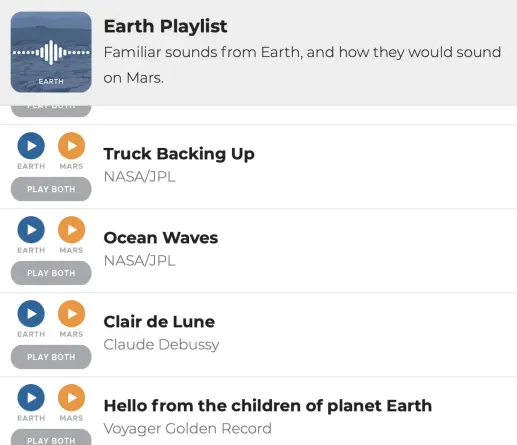
Earth Playlist on the Sounds of Mars page - All Rights Reserved to NASA
The second tab is the "Mars Playlist", which contains the actual sounds recorded on Mars for the first time by the Perseverance Rover a few days ago. You can listen to sounds of the rover and of Martian wind.
The third tab, the funniest, is called "You On Mars". There, you can record yourself (up to 10 seconds) and listen back to hear how you would sound on Mars!
How does it work?
This is all fun, but you might be asking yourself "how can NASA know what I would sound like on Mars?". Or even birds or trucks for that matter.
Well, we do know that Mars' atmosphere is different than Earth's, and we do know what it is made of. As sound moves by waves, the laws of physics we know allow us to estimate how sound waves would travel in an environment such as Mars' atmosphere.
As it is explained on the website, Mars' particular atmosphere will have an impact on 3 key elements related to sound: the speed, the volume and the quality. Because of the extremely cold temperatures on the surface of Mars, sound moves (slightly) slower (about 100 meters per second slower). Because of the low density of the atmosphere, sound can't travel as efficiently as it does here on Earth, meaning you would need to be closer to the source of the sound to hear it at the right volume. And, because of the high volume of carbon dioxide in the atmosphere (96%), lower-pitched sounds travel further than high-pitched ones. This means that, from a certain distance you would not hear any high pitched frequency, thus reducing the overall sound quality. NASA explained it all in more details at the bottom of this page.
So, what do you sound like on Mars?
---
If you enjoy this content, please consider following me here and on my different social media, to show your support. It is really appreciated and helps me grow and create more enjoyable and good quality content:
Youtube: https://www.youtube.com/channel/UC8bBNDVVmXBRHb6qJP9ZMWA
Twitter: https://twitter.com/PierreLizet
Instagram: https://www.instagram.com/plizet.video
And if you are new to Publish0x, it is a blogging platform where you get paid for reading articles! You can join using this link to support me: https://www.publish0x.com?a=Vyb8NjLevA
Credits: Photo by Nicolas Lobos on Unsplash