
Full disclosure, I was an early user of the original Arbitrum protocol and received an airdrop for the trouble. This enabled me to be an active user of the protocol and many of the projects that sprang up through-out the protocol's eco-system. The fact that the protocol has been really successful so far means I'm very positively biased in favour of the project, but I promise I'm trying to be as objective as possible here.

This is my day job.
I've been keeping my eye on the latest developments in the world of blockchain technology. And one project that caught and held my attention is Arbitrum.io - a protocol designed to make Ethereum transactions faster and cheaper. In this review, I'll provide an overview of what Arbitrum is, how it works, and why it matters.
A Quick Primer:
Firstly, let me start by explaining what makes a Layer 1 blockchain network like Ethereum and why it might need a protocol like Arbitrum. At its core, the Ethereum network operates on a proof-of-Stake (PoS) consensus mechanism. A PoS system is a way to prove that validators have put something of value into the network that can be destroyed if they act dishonestly. To become a validator, a coin owner must stake a specific amount of coins, such as 32 ETH, into a smart contract on Ethereum. At time of writing 1 ETH is roughly $2500 so multiplied by 32 makes staking into the network a very serious capital deployment. This makes Ethereum an incredibly secure and decentralized system.
The problem is a pesky thing called the blockchain trilemma. Ethereum chose the bottom two. Scalability is going to improve over time as the network evolves, however it still needs something extra to make it the true future of the internet.
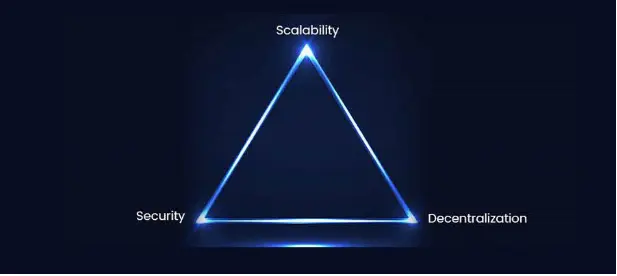
You can only pick 2
Scaling the Heights with Layer 2:
Arbitrum offers a solution to this problem (Increasing the scalability so that the network can grow) through its use of Arbitrum Rollup and Arbitrum AnyTrust protocols. Essentially, these technologies enable multiple transactions to be bundled together off-chain, dramatically reducing the load on the Ethereum mainnet while still maintaining the security and decentralization of the network.
Technically, Arbitrum has already made significant strides in terms of scalability and cost-effectiveness. Its flagship chain, Arbitrum One, is currently processing over 500k transactions per day with an average transaction fee that is measured in Cents instead of the typical Dollars range for Mainnet Ethereum while inheriting the security of the Ethereum layer 1 - this makes it one of the most competitive blockchain networks in terms of the blockchain trilemma.
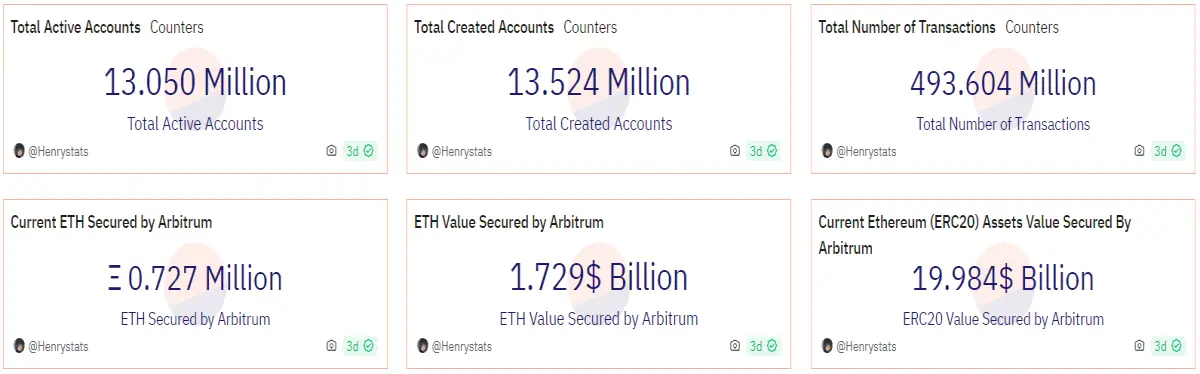
https://dune.com/Henrystats/arbitrum-metrics
But there's still room for improvement, and Arbitrum's development team is actively working on new innovations that will help to further improve the protocol's scalability and interoperability. Some of the key areas of focus include:
-
Improving cross-chain messaging between Ethereum and Arbitrum One
-
Developing new scaling technologies for Arbitrum Nova (A second blockchain focused on maximising transaction throughput) and future chains
-
Enhancing the security and reliability of the protocol through new consensus mechanisms
The importance of Governance:
The use of Rollup and AnyTrust technologies has led to significant improvements in scalability and cost-effectiveness for Arbitrum's flagship chain. But what really sets Arbitrum apart from other blockchain projects is its commitment to decentralized governance.
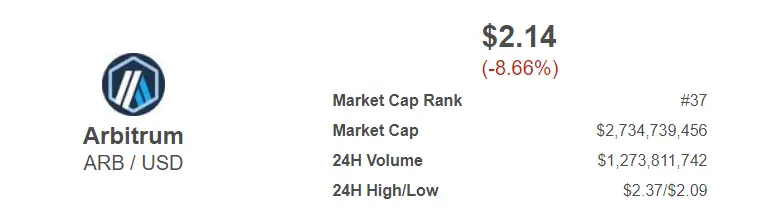
https://www.coingecko.com/en/coins/arbitrum
Arbitrum's governance token, $ARB, provides token holders with the ability to shape the future of the project through a system of proposals and voting. This allows for a more democratic and participatory decision-making process, which helps to ensure that the protocol is evolving in a way that best serves its community.
https://docs.arbitrum.foundation/gentle-intro-dao-governance
But why is this important? Well, for starters, it allows for greater transparency and accountability in the decision-making process - token holders can see exactly how their votes are being used, and they have the ability to vote against proposals they disagree with. This helps to ensure that the protocol is evolving in a way that's in the best interests of its community, rather than just a small group of stakeholders.

Imagine a council of elders where everyone is a member.
Moreover, decentralized governance allows for greater flexibility and adaptability in the face of changing circumstances. As new challenges arise, token holders can propose solutions and vote on whether or not they should be implemented - this helps to ensure that the protocol is evolving in a way that's responsive to the needs of its users.
Of course, decentralized governance isn't without its drawbacks - it can be difficult to achieve consensus in a large and diverse community, and there's always the risk of malicious actors trying to manipulate the system for their own benefit (just ask any ostensibly free and democratic society). However, I believe that the benefits of decentralized governance outweigh the risks - it helps to ensure that the protocol is evolving in a way that's truly responsive to the needs of its users, rather than just a small group of stakeholders.
Not to get overly wide-eyed and utopian, but I truly believe that this is a revolution in how all governance, including the practical and real world political sense of the word, will be practiced.

It blows my mind that this is actually how democracy still functions. It's like looking at a cave painting.
One of the key challenges facing Arbitrum right now is ensuring the long-term viability and sustainability of the project. This requires a combination of technical innovation, strategic partnerships, and community engagement - all of which are critical components of the Arbitrum ecosystem.
In terms of strategic partnerships, Arbitrum has already established relationships with some of the most influential players in the blockchain industry. These include:
-
ConsenSys: A leading blockchain technology company that's helping to develop new scaling technologies for Arbitrum One and Arbitrum Nova.
-
Polygon Technology: An initiative by Polygon that's focused on supporting the development of decentralized applications (dApps) on Polygon's sidechain solution, which can be used in conjunction with Arbitrum to further improve scalability.
-
Chainlink: A leading blockchain oracle network that's helping to develop new smart contract solutions for Arbitrum One and Arbitrum Nova.
But perhaps the most important factor in ensuring the long-term viability and sustainability of the Arbitrum ecosystem is community engagement. This requires a combination of transparency, accountability, and openness - all of which are critical components of the Arbitrum DAO's decision-making process.
As a member of the Arbitrum community, I believe that it's important for token holders to stay informed about the latest developments within the project, as well as any proposed changes or updates. This requires a commitment to open and honest communication, as well as a willingness to listen to feedback and suggestions from other members of the community.
Overall, I believe that Arbitrum has the potential to become one of the most innovative and impactful blockchain projects in the industry. Its focus on decentralized governance, technical innovation, strategic partnerships, and community engagement is helping to ensure that the protocol is evolving in a way that's responsive to the needs of its users, while also staying at the forefront of new developments within the blockchain space."
If you have read this far, I thank you. Here is a picture of a tropical beach as a reward.

I need a holiday!






