The periodic table is a tabular display of the chemical elements. The chemical elements are ordered according to their atomic number; this number is represented in the box of each element, together with its abbreviation, name and atomic weight.
The following image describes the first element of the table. The atomic number (1) is indicated at the top left, the abbreviation (H) in large, followed by the name of the element (Hydrogen) and at the bottom its atomic weight (1.008).

The most used periodic table is that of Mendeleev. The elements are placed progressively in each period from left to right according to the sequence of their atomic numbers, starting a new line after a noble gas. The first element in the next line is always an alkali metal with an atomic number greater than one unit compared to that of the noble gas (for example after krypton, a noble gas with the atomic number 36, a new line begins with rubidium , an alkali metal with the atomic number 37).
Each column of the table represents a group that includes elements that have the same external electronic configuration (ie the way in which the electrons arrange themselves around the nucleus); since the chemical properties of the elements depend on their electronic configuration, within each group there are elements with similar chemical characteristics (ie that behave in a similar way during the course of chemical reactions).
Elements on the same horizontal row belong to the same period. Each period begins with an element whose atom has as its external electronic configuration an electron of type ns, where n is the principal quantum number, and proceeding towards the next atoms (more to the right on the same line), the atomic number Z increases by one units at each passage; [41] therefore the elements of the same period have the same number of atomic orbitals.
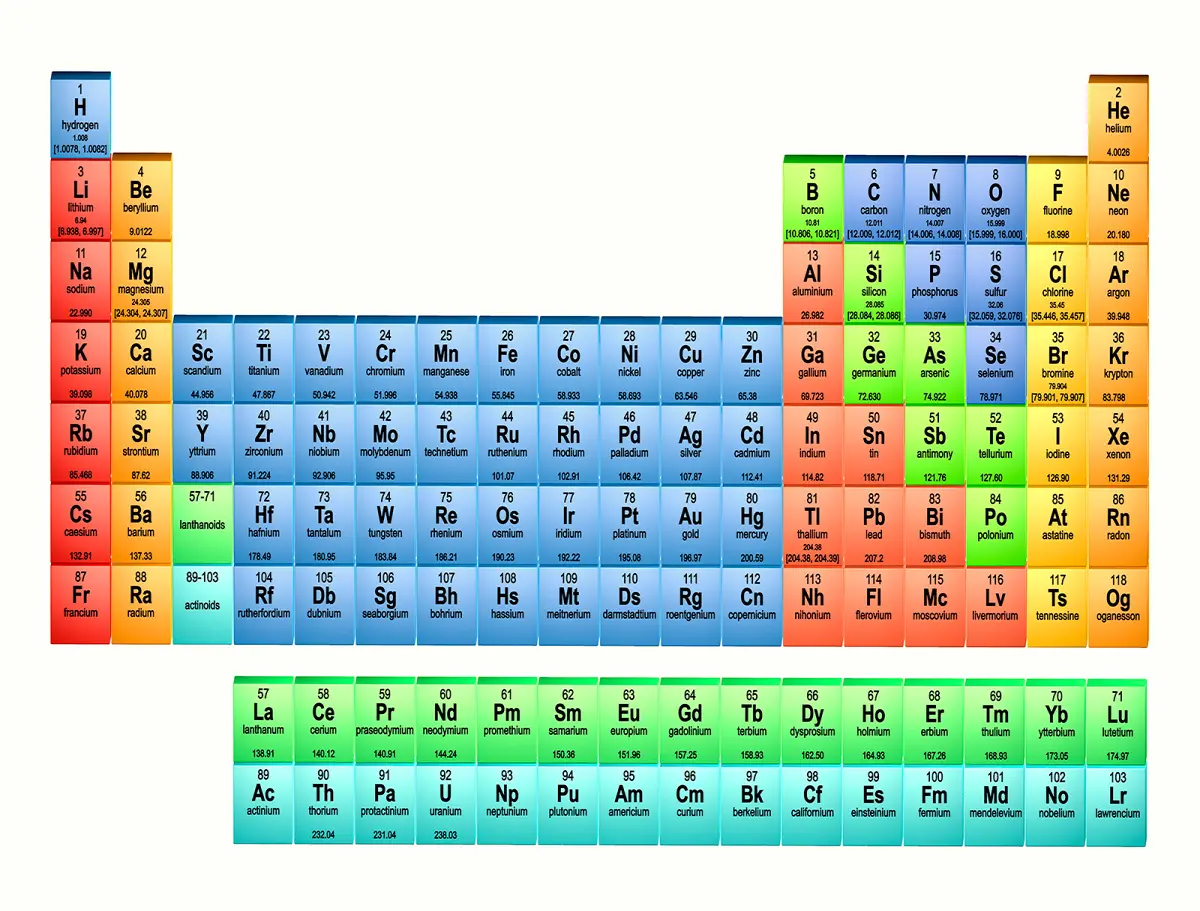
Because of the importance of the outermost electron shell, the different regions of the periodic table are sometimes called blocks of the periodic table, named after the sub-shell in which the "last" electron resides. For example, block s includes the first two groups (alkali metals and alkaline earth metals) as well as hydrogen and helium. Block p comprises the last six groups, which correspond to groups 13 to 18 in the IUPAC numbering and contains, among others, all the semimetals. Block d includes groups 3 to 12 according to the IUPAC numbering and contains all transition metals. Block f, usually located below the rest of the periodic table, includes the lanthanides and actinides.
Conclusion
As we have seen, the periodic table is not limited to listing the various elements of the universe, but there are various conventions that compose it: horizontal, vertical lines, blocks, colors, sequences, ...
The subject can sometimes be seen as very complex, but if approached in small steps it can have its charm.
The Periodic Table NFT project aims to raise awareness of chemical elements in a modern key, basing the approach on blockchain and Non Fungible Token.
Day after day it will be possible to know the single elements that make up the table, to collect curiosities about each of them and about the table in general.
We are working to be able to learn, in a playful way, also what happens by combining the various elements.
The whole project is based on the collection of NFTs that can be bought on the site https://wax.atomichub.io/market?collection_name=periodicelem&order=desc&sort=created&symbol=WAX or by participating in simple giveaways published on publish0x.
Link to save
- Market on atomichub for the purchase of NFTs
- Blog on publish0x to be updated
- Giveaways still open (at the writing of the article): Lithium and Beryllium





