
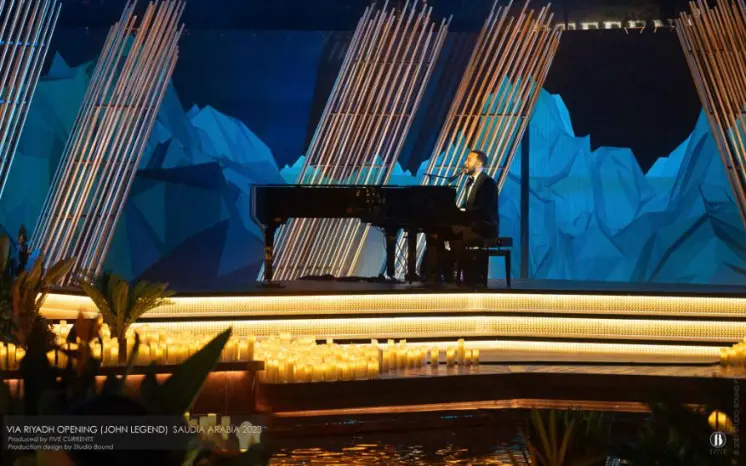
There are productions where the designed environment is the point. The audience comes for the environment — to be inside the world the designer has built, to move through it, to be changed by it. These are the productions where the production designer's work is most visible, most discussed, most documented. And then there are productions where the designed environment must, by definition, not be the point — where the design succeeds precisely when no one in the room is thinking about it.
The Via Riyadh 2023 opening gala was that second kind of production. John Legend performed. The audience was among the most significant people in Saudi Arabia's cultural, political, and business life — guests who have attended equivalent events in Paris, London, and New York, and who understand, precisely and instinctively, what international excellence looks like. The producers were Five Currents. The context was the opening of Riyadh Season, Saudi Arabia's flagship entertainment programme and one of the central productions in Vision 2030's cultural agenda. And Patrick Larsen and Studio Bound designed the environment in which all of this happened — an environment that, if it worked correctly, no one in the room would remember.
The Invisible Design Problem
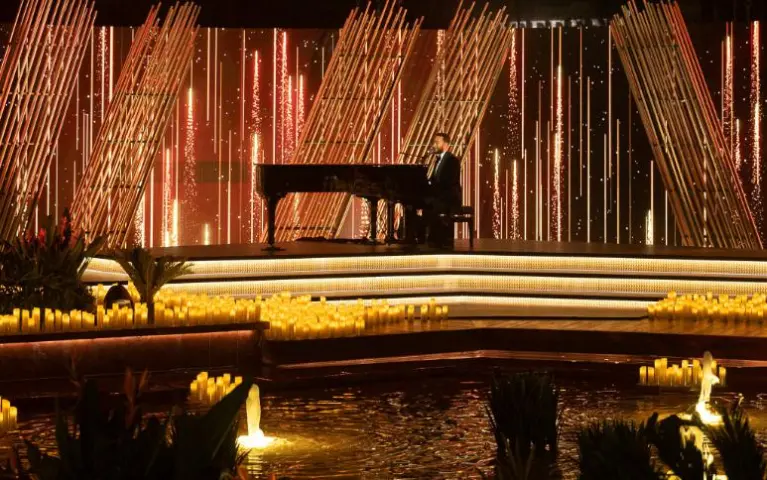
When John Legend performs, everything else in the room is in service of that fact. The performer is the event. The production design's job is to make the performer's presence as powerful and as inevitable as possible — to remove every obstacle between the audience and the experience of being in the room with that artist. A designed environment that competes with the performer undermines the event it is supposed to support. A designed environment that disappears behind the performer, while simultaneously creating the conditions that make the performer's presence feel significant, has done its job correctly.
The challenge is that a designed environment that truly disappears is not the same as a designed environment that has no presence. An empty room does not make a performer feel significant — it makes them feel exposed. The environment has to create scale, atmosphere, and a sense of occasion that tells the audience, before a single note is played, that what is about to happen matters. And then it has to step back.
Patrick Larsen approached the Via Riyadh stage and scenic architecture by working backwards from the performer's experience of the space. What does this environment look like from the microphone? Does it give the performer a space that feels worth inhabiting — with the correct proportion, the right sense of being contained and supported, a physical context that makes the act of performance feel consequential? And does it achieve that while allowing the audience's attention to flow through the environment directly to the artist, unobstructed?
Designing for an Audience That Has Seen Everything
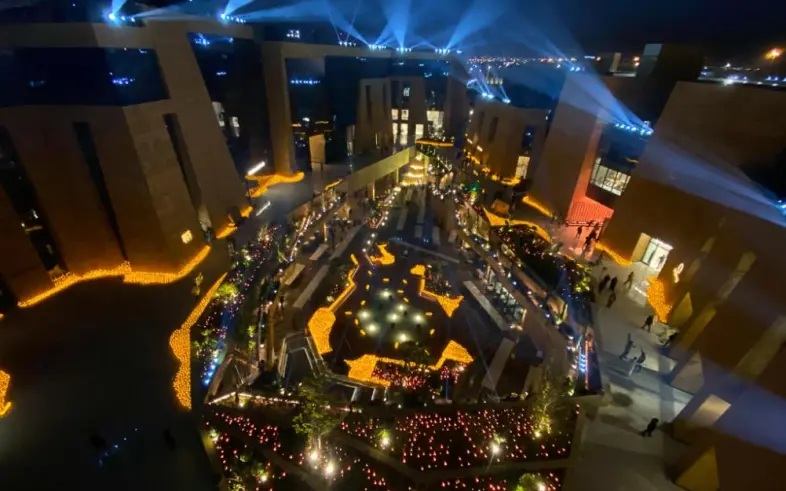
The Via Riyadh gala audience presented a specific challenge that not every production designer faces. These were guests who had been inside the great event spaces of the world — who had a calibrated sense of what excellence looked like in London, Paris, New York, and Tokyo. Any environment that read as merely competent would register, precisely and immediately, as falling short. The standard was not "impressive by regional comparison." The standard was international.
That standard applies equally to what is there and what is not there. An over-designed environment — one that tries to prove its own ambition through visual complexity or scale — fails just as clearly as an under-designed one. The guests at Via Riyadh would notice both. What they should not notice is the design itself. What they should notice is that the evening feels significant, that the space is correct for the occasion, that the whole event has the quality of something that has been done at the highest possible level.
The balance Patrick Larsen reached for Via Riyadh was architectural presence that receded into the event's larger visual logic the moment John Legend walked on stage. Present enough to create the occasion. Restrained enough to give it away. That is the discipline of designing for a show where nothing, in the end, can be shown — because everything in the room is in service of something that no amount of production design can replace.
Via Riyadh and the Saudi Cultural Moment
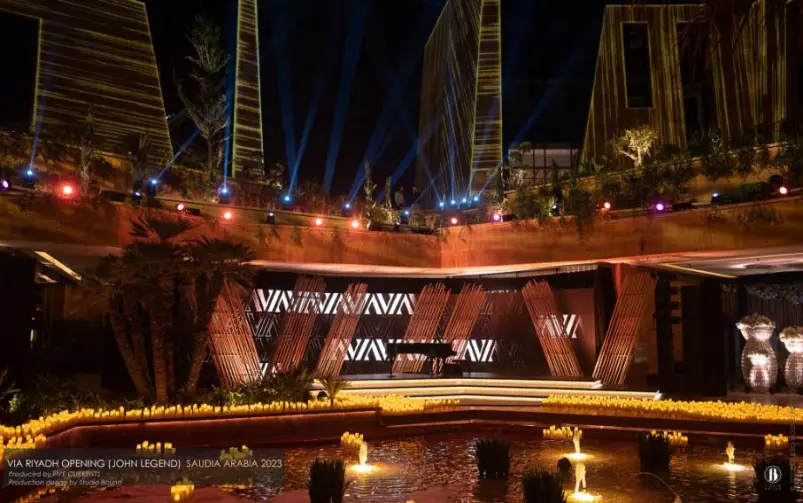
Designing in Saudi Arabia in 2023 is designing inside one of the most significant cultural transformations in the contemporary world. Vision 2030 is building an entertainment sector that did not exist in its current form a decade ago. The productions that Saudi Arabia is commissioning — at Riyadh Season, at major cultural venues, at the permanent destinations being built across the Kingdom — are intended from the outset to be benchmarks, not approximations. The ambition is to produce, rapidly and at scale, a cultural entertainment infrastructure that competes with the world's best.
Via Riyadh was an early and significant statement of that ambition — an opening gala for a flagship entertainment programme, designed to signal to the international creative community and to Saudi Arabia's own audiences what the country's entertainment aspirations were. Patrick Larsen and Studio Bound were part of making that statement. The invisible design that made the event work was, in its own way, a demonstration of exactly the standard the Kingdom was reaching for: work that looks, to the untrained eye, as if no work was done at all.
Further reading: Designing Terhal: When a Theater Becomes a Portal | Studio Bound: Five Projects That Define Production Design in 2025

About Patrick Larsen
Patrick Larsen is an Emmy Award-winning production designer and the founder of Studio Bound, based in Singapore. Over two decades, he has designed environments for global audiences — from the Expo 2020 Dubai ceremonies and Olympic broadcast environments to Las Vegas residencies, Broadway-scale theatrical productions, and permanent installations across Asia and the Middle East. Studio Bound takes projects from concept to build with one fully integrated team of designers, concept artists, technical drafters, and production managers. Visit studiobound.sg or read more at patricklarsen.studio






