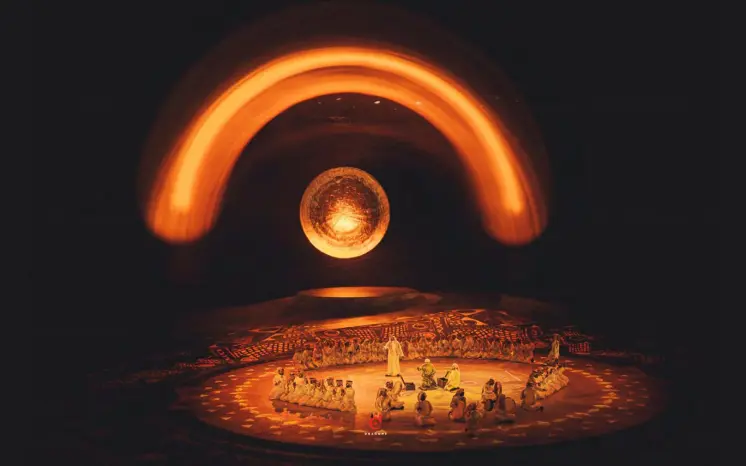
When the Riyadh Season commission for Terhal came in, it was my second consecutive year designing for Saudi Arabia's flagship cultural entertainment programme — and the brief was a genuinely different challenge from Via Riyadh the year before. Via Riyadh was an opening gala, built around a single performer, designed to announce an occasion. Terhal was something else: a full immersive theatrical experience navigating Saudi Arabia's cultural history and heritage, built for an international audience who would move through it rather than watch it.
The word terhal in Arabic relates to the idea of journey, of travel, of moving through time and place. The production was built around that concept — a designed physical world that took the audience from one chapter of Saudi cultural history to the next, each chapter given its own environment, its own atmosphere, its own emotional register. This is the kind of brief I find most interesting. Not a backdrop for a performance, but a world that is the performance.
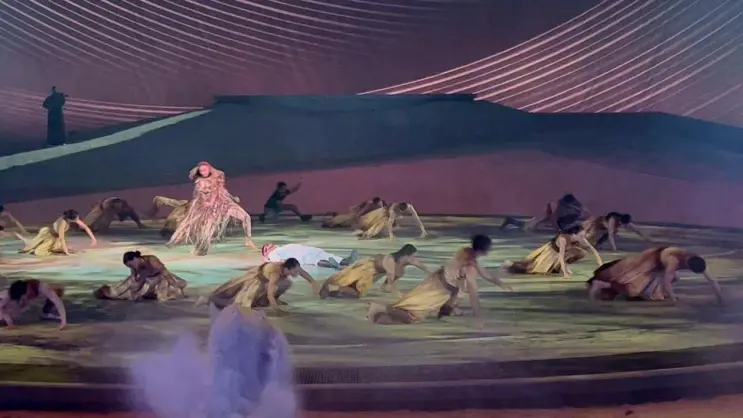
The Brief: Making History Feel Like Now
The specific challenge with a commission built around cultural heritage is the museum problem. Museums tell you about history. The best immersive design makes you feel it — makes the past present in a way that a chronological display never can. The design has to carry emotional weight, not just historical information. It has to make an international audience, many of whom are encountering Saudi cultural history for the first time, feel the specific texture of something ancient without reducing it to spectacle or simplification.
I worked with the Dragone production team on developing the visual language for Terhal, and that collaboration shaped how we approached the heritage question. Dragone's standard for environmental coherence is the highest I've worked to — nothing in the space is decorative in isolation, every element justifies its presence in relation to every other element, and the total environment is held to a standard of integrity that has no room for the generic. That standard is what makes the difference between a designed world that feels real and one that feels like a themed attraction. Terhal had to feel real.
The Space: Architecture You Move Through
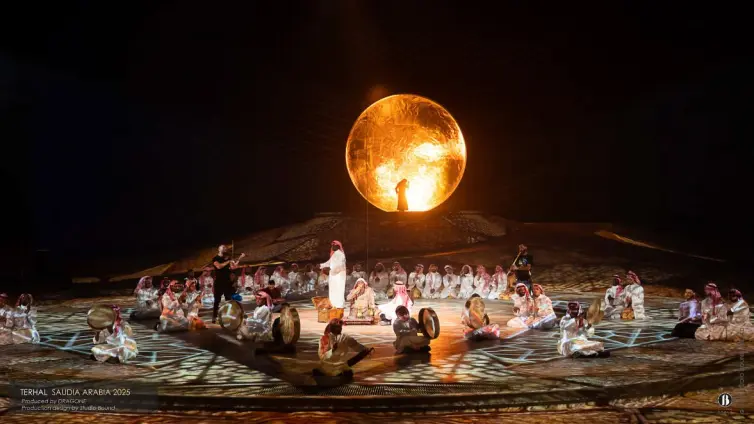
The spatial architecture of an immersive journey is fundamentally different from the spatial architecture of a stage production. In a stage production, the audience is fixed and the performance comes to them. In an immersive experience, the audience is moving and the design has to work from every angle, at every scale, at every moment of the journey. There is no single sightline I can optimise for. Every position the audience occupies has to read correctly — has to feel like they are inside the world rather than looking at it.
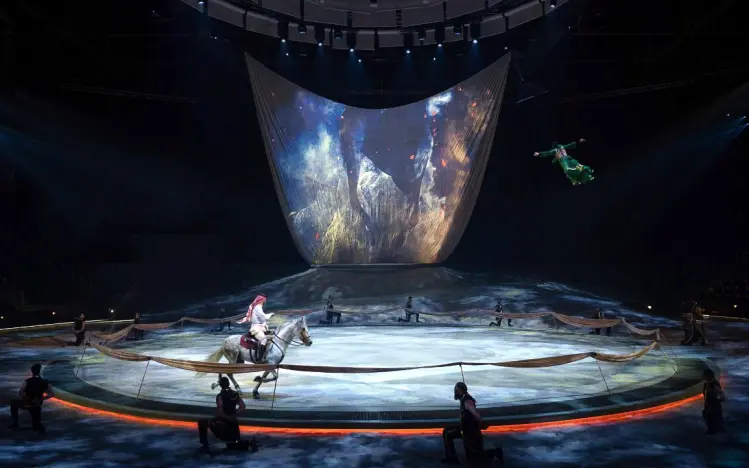
For Terhal, I designed the journey so that each chapter of the Saudi cultural narrative had a distinct physical environment: different material palettes, different scales, different relationships between the space and the human body within it. The transitions between chapters were as important as the chapters themselves — the moments of movement between environments were designed to signal a shift in time and place, to prepare the audience emotionally for what was coming next without telling them what that was.
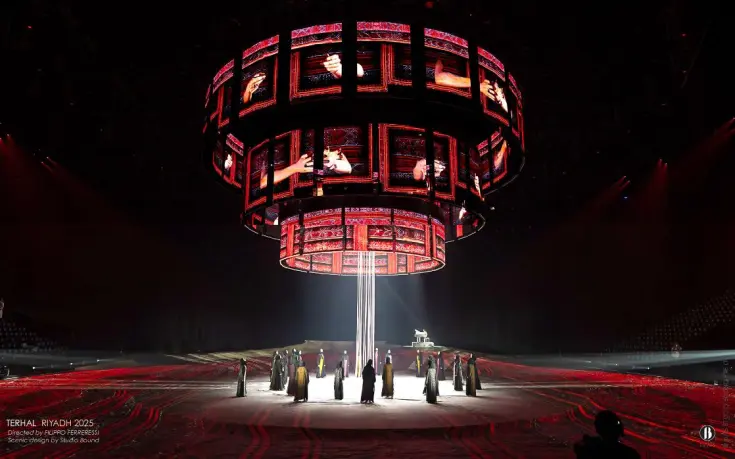
Light and projection were the primary technical tools throughout. In immersive design at this scale, light is not just illumination — it is the material that transforms a physical environment from one thing into another. The same scenic structure reads as ancient stone under one lighting state and as something entirely contemporary under another. Projection adds another layer: narrative, context, emotional depth, without ever becoming a screen that the audience watches rather than an environment they inhabit. The technology in Terhal is always in service of the cultural narrative, never the reason for the experience.
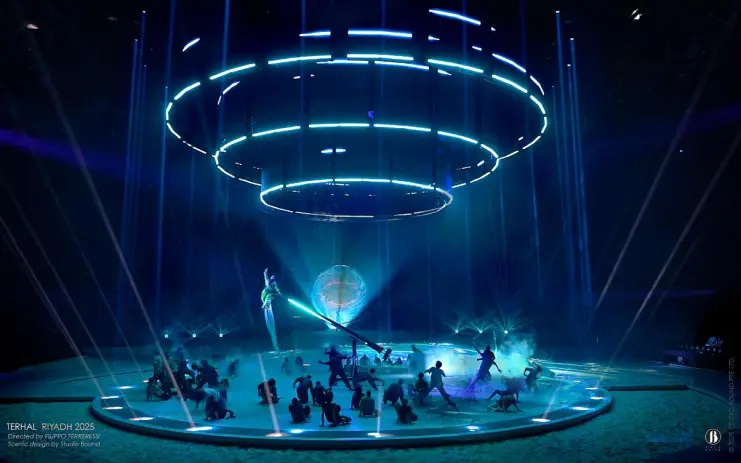
The Dragone Standard
This was my fourth collaboration with the Dragone production company, and each one has pushed the practice into territory I hadn't been before. Dragone's working method starts from a standard of environmental coherence that most productions don't attempt — the conviction that every element in the designed world has to be at the same level, that the overall integrity of the environment is only as strong as its weakest detail.
In practice that means designing to a level of specificity where the material choices for a surface the audience might never consciously notice are still made with the same care as the centrepiece scenic element. It means questioning every default, every shortcut, every solution that is merely adequate. It is demanding work, and it is the work that produces the strongest results. The audience may not be able to articulate why a Dragone production feels different from other work at the same scale — but they feel it.
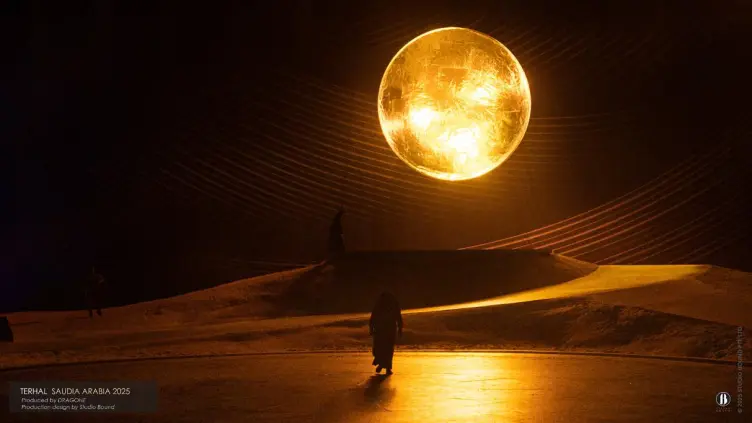
Saudi Arabia: Three Productions, Two Seasons
Terhal was the second Studio Bound commission for Riyadh Season, following Via Riyadh in 2023. By the time Souk Wonders opened in 2025 alongside Terhal, we had delivered three complete production design environments for the programme across two consecutive years. That density of work in a single market is unusual for Studio Bound — we typically move between markets and sectors — but Saudi Arabia in this period was unusual too. Riyadh Season had the ambition and the resources to commission work at a level that very few programmes anywhere in the world can sustain, and the creative challenges each commission presented were genuinely different from each other.
What the three Riyadh Season commissions gave us collectively was something a single project cannot: a deep understanding of the cultural context we were designing for. By Terhal, I understood the Saudi audience — their expectations, their relationship to their own heritage, the emotional registers that resonate — in a way that only comes from sustained engagement. That understanding is in the work. You can see it in the specificity of the design choices in a way that a designer coming in fresh to the market for a single commission could not have achieved.
Riyadh Season is the largest entertainment initiative in the Middle East, and the ambition behind it — to position Saudi Arabia as a destination for world-class cultural entertainment — is being delivered production by production. Terhal is one of those productions. The design we built for it is designed to show an international audience something about Saudi Arabia they had not seen before and could not have encountered anywhere else. That is what a commission grounded in cultural heritage can do when the design is done at the right level. It doesn't just entertain. It changes how the audience understands where they are.
Further reading: Designing Terhal: When a Theater Becomes a Portal | Studio Bound: A Decade of Work Across Five Continents

About Patrick Larsen
Patrick Larsen is an Emmy Award-winning production designer and the founder of Studio Bound, based in Singapore. Over two decades, he has designed environments for global audiences — from the Expo 2020 Dubai ceremonies and Olympic broadcast environments to Las Vegas residencies, Broadway-scale theatrical productions, and permanent installations across Asia and the Middle East. Studio Bound takes projects from concept to build with one fully integrated team of designers, concept artists, technical drafters, and production managers. Visit studiobound.sg or read more at patricklarsen.studio