The term ‘polygamy’ is quite widely used. As per the Oxford Dictionary, it is the condition or practise of having more than one spouse at a time. ‘Polyandry’ is a form of polygamy where a woman takes more than one husband at a time.
Some societies might have adapted polyandry due to socio-economic reasons. In some places, economic resources like land were scarce and marriage of all brothers to a single lady ensured that the land did not get divided and family remained united. It was also a tool to control the human population and enhance child survival. Gender imbalance also might be a reason for polygamy. In Indian ancient texts, the practice of polyandry was often mentioned. Yes, it was a rare form of marriage which existed amongst elites as well as peasants. Are you thinking that polyandry is non-existent today? Oh no! It is still practised in some parts of India, Tibet, Nepal. Let us now explore polyandry in Indian ancient texts and mythology to understand its origin.
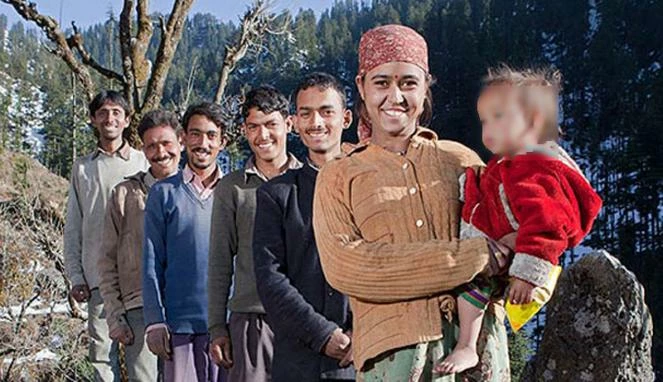
Image Source - A young Indian woman with her multiple husbands
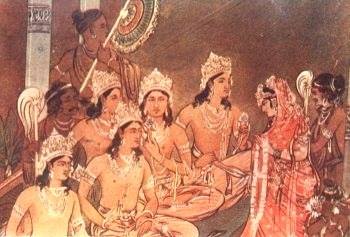
Mahabharata is an ancient Sanskrit epic of India about the struggle between two group called Pandavas and Kauravas. It was written approximately around 400 BCE as per many historians and it is 10 times the length of Iliad & the Odyssey. In Mahabharata, there is citation of Kunti and Madri, wives of King Pandu, having sons from several gods. Pandu had a curse so he could not make love to his wives. Kunti and Madri had to receive blessings from several gods for their motherhood. It might not be considered as polyandry as they might not have married and lived with the gods. But Draupadi had a pure polyandrian wedding. She was married to five Pandavas (Yudhishthira, Bhima, Arjuna, Nakula and Sahadeva) as per the wish, uttered by mistake, of their mother Kunti. This marriage became the talk of the town and was regarded as extremely controversial due to political reasons. Draupadi & Pandavas was often ridiculed by their main opponent Kauravas several times due to the nature of this marriage. Draupadi had five sons out of this marriage.
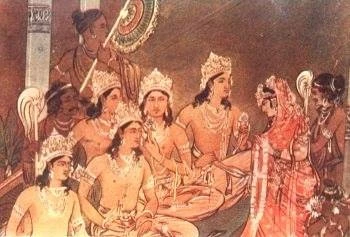
Image Source - Draupadi's Marriage
In Mahabharata, there are more examples of polyandry. In Udyoga Parva of Mahabharata, Narada narrates a story about a princess called Madhavi, the only daughter of king Yajati. The story also raises the question about the treatment of women in the society. Madhavi was strikingly beautiful and she regained virginity after each childbirth due to a blessing. Madhavi lived with several kings serially and gave childbirths although she never married technically. At the end, she lost interest in childbirth or marriage and selected forest as her last assort.
Mahabharata also has a short citation about a beautiful princess called Bhaumasvi. At her Svayamvara (a ritual to select a husband for a princess), five sons of King Nitantu appeared and they fell in love with her. Eventually, all of them married the princess and lived happily ever after.
The Saptarishi were the seven rishis in ancient India and their reference is found in many mythological texts. They were married to a single woman Jatila, the daughter of the sage Gautama. Her reference story is cited in Mahabharata also.
Marisha’s story is given in Vishnu Purana. Pracheta brothers were devotees of Lord Vishnu and they mediated under the sea for ten thousand years with the aim to make the world full of people. They emerged from the sea one day. They saw that in their absence, trees had covered the earth. They started to destroy trees. Soma, the king of the trees could not bear the pain of destruction and tried to appease them. Marisha was a beautiful girl born from the trees and she was brought up by Soma. Soma got her married to ten Pracheta brothers and Daksha was born a result of the marriage. As per Soma’s promise, Daksha made the world full of people.
It can be assumed that polyandry might have been prevalent in the pre-Vedic era of India as in Rigveda(the oldest known Sanskrit text dated roughly 2000BC), there is no reference of polyandry and a wife having more than one husband was prohibited. The way Draupadi’s marriage to five Pandavas became a controversy in Mahabharata also reinforces the assumption. In fact, the eldest Pandava Yudhishthira spent a long time to convince King Druapada, the father of Draupadi, to convince about his daughter’s marriage to five brothers as he broke down in pain. Polyandry already should have become disrespected at that time and was not widely practised.
Indian mythology is complex in nature and such stories added spice in the stories! Women characters often came as a factor of many incidents. It provided the necessary riveting drama and twists.
Note: You can follow the author on twitter.