
"A lot of people automatically dismiss e-currency as a lost cause because of all the companies that failed since the 1990's. I hope it's obvious it was only the centrally controlled nature of those systems that doomed them. I think this is the first time we're trying a decentralized, non-trust-based system."
- Satoshi Nakamoto in Bitcoin open source implementation of P2P currency
Bitcoin's acceptability was created from its decentralized structure. But we can see several bitcoin related patents nowadays. The US based cryptocurrency exchange Coinbase is one company, which has been filing several patents related to bitcoin or blockchain technology. Coinbase cites various reasons to file such patents. Defending against trolls, creation of prior record of technology in the defense of future frivolous infringement claims even if the patent application is rejected, reducing risk of opponents, increasing value of the business are the possible logics for filing the patents.
"If you are running a tech company and not applying for patents at some point, I’d argue you are doing it wrong"
- Brian Armstrong, Coinbase CEO in his blogpost
Coinbase recently got a patent for a mechanism which allows them to send bitcoin over email. It was filed in 2015 but they were granted the US patent a few days back. For a successful transaction, both the sender and the receiver must have a bitcoin hot wallet mapped to a certain email address. The sender can send the request to transfer certain amount of bitcoin by specifying the email address. The transaction takes place by 48 hrs. Coinbase has full control over the transaction and they can stop the transaction in case anything suspicious is found. It stores all unclaimed bitcoin in a vault for safety. Coinbase's argument is that such application will help mass adoption of bitcoin. 'Banking the unbanked' has remained a theoretical concept of cryptocurrency till date due to poor adoption. This easy process of bitcoin transfer may facilitate popularity of cryptocurrency like bitcoin. Okay! The argument looks valid to some extent.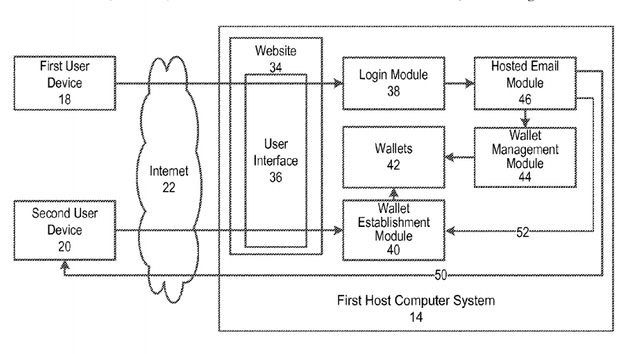
Image Source Flowchart representation of the patented invention
In today's era, a project like Ethereum is planning to move towards anonymous transaction to achieve the virtue of true decentralization and privacy. It looks really odd that a big centralized KYC/AML enabled cryptocurrency exchange is trying to monitor the transactions by being the guardian of the blockchain!
Image Source - Ethereum cofounder Vitalik Buterin's changed stance on privacy as posted by his twitter handle on 28th May'18
Privacy and decentralization are the key features of bitcoin as per Satoshi's vision. Coinbase's patent to hold transactions of bitcoin email is a drastic shift from decentralization. We should remember that government is not my neighbor Peter's dad! Government controls us through several institutions and interfaces. Coinbase's patent opens a Pandora’s Box. Government can think about controlling transactions of centralized exchanges very soon as the way is shown.
"If we want freedom and privacy, we must persuade others that these are worth having.”
- Hal Finney, POLI: Politics vs Technology, 1994-01-02
Privacy is our fundamental right but Coinbase's patent can bring on a monstrous technological watchdog in the blockchain field. Law and technology can interact in a disastrous way to destroy true decentralization. Coinbase's patent is definitely a legal route to control your privacy.
Note: You can follow the author on twitter.






