
🟠 Introduction:
I’ve been mining Bitcoin since 2019. And one of the most misunderstood aspects of mining isn’t the hardware, the electricity costs, or even the difficulty adjustments. It’s transaction fees.
Most people think miners earn Bitcoin from “solving math problems.” That’s half true. Miners earn revenue from two sources: the block subsidy (newly issued Bitcoin) and transaction fees paid by users. Right now, the subsidy dominates. But that won’t last forever. Understanding the shift from subsidy driven mining to fee driven mining is critical for anyone trying to grasp Bitcoin’s long-term viability.
Let’s break down how transaction fees actually work, why they matter more every halving cycle, and what miners like me see when we watch the mempool fill up.
▶️ Every week I break down mining economics, fee markets, and what actually moves profitability. Subscribe for free to get new insights straight to your inbox.
🟠 How Transaction Fees Actually Work
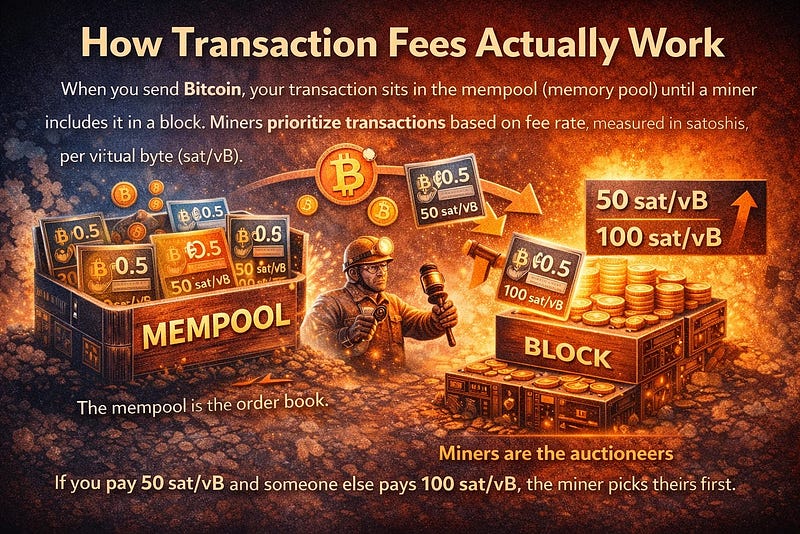
When you send Bitcoin, your transaction sits in the mempool (memory pool) until a miner includes it in a block. Miners prioritize transactions based on fee rate, measured in satoshis per virtual byte (sat/vB).
If you pay 50 sat/vB and someone else pays 100 sat/vB, the miner picks theirs first. It’s an auction. The mempool is the order book. Miners are the auctioneers.
Here’s the critical part: miners don’t set fees. Users do. When the mempool is empty, you can get away with 1–5 sat/vB and confirm in the next block. When it’s congested (ordinals activity, NFT mints, exchange withdrawals during volatility) fees can spike to 200+ sat/vB.
I’ve watched blocks during peak ordinals mania where fees alone paid miners more than the block subsidy. That single observation tells you everything about Bitcoin’s post subsidy future.
🟠 The Block Subsidy vs. Transaction Fees
After the April 2024 halving, miners earn 3.125 BTC per block in subsidy. At $100,000 per BTC, that’s $312,500 per block. Transaction fees typically add another 0.05–0.3 BTC during normal activity — roughly $5,000–$30,000. So fees currently account for around 5–7% of total mining revenue in a typical week.
Critics love to weaponize this: “What happens when the subsidy disappears? Why would miners keep securing the network?” The answer is straightforward. If fees don’t rise enough, hashrate drops. If hashrate drops far enough, the network becomes less secure. If security drops, Bitcoin’s value proposition weakens, price drops, and the remaining miners become profitable again at the new equilibrium. It’s a self-correcting feedback loop that’s played out every cycle since 2012.
The question isn’t if fees will rise. It’s how and when they become the dominant revenue source.
🟠 What Drives Fee Spikes
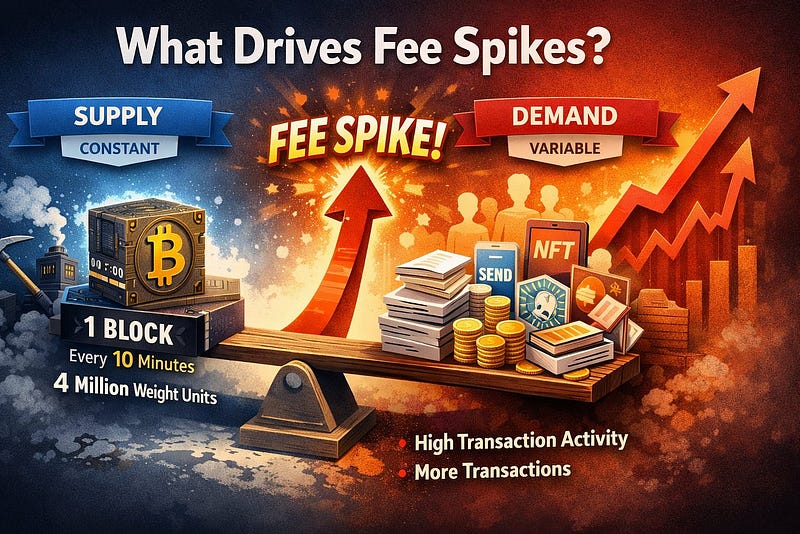
Transaction fees spike when demand for block space exceeds supply. Bitcoin produces one block roughly every 10 minutes with a fixed size limit of approximately 4 million weight units. Supply is constant. Demand is not.
When ordinals exploded in early 2023, fees hit 500+ sat/vB during peak minting. Blocks were full for weeks. The mempool backlog reached 500,000+ unconfirmed transactions at one point. Users who wanted priority paid whatever it took, and miners printed record fee revenue.
When Bitcoin’s price swings 10–20% in a day, exchanges see mass withdrawal requests. Tens of thousands of transactions hit the mempool simultaneously. Fees spike because users are desperate to move coins before the next leg up or down. Large holders consolidating thousands of small UTXOs into single outputs can also pay significant fees even at modest sat/vB rates — those transactions are massive in size. And as Lightning Network and other L2 protocols grow, their periodic on-chain settlement transactions add to base layer demand.
From a miner’s perspective, none of this is predictable day-to-day. But the pattern is clear: activity drives fees, and fees compensate for shrinking subsidies.
🟠 Mempool Dynamics: What Miners Actually See
The mempool isn’t a single queue. It’s a priority sorted pool where every transaction competes for inclusion based on fee rate. When I run my node, I can see it organized by fee tiers in real time — 200+ sat/vB at the top, working down to 1 sat/vB at the bottom. When a new block is found, the miner selects transactions from the top down until the block is full. Everything else waits.
During congestion, the mempool can grow to hundreds of megabytes. Low-fee transactions can sit unconfirmed for days or weeks. Here’s what most users don’t realize: miners have no incentive to clear the mempool quickly. Congestion means high fees. High fees mean higher revenue. We’re not rooting against users — but the economic incentive structure is what it is.
This is why tools like mempool.space exist. Want confirmation in the next block? Pay top tier. Can wait an hour? Pay mid-range. Not urgent? Go low and hope the mempool clears. It’s pure supply and demand. No central authority. Just users bidding for scarce block space.
🟠 The Halving Cycle’s Impact on Fees
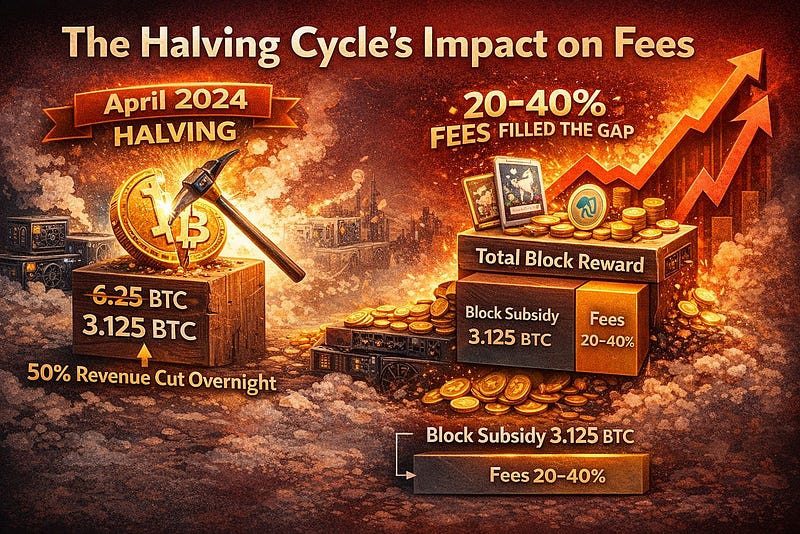
Every halving cuts mining revenue in half overnight. The April 2024 halving dropped the subsidy from 6.25 BTC to 3.125 BTC. Miners who couldn’t survive on 50% revenue either upgraded hardware, found cheaper power, or shut down.
But here’s what actually happened: fees spiked. Ordinals activity, runes launches, and general network excitement drove massive on-chain volume. During the weeks around the halving, transaction fees accounted for 20–40% of total block rewards in some blocks. Miners bracing for a 50% revenue cut instead saw only a 30–35% cut because fees filled the gap.
That’s the thesis in action. As subsidies shrink, fee pressure increases. Not because miners demand it, but because Bitcoin’s utility grows and on-chain activity scales with adoption.
The 2028 halving will be the real test. The subsidy drops to 1.5625 BTC ($156,250 per block at $100K). If fees don’t average at least 0.5–1 BTC per block by then, marginal miners shut down, hashrate drops, difficulty adjusts downward, and remaining miners become more profitable. Same self correcting loop. Every cycle.
🟠 When Fees Overtake the Subsidy
As of early 2026, the average block includes about 0.1–0.2 BTC in fees during non-spike periods. For fees to match the current subsidy (3.125 BTC per block), they’d need to increase 15–30x from baseline. That sounds extreme, but during peak ordinals mania in 2023, some blocks saw 2–3 BTC in fees alone. Already within striking distance.
By the 2032 halving (subsidy: 0.78125 BTC), fees would only need to average 0.5–0.8 BTC per block to represent over half of total revenue. That’s when Bitcoin transitions from a subsidy-driven network to a fee-driven network. The timeline isn’t certain, but the direction is.
Here’s the optimistic case: if Bitcoin continues to serve as a global settlement layer, if Lightning Network and other L2s keep growing, if institutional adoption increases on-chain activity — then fee pressure rises naturally. Users won’t have a choice. They’ll pay what the market demands because the alternative is waiting days for confirmation or not transacting at all.
And here’s the insight most critics miss: fees don’t need to replace the BTC-denominated subsidy. They need to replace the dollar value of the subsidy. If Bitcoin hits $500,000, the 2032 subsidy (0.78125 BTC) is still worth $390,000 per block. Fees only need to add another 0.5–1 BTC to keep miners whole. That’s already happening during peak activity today.
🟠 The Bottom Line
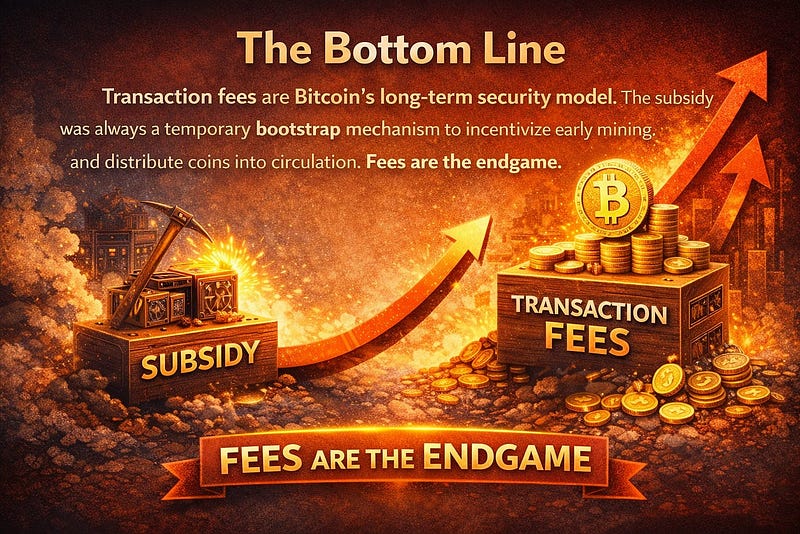
Transaction fees are Bitcoin’s long-term security model. The subsidy was always a temporary bootstrap mechanism to incentivize early mining and distribute coins into circulation. Fees are the endgame.
Mining since 2019, I’ve watched fees go from an afterthought to a significant revenue stream during spikes. The trend is clear. The economic logic is sound. If Bitcoin succeeds as a global settlement layer, on-chain demand rises. If demand rises, fees rise. If fees rise enough, miners stay profitable even as the subsidy shrinks to zero.
The critics who say “Bitcoin dies when the subsidy runs out” are missing the forest for the trees. The self-correcting feedback loop between hashrate, difficulty, and miner profitability has worked every cycle since 2012. There’s no reason to believe it stops working just because the subsidy shrinks.
The shift from subsidy to fees is Bitcoin’s most important economic transition. Miners are the ones who’ll either prove it works or prove it doesn’t.
From where I’m sitting, the data looks good.
✅ Subscribe for Weekly Bitcoin Mining Insights
I publish weekly operator breakdowns on mining economics, fee markets, and Bitcoin fundamentals. No hype, no price calls—just hands-on analysis from an operator mining since 2019. Subscribe now to receive early access straight to your inbox!
✅ Socials
Follow along on my socials:
🔸 🐦 X: @OrngeHorizonBTC
🔸 🦋 Bluesky: @orngehorizonbtc.bsky.social
Disclosure: Some images of this story were created with assistance from DALL·E.





