
That's why I didn't jump on OpenClaw cause I knew… Claude Cowork
Making AI Agents easy is the goal
Welcome back, and I knew it, that is why I didn't focus too much on OpenClaw because when I saw OpenAI buy him out, I’m like they're about to just duplicate and make his tool more mainstream and more consumer-friendly.
That's when you get Claude Cowork, aka Anthropic, I say that cause since they did the whole defense contract stuff, they have been booming and shit, even having issues logging in or using because so many new users and use cases.
People like Claude better with development and coding.
WHAT I PEEPED LONG TIME AGO
The main thing now will be these people, AI will transform a lot in society but still it will not take away things, jobs, and talents that deal with a real HUMAN. For example, a brain surgeon can use AI and robotics, but you can not take away the human touch and the ability to think on your toes.
That where AI cant mimick the human ability by being able to spontaneously think and make decisions like a human could. Another is documents, data, and personal information that a person isn't going to want on a hard drive, in a company's data server, or just emotionally think, will you connect with a robot?
So things like a psychologist will still be needed, private accounting and trades, privatizing people's data from these companies, and the web. Another point being that we are in the beginning stages of this technology, so its eaither get in or soon the major companies will control becuse why the lack of teaching on something so new.
WHERE THIS ALL FITS IN
For me, I have been into development and tech as a novice and older than most in this arena. But I do know the system a little better than before, for example, Open Source. In the urban commnity do you think a lot of people know about open source and then know they can then take that code and knowledge and develop a product, software, or a digital company?
NO!
Even now with AI, there is a large gap in the real application of using this tech to build and or grow. Most is just research and chatting. Not too many new products being built by the masses or reagular 9 to fivers and or major companies. You might think there is because you're into this technology, but that isnt what is happening outside the algorithm.
So OpenClaw Versus Claude Cowork
The main difference between the two is the ease of use. That is where Claude knew they could compete. So they dropped Claude Cowork, which comes in a desktop app and operates similarly to openclaw just less technical stuff to install, use, and operate.
Let’s break down
What OpenClaw actually is
OpenClaw (formerly Clawdbot/Moltbot) is an autonomous, open‑source AI assistant that runs primarily on your own machine and connects into chat apps like WhatsApp, Telegram, Discord, iMessage, and others through a single gateway process. It’s designed as a local‑first agent runtime: you configure models and tools, it assembles rich context, calls the model, executes tool calls (shell, browser, file system, etc.), and loops until the task is done.
Key traits:
- Open‑source, local‑first: Licensed under Apache 2.0, built to be self‑hosted, with data staying on your infrastructure by default.
- Multi‑channel gateway: one process can drive agents across WhatsApp, Telegram, Discord, iMessage, and more via extensions.
- Agent loop + tools: it runs a ReAct‑style loop — model thinks, calls tools, sees results, iterates up to many steps per task.
- Model‑agnostic routing: unified interface for OpenAI, Anthropic, Grok, and local models via Ollama/Llama.cpp, with failover and cost/latency‑aware routing.
- Memory + search: uses embeddings and a local database (e.g., SQLite) to semantically search past conversations and workspace files and inject them into context.
In practice, people are using OpenClaw to clear inboxes, send emails, manage calendars, check in for flights, and run multi‑step automations via chat — “the AI that actually does things” from the messaging apps they already live in.
What Claude Cowork is
Cowork is Anthropic’s new Claude desktop agent that runs as a companion app on your computer, with a focus on working inside your files and apps rather than living in chat only. You grant it access to one or more folders; Claude can then read, edit, and create files in those folders, using an internal “agent loop” to plan, execute, verify, and ask for clarification.
Key traits:
- Desktop‑first UX: Cowork runs in a desktop environment with a task queue; you “leave tasks” for Claude, which it executes more like a colleague than a chatbot.
- File‑scoped access: you point it at a folder; within that sandbox, it can open, modify, and generate documents, code, slides, etc., using predefined “skills.”
- Built‑in computer use: via Claude 3.5 Sonnet’s “computer use,” it can actually see a virtual screen, move a cursor, click, and type — enabling UI automation for tools that don’t expose APIs.
- Safety and isolation: Anthropic stresses VM isolation, controlled scopes, and UX patterns that prompt for clarification when the model is uncertain.
- Tied to Claude ecosystem: deep integration with claude.ai connectors (Drive, Notion, etc.) and Claude’s Artifacts workspace for editing generated outputs side‑by‑side.
Cowork’s pitch is essentially “agentic Claude for everyone”: you don’t configure runtimes or models; you just install, connect folders/apps, and start delegating work.
Your Choice or Ease of Use
What will come now for these tools is basically the person's choice and the ease of use. And;
Right now, the AI agent space is still in its early innings.
My opinion is to learn some coding skills with AI development tools lol. If not Iwould go with Claude Cowork. They have built-in security, a gateway connection now through the app and the desktop app. It seems to me to only accesses the files, folders, and environments you give it access to. So, for an easier way to get into agentic AI agents and you're still paying for Claude Code, then go with Claude Cowork and learn it.
Tools like OpenClaw show what’s possible when you give developers full control over automation, models, and infrastructure. On the other side, products like Claude Cowork show how powerful agents can feel when the experience is polished, guided, and simple enough for everyday users.
How to Set Up and Use Claude Cowork
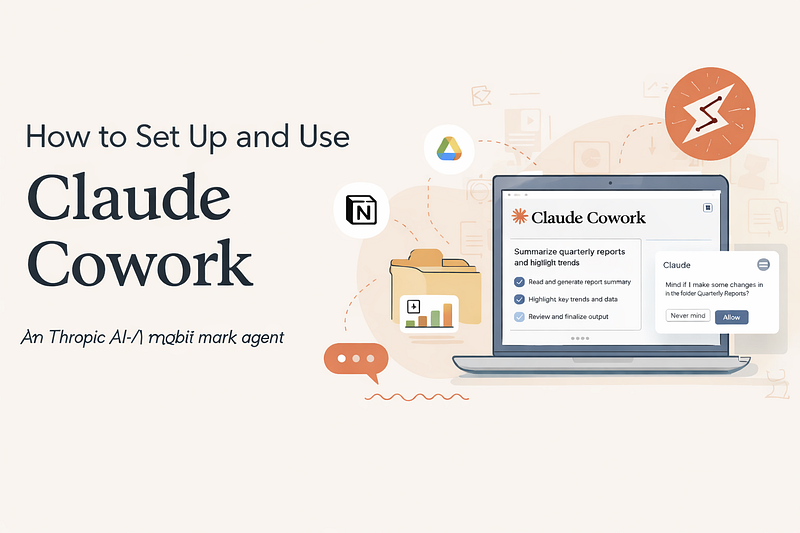 pardon the ai text typos in image
Getting started with Claude Cowork is designed to be much simpler than configuring most developer-focused AI agent frameworks. Instead of installing runtimes or editing configuration files, the process is closer to installing a normal desktop productivity tool.
First, download the Claude Desktop app from the official Anthropic website and sign in with your Claude AI account. Cowork features are typically available through paid plans like Pro, Max, or Team. Once installed, open the app and navigate to the Cowork workspace, where you can begin assigning tasks to Claude instead of simply chatting with it.
The next step is granting Claude access to the resources it needs. You can point Cowork to specific folders on your computer, allowing it to read, edit, and generate files within that sandbox. You can also connect common productivity tools such as Google Drive, Notion, or Slack so Claude has context across documents, notes, and team communication.
Once permissions are set, you simply describe the work you want done. For example, you might ask Claude to analyze a folder of documents, summarize meeting notes, generate a report, or organize project files. Cowork then creates a task plan and begins executing the steps using an internal agent loop — reading files, writing outputs, and checking progress as it goes. You can watch the process in real time, pause tasks, or approve actions when Claude requests confirmation.
One important feature of Cowork is its safety model. Actions happen inside a controlled environment, and the system typically asks for confirmation before performing sensitive operations like deleting files or making major edits. This gives users the benefit of automation while still maintaining control over what the AI agent can do.
In practice, this makes Cowork feel less like a chatbot and more like a digital teammate — one that can take a task, work through multiple steps, and return with completed results rather than just suggestions.
Why builders should start learning this now
For regular readers, the takeaway isn’t just to watch this space.
It’s time to start learning and building inside it.
The same way people who learned early web development in the 1990s or mobile apps in the early 2010s gained an advantage, the same thing is happening right now with AI agents.
You don’t have to start by building something massive.
Start small.
Learn how these systems work.
Experiment with open-source tools.
Break things. Fix them. Build again.
That’s how real skills develop.
This is also why we’ve been sharing frameworks and guides inside our community to help people understand how to turn AI tools into real products.
One of the biggest ones is our FMB Framework, which breaks down how to go from idea → prototype → product → revenue using AI tools and automation.
Read our Article and Guide on building an MVP and PRD for a Vibe Coded App, Webapp, or Software:
If you’re serious about learning how to build and monetize AI projects, that’s a great place to start.
Learn, build, and join the community
If this article helped you understand the space a little better, here are a few ways to go deeper.
Explore the resources we’ve been building around AI tools, automation, and product development:
• Main hub and resources
https://linktr.ee/omniai
• Book a consultation if you want help building AI agents or automation for your business
https://cal.com/bookme-daniel/ai-consultation-smb
• Support the work and grab guides or templates
https://buymeacoffee.com/coinvest
We also share experiments, tutorials, and new tools regularly across our platforms, so if you’re building in AI or want to start learning, it’s a good place to plug in.
Because one thing is clear:
AI agents aren’t going away.
And the people who understand how they work — and how to turn them into real products — are going to have a serious advantage over the next few years.






