
Let's cover alternatives for this new predicament.
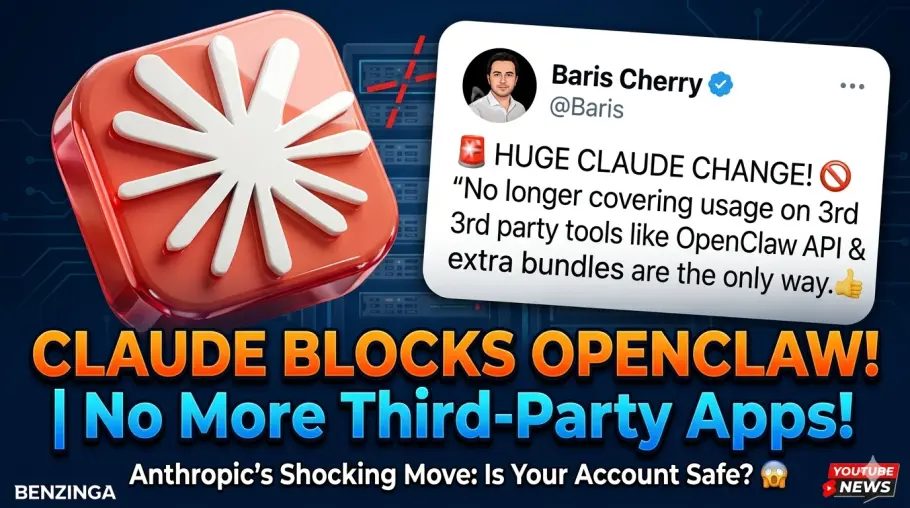
Welcome to Money Making Monday, from the Streets to Entrepreneurs, and FDWA. And what a time to be had with technology, so I got an email the other day from @claude for some free credits and stuff, thank you, and I needed that. But as I kept reading, I started to see that they stated that they will be stopping or banning all third party api usage for certain products and changing the fees and pricing.
Big attack towards and from = OpenClaw. Especially after being brought by OpenAI (even though OpenCLAW is still open source). Competitor-wise, they like you not about to use our models for the opposition now and at a cheaper fee.
Now, for a lot of Vibe-coded apps and third-party apps that are built off Claude’s API, they will need to change or monitor their usage with Anthropic’s api. It is, to me, one of the best AI models out there, if I were asked, versus, let's say, ChatGPT.
(meaning overall versus per use case)
After some research, I understood a little more than it's just a company beef thing. After reading an article from Dev Post by MC Rolly
API Loophole Anthropic Closed
See, it was also about MONEY,
Developers were routing frontier AI through personal subscription OAuth tokens at flat-rate pricing while consuming compute that should have been billed per-token.
So basically, developers discovered that they could use their personal flat-rate subscriptions, intended for individual use, to power large-scale, automated AI agents. These agents would then make a huge number of requests to the AI model, consuming a vast amount of “compute” (the processing power used by the AI).
Simple Math Example
Imagine a developer has a Claude Max subscription for $200 per month. This subscription allows them to use the powerful Claude Opus model.
If this developer were to use the Claude Opus model through its standard API, they might be charged, for example, $0.05 per 1,000 tokens. ($50 per 1,000 tokens now)
Now, let’s say an automated agent, powered by this subscription, makes requests that consume 100 million tokens in a month. If this usage were billed at the API rate:
Cost = (100,000,000 tokens / 1,000 tokens) * $0.05 = 100,000 * $0.05 = $5,000
In this scenario, the developer is paying $200 for a subscription, but consuming resources that would typically cost $5,000 if billed per token. The difference of $4,800 ($5,000 — $200) is the “arbitrage” profit or the value gained by exploiting the pricing discrepancy.
I'm sorry, I didn't know this math before they blocked lol sie nah but imagine as a company taking that loss by the Thousands…
So business-wise, I see why they did it.
WHAT THIS MEANS TO AI AGENT USERS (OpenClaw, Hermes Agent, NanoClaw…)
A heavy OpenClaw user running Opus 4.6 through automated coding sessions — say, 500K input tokens and 200K output tokens per day — is looking at roughly $22.50/day at API rates. That’s $675/month against a previous $200/month Max subscription.
SO, now that we know that, what are the SOLUTIONS / alternatives ?
We here at TS2E and FDWA, see we are a solution-based space.
You have to learn that every Failure is just another teacher of Success.
OPEN SOURCE OPEN SOURCE OPEN SOURCE
What you might need to get into is Open Source. History Open source code originated in the 1950s-60s as an academic and corporate culture, where software was shared freely alongside hardware. Basically, from my understanding, I think that the early creators of the tech and hardware that brought on the internet knew that one day someone with power or some government would try to control the internet, so they made a space for people to freely share and give out code, software, information, and hardware designed around the technology of the internet.
But why do I bring up Open Source in this blog? Cause a lot of people have no clue about this space, trust me, I'm from the ghetto’s of upstate NY and an 88 baby, I can tell you I never in my whole schooling and adult life never heard of open source and or the tech behind it. I didn't learn anything until I read a Popular Mechanics magazine as a bad youth years ago, and at the same time, I first read about Bitcoin and knew it would be game-changing, and look now, that was when Bitcoin was like 0.50.
I WOULD BE RICH RIGHT NOW.
What I'm getting at is missed opportunities and also the cause, the lack of information on why and how. How was I, being a black male youth at that time, to get the training, teaching, and skills for coding or development? That is why, today, with the economy so bad and the fatigue of the American society trying to keep us divided.
One thing they can't divide is the STRUGGLE, the everyday struggle of living is now a norm to everyone, regardless of color or race. Yes, we have the so-called pointing fingers and blame, and those who are so-called running the wealth, but sorry, to say that's also an excuse and has drastically changed.
One reason the average millionaire has increased, and the age range has changed, meaning there are more younger millionaires in America than ever in history, and for all races.
EVERYONE RIGHT NOW IS LOOKING FOR A WAY TO MAKE ANOTHER DOLLAR, AND OR HOW TO GET OUT OF THE RAT RACE….
They can't beat that, so that's what we stay focused on: solutions with this change in life and mindset. Cause life is definitely lifing…. So we can stay in that depressed state, or we can find a way out.
So, back to it, open source is where a lot of major platforms have used to build off of, for example, Facebook, Reddit, Amazon, and more. They use a lot of free open source code to build the digital empires and businesses they are today.
Remember Y2K and the Dot Com boom? Or what about Silicon Valley? See, these are places and or opportunities that have changed the lives of millions, because they knew about it for one, and they also have the skills and or talent to have known how to use this technology to get ahead or build a business off of.
NOW WE CAN TOO
So sorry to get into all that, but I think that just giving out a whole list of tools and stuff is a little too easy and mostly can be done with a quick AI search.
So, bam, open source is free ok we get that, but how the heck does that pertain to Claude stopping third-party usage and openclaw and or AI Agents systems?
Cause now we have Open Source LLMs. Yes, that means that with open source, they soon had to find a way to give Artificial Intelligence to people more cheaply, more freely, and more accessible. Like, for me, the top Free LLM platform I use for free open source models to run my AI Agents is Ollama.
The only issue before with Ollma was the hard drive space to host or how to self-host. A lot of that has changed, and now, with Google dropping Gemma4, a new, smaller LLM model and open source, you can even run it on your phone. Is showing a change is coming with tech, and we'd better get on.
SO what does this mean? This means that you can literally run OpenClaw and systems like it totally free using open source models. The only issues some might face is that Claude is top of the line lol and alot of smaller modesl you will need a lil bit of time to spare for issues and errors becuse alot of open source models depending on models and the amount of space you have to get larger models, is there abilities to do certain tasks, how many task can they do in a single run or workflow? How good are they with AI agent automations and tool calling, context windows? How do they communicate with frameworks and other llms?
And that is just some of the basics; one main issue I saw was token usage. Basically, if you don't have certain control over your AI agent system, it will use up all your tokens. For example, you set a workflow or task, and the system then runs it nonstop, then hullicination, prompt values and context windows, plus memory builds up, and all that is consistently added throughout a workflow, and or task. Next thing you know, you hit your monthly Claude usage subscription of $200 in just a few days or hours.
TOP LIST OF FREE OPEN-SOURCE MODELS FOR AI AGENTS
We came up with a list of the top models for AI Agent systems based on our trial and errors. For another example, we were using Nvidia Nemtron models for our AI agent system that we are building with Langchain. We had a large task, so from using Langsmith also, we started to learn that the Nemtron model, even though powerful and free, had a hallucination issue while it was doing tool calling every time. Its compatibility since new was difficult to add with the LangChain frameworks to add helpers and guardrails for stopping this issue.
Here is the techy term behind it: Model reads its own reasoning as “user” input → Classic context-window poison. Reddit users report Nemotron 3 Super (and the 49B family) treating its internal thinking output as a new user message → context overload + loop of doom. “Is the context window overflowing during reasoning?” is a repeated question.
This is an issue cause each run adds the reasoning, system prompt, skills, memory, and more with a run and or task, and this issue now adds more tokens to your context window, which now builds up and costs, and then start to cause hallucination because it can't read what's happening or it's taking to much context to decipher.
WASTE OF MONEY, TIME, AND TOKENS
So I had Grok take all the coding issues I saved from this and gave me a list of some of the top models for an agentic use case, and these are some of the ones I have also used and tested.
-
DeepSeek-V3.2 (DeepSeek, 671B total / 37B active MoE)
Pros: First model with “thinking-in-tool-use” — retains full CoT across tool calls without bloating context. Excellent for enterprise agents, math-heavy reasoning, and 100+ step workflows. MIT License. Strong BFCL scores.
Cons: Huge VRAM needs (even quantized); Special variant drops tool calling for pure reasoning.
Why great for agents: Solves your exact “reasoning with tool calling” issue — no context overload. Persistent memory across calls. Top for autonomous coding/debugging agents. -
DeepSeek-V3.2-Speciale (variant of above)
Pros: Gold-medal reasoning (beats GPT-5 on AIME/IMO).
Cons: No native tool calling (use for planning only).
Why great: Pair with V3.2 for hybrid agent brains. -
GLM-5 (Zhipu AI, 744B total / 40B active MoE)
Pros: Purpose-built for long-horizon agentic tasks (web browsing, terminal ops, full-stack code). 200K context + massive output (128K tokens). Top SWE-Bench. MIT.
Cons: Enterprise hardware required for full model.
Why great: Handles complex multi-tool orchestration without drift. BFCL leader. -
Kimi K2.5 (Moonshot AI, 1T total / 32B active MoE)
Pros: Agent Swarm (100+ sub-agents, 1,500 tool calls, 4.5× faster). 256K context. Multimodal.
Cons: Modified MIT (attribution for big commercial use). High VRAM (~240GB quantized).
Why great: Unmatched for long tool chains — no coherence loss. -
MiniMax-M2.5 (MiniMax, 229B total / 10B active)
Pros: Built for real-world productivity agents + software engineering. BFCL ~76.8%. Extremely efficient.
Cons: Can hallucinate on vague prompts; verbose.
Why great: Spec-first code agents and structured tool pipelines. -
Llama 4 Scout (Meta, 109B / 17B active MoE)
Pros: 10M token context (!). Multimodal. Strong general agent support.
Cons: Llama license (some restrictions).
Why great: Massive context = no overload in long agent sessions. -
Gemma 3 27B (Google)
Pros: Runs on a single consumer GPU. Native function calling via markdown. Great for on-device/local agents. 128K context.
Cons: More hallucinations on knowledge tasks.
Why great: Privacy-focused edge agents.
Another key highlight we have to add to open-source local models is Data Privacy. Using a local model in your own environment now gives you full control over data. These are just some of the models; there are many more to try and test for free.
You can get these models and or access from these platforms:
-
Hugging Face
-
Ollama
-
LM Studio
-
vLLM
-
llama.cpp
Another route we took was gathering as many free api keys from platforms like Mistral and Openrouter, for testing and to start out. We then just rate-limited and delegated different models and APIs to different AI agents per task. So for larger tasks, stronger models, and for simpler tasks, simpler models.
And honestly, this is just for now cause as we see, as time progresses, things will become cheaper, easier, or way more advanced, to the point where a lot of this will not even be needed.
But what will be needed are those who are now learning and building with it.
Thank you, and stay tuned for more.
Need your own AI Agent system developed? Book a free consultation:
https://cal.com/bookme-daniel/book-a-1-on-1
Join our community:
OpenClaw SetUp Guide + Security





