
Meta description: A clear guide to stablecoins: the three kinds, what backs them, how two famous depegs happened, six hidden risks and a seven-point checklist before you hold or send one.
Intro
Most crypto prices jump around. Stablecoins are meant to do the opposite: stay at a steady price, usually one US dollar. That makes them the "calm" part of crypto, used for trading, sending money across borders and holding value between trades.
But "stable" describes the goal, not a guarantee. This guide explains how stablecoins try to hold their price, what has gone wrong before and how to protect yourself.
This article is educational only and is not financial advice. Crypto is risky, and you can lose everything you put in.
How big are they?
Stablecoins are no small corner of crypto. On 27 September 2026, about $313.1 billion of dollar-pegged stablecoins were in circulation, according to DefiLlama. The market is also concentrated: by mid-April, Tether's USDT made up roughly 58% of the total, and USDT plus USDC together accounted for about four-fifths of it. That concentration is itself a risk to remember, because trouble at one big issuer can spread. (upshift) (assetwhisper)
3 kinds of stablecoin
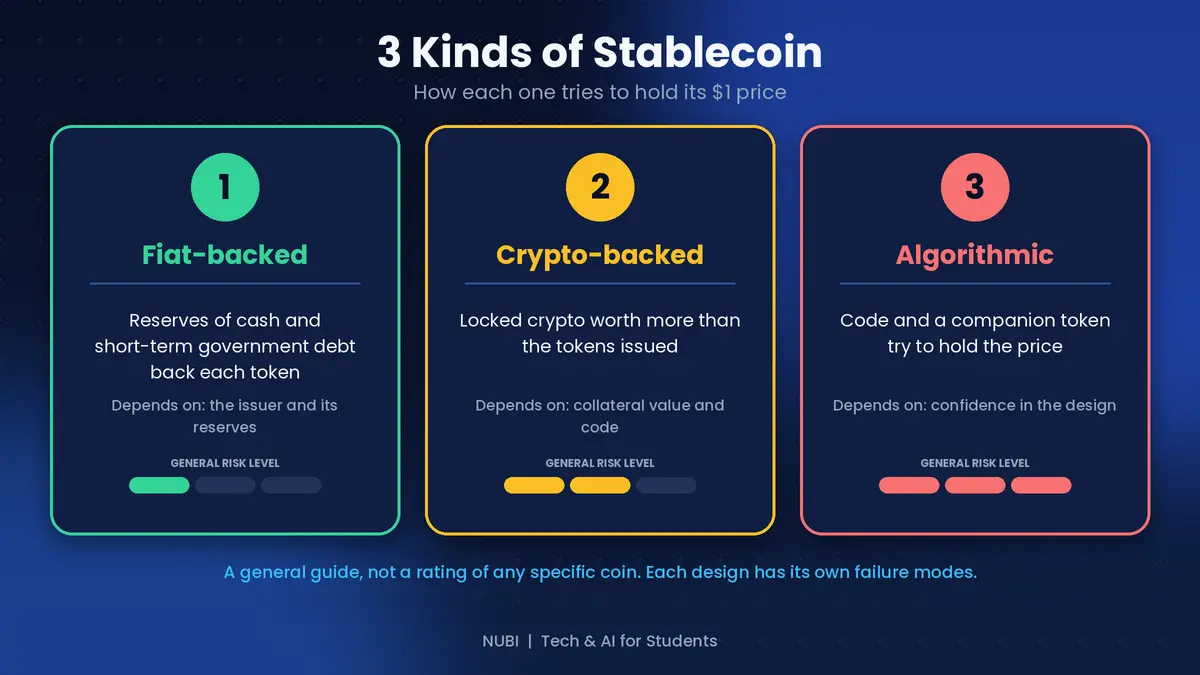
Fiat-backed. Reserves of cash and short-term government debt back each token. It depends on the issuer and its reserves.
Crypto-backed. Locked-up crypto worth more than the tokens issued backs the coin. It depends on the collateral's value and the code.
Algorithmic. Code and a companion token try to hold the price. It depends on confidence in the design, and this group has the worst history of failures.
This is a general guide, not a rating of any specific coin. Each design has its own ways to fail.
What backs a stablecoin
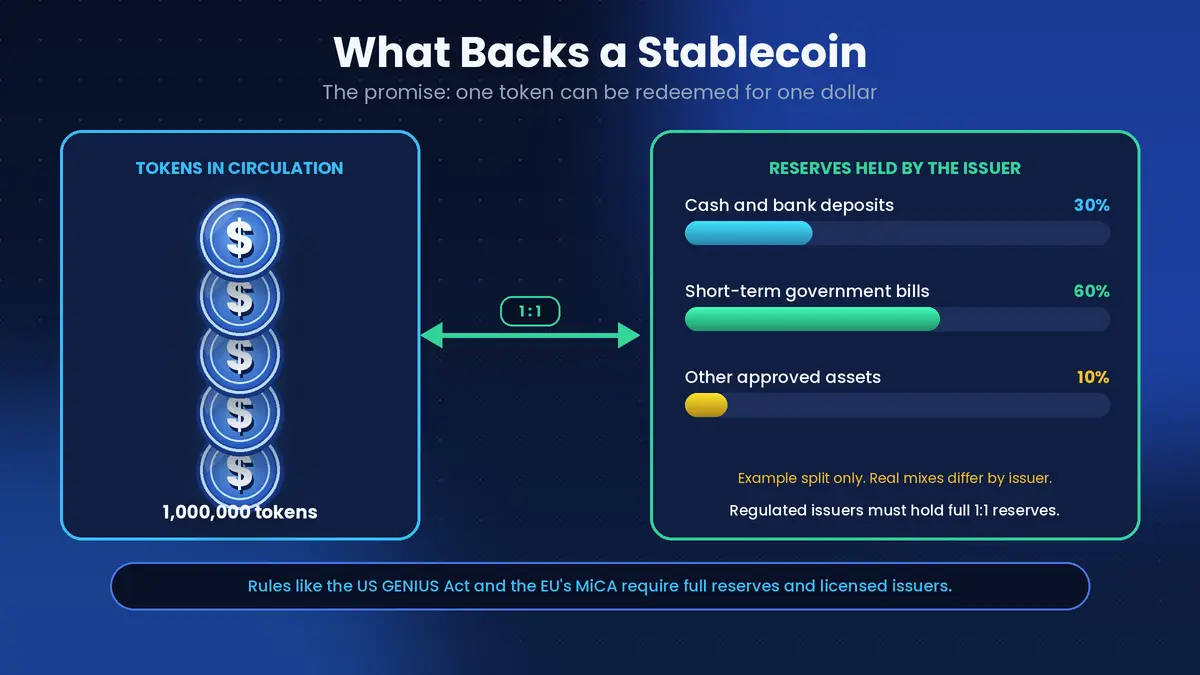
The core promise is simple: one token can be redeemed for one dollar. For a fiat-backed coin, the issuer holds reserves, such as cash, bank deposits and short-term government bills, equal to the tokens in circulation.
Regulation now tries to enforce this. The US GENIUS Act, signed on 18 July 2025, requires licensed issuers and one-to-one reserves, and it bars issuers from paying holders interest. In Europe, MiCA has been in effect since December 2024. Other places, including the UK, Singapore, Hong Kong and Japan, have their own rules too. Check what applies where you live, because the rules differ and keep changing. (upshift) (coinpaprika)
When the peg breaks
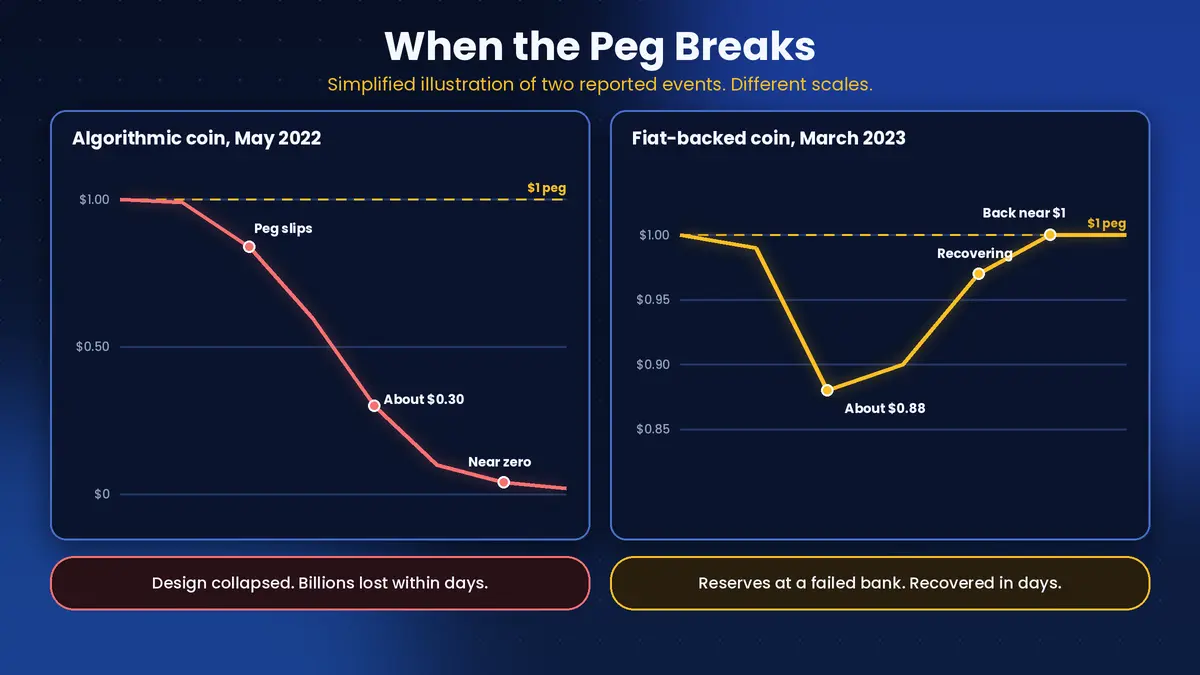
Two events show how stablecoins can fail in very different ways.
TerraUSD, May 2022. This algorithmic coin relied on a design linked to a volatile sister token. When confidence cracked, it spiraled: close to $18 billion in market value disappeared within four days. Counting its companion token, estimates of the total wipe-out run to roughly $40 billion or more. The design itself was the weakness. (eco3min) (spark)
USDC, March 2023. This was a fiat-backed coin, so the cause was different. When Silicon Valley Bank failed, issuer Circle disclosed that $3.3 billion of its reserves were stuck at the bank, and the coin fell as low as $0.88. The problem was where the reserves were held, not how the coin was designed. It climbed back to its $1 peg after positive developments around those reserves. (theblock) (Cointelegraph)
The lesson: a stablecoin is only as strong as the confidence in what stands behind it, and even well-known coins can wobble.
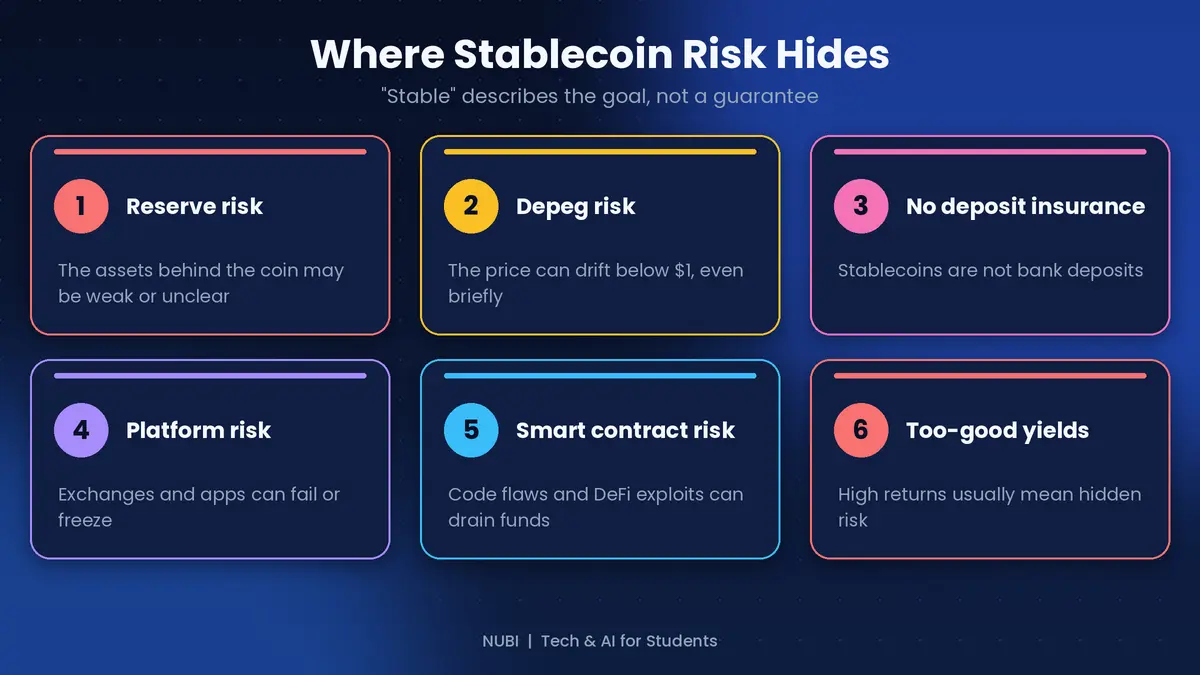
6 places stablecoin risk hides
Reserve risk. The assets behind the coin may be weak or unclear.
Depeg risk. The price can drift below $1, even briefly.
No deposit insurance. No stablecoin carries deposit insurance in any jurisdiction, and regulation does nothing about exchange collapses or DeFi exploits, which is how most losses happen. (stablecoininsider)
Platform risk. Exchanges and apps can fail or freeze withdrawals.
Smart contract risk. Code flaws and DeFi exploits can drain funds (see Day 19).
Too-good yields. High returns usually mean hidden risk. If a platform offers a very high return on a "stable" coin, ask where the money comes from.
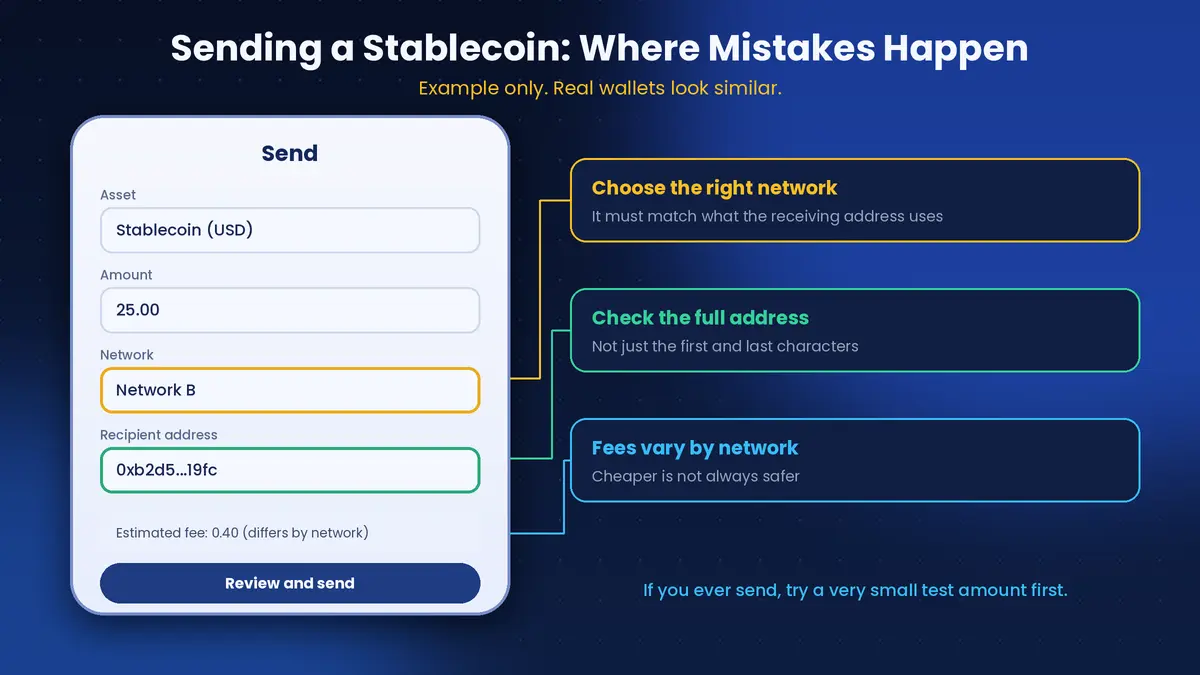
Sending a stablecoin: where mistakes happen
Most everyday losses aren't dramatic collapses. They're small mistakes when sending:
Choose the right network. Many stablecoins exist on several networks, and the receiving address must use the same one (see Day 14).
Check the full address, not just the first and last characters.
Know that fees vary by network, but a cheaper network isn't automatically safer.
If you ever send, try a very small test amount first.

Seven checks before you hold or send one
Who issues it? Look for a named, licensed company with a track record.
Are reserves reported? Regular public reports, ideally independently checked, are a good sign.
Can you redeem 1:1? Know who can redeem, and how quickly.
Is it allowed where you live? Rules differ by country.
Which network are you on? Match it on both sides of every transfer.
Is a yield offered? Unusually high returns are a warning sign.
Is everything in one place? Avoid putting all your funds on one coin or platform.
Quick recap
Stablecoins try to hold a steady price, usually $1
Three kinds: fiat-backed, crypto-backed and algorithmic
Reserves, redemption and regulation are what support the peg
Peg failures have happened in very different ways
Stablecoins have no deposit insurance
Most everyday losses come from mistakes like the wrong network or address
Final thoughts
Stablecoins are useful, and they're probably the most practical part of crypto for many people. But "stable" should make you more careful, not less, because the risk is easy to forget. Know what backs your coin, where it's held and how you'd get out. What would you like to understand better about stablecoins? Tell me in the comments and I'll write about it.
Support this blog
If this guide helped you, you can tip me here: [your tip link]. Every bit helps me keep creating free guides for students. Thank you!

Next : what NFTs really are, and what you actually own when you buy one. Follow so you don't miss it.






