
Meta description: A plain-English guide to smart contracts: the vending machine analogy, what the code looks like, six ways they go wrong, how to read an audit report and how to check a contract on a block explorer.
Intro
You've probably heard that crypto lets people trade, borrow, lend and vote without banks or middlemen. The technology that makes much of this possible is called a smart contract. The name sounds complicated, and it's often used to make things sound more impressive than they are. The idea is actually simple, and once you understand it, you can also understand where the dangers hide.
This article is educational only and is not financial advice. Crypto is risky, and you can lose everything you put in.
The vending machine analogy
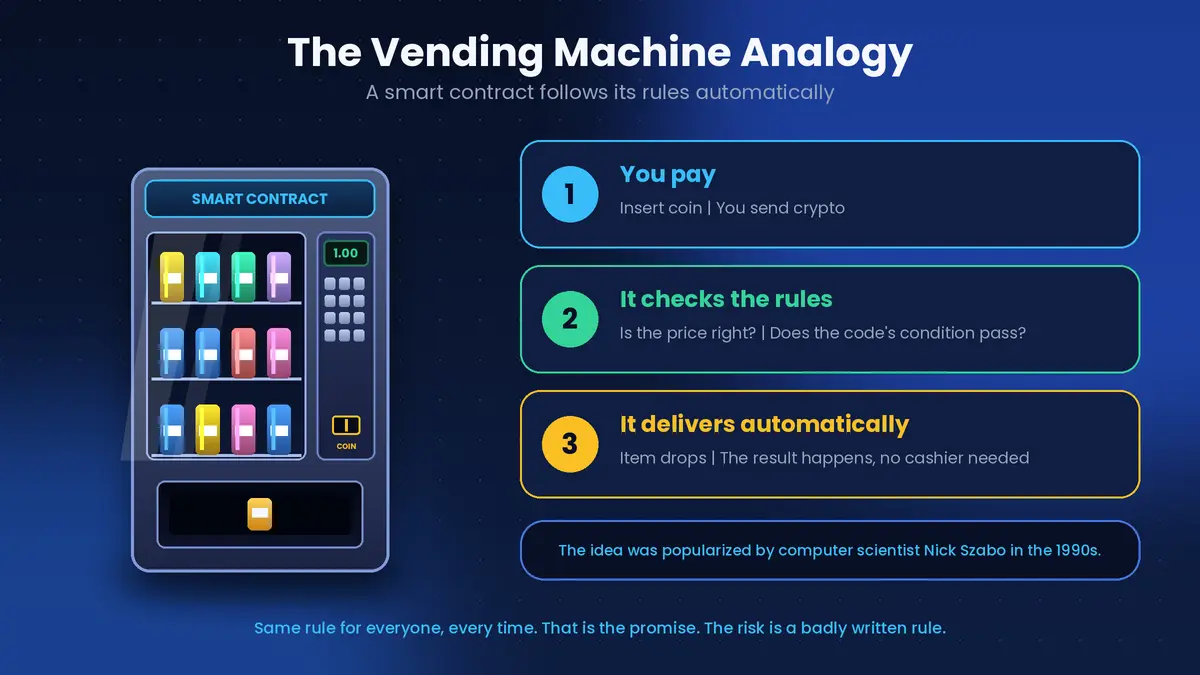
Think about a vending machine. You insert the right amount, press a button, and the machine checks the rules: is the price right? If yes, it drops your snack. No cashier, no negotiation, no one deciding whether they like you. The rules were set in advance, and the machine follows them every time.
A smart contract works the same way:
You pay, by sending crypto to the contract.
It checks the rules, because the code defines conditions that must be met.
It delivers automatically. If the conditions pass, the result happens with no cashier or company in the middle.
The idea was popularized by computer scientist Nick Szabo in the 1990s, long before blockchains existed. Blockchains like Ethereum later made it practical, because a shared, tamper-resistant record is a good place for a vending machine that nobody owns.
Despite the name, a smart contract isn't automatically a legal contract, and it isn't "smart" in the sense of thinking. It's code that follows instructions exactly.
What a smart contract looks like
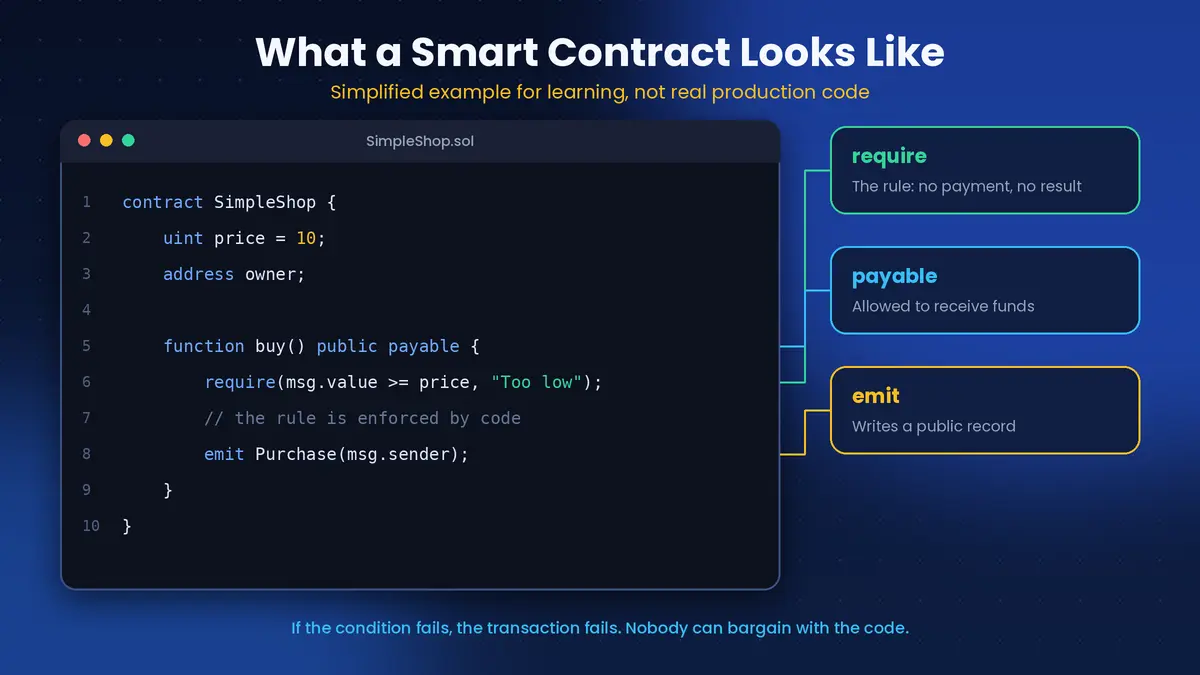
Here is a simplified example. It isn't real production code, only a way to see the logic:
require(msg.value >= price, "Too low") is the rule: if the payment is too low, the transaction fails.
payable means the function is allowed to receive funds.
emit writes a public record that the purchase happened.
You don't need to read code to use crypto safely. But seeing this helps you understand one important point: the code does exactly what it says, not what the creators promised in their marketing. If the code has a mistake, or a hidden power for the owner, the contract follows that too.
What smart contracts are used for
Token swaps and decentralized exchanges: trading directly from your wallet.
Lending and borrowing: rules that hold collateral and release loans automatically.
Digital collectibles (NFTs): proof of ownership recorded by code.
Group decisions: voting systems for online communities.
Escrow: holding funds until both sides meet conditions.
6 ways smart contracts go wrong
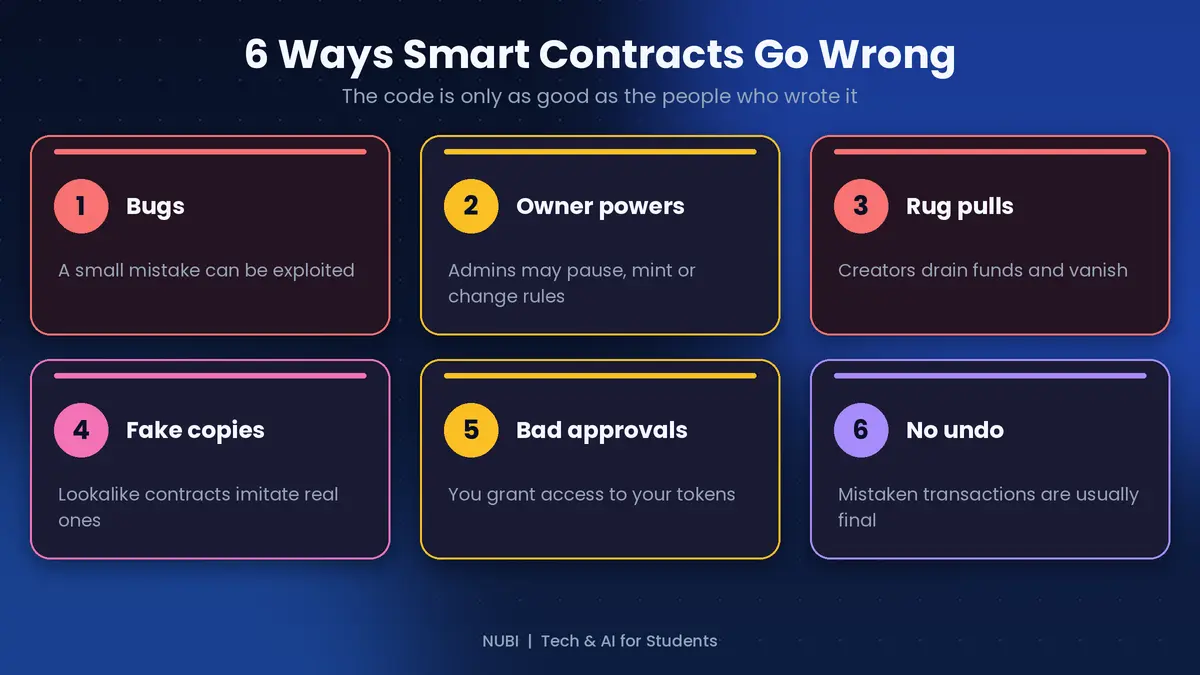
Bugs. A small coding mistake can be exploited, sometimes draining millions.
Owner powers. Some contracts let an admin pause withdrawals, create new tokens or change the rules.
Rug pulls. Creators build hype, collect funds and vanish.
Fake copies. Scammers deploy lookalike contracts that imitate real projects.
Bad approvals. You may grant a contract access to your tokens without realizing how much (Day 16 covers this).
No undo. Mistaken transactions are usually final, because there's no support desk on a blockchain.
The vending machine analogy has a dark side too: a machine with a hidden door in the back can still empty itself into someone's pocket. Reading the rules matters.
Reading an audit report
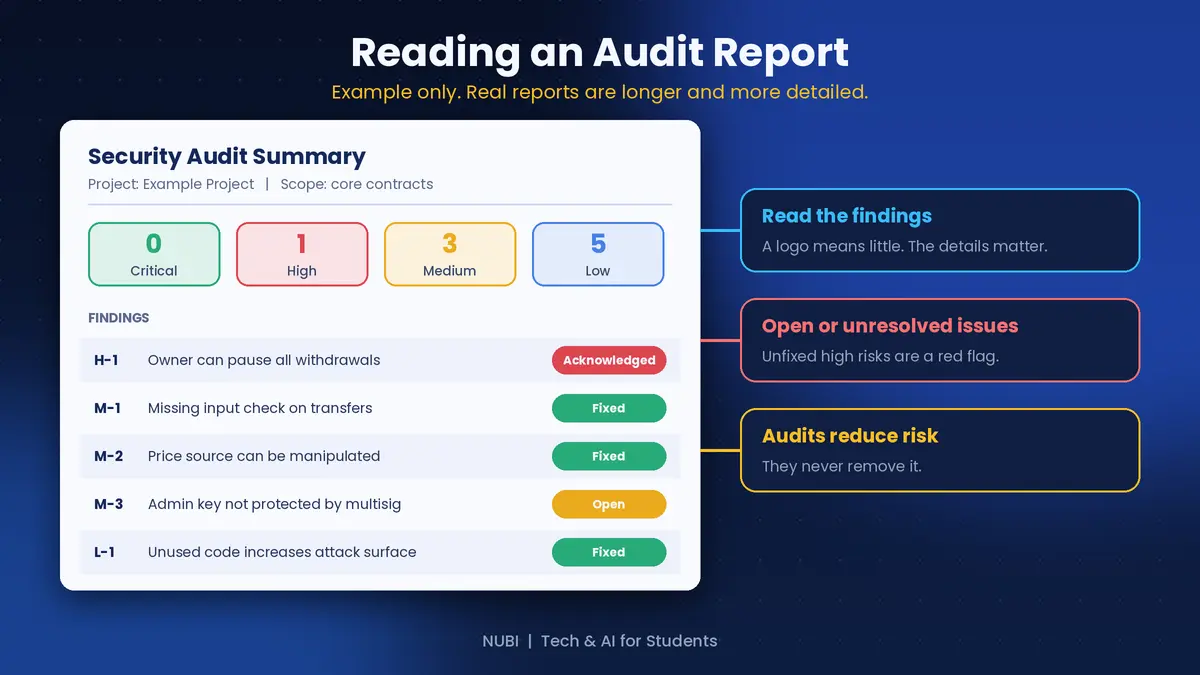
An audit is when independent security experts review a contract's code and report what they find. Findings are usually ranked by severity: critical, high, medium and low. Audits are useful, but treat them with care:
Read the findings, not just the logo. A badge saying "audited" means little without the details.
Check whether issues were fixed. Unresolved high-risk findings are a red flag.
Remember the limits. Audits reduce risk, but they never remove it, because a review is a snapshot of one version of the code.
Checking a contract on a block explorer
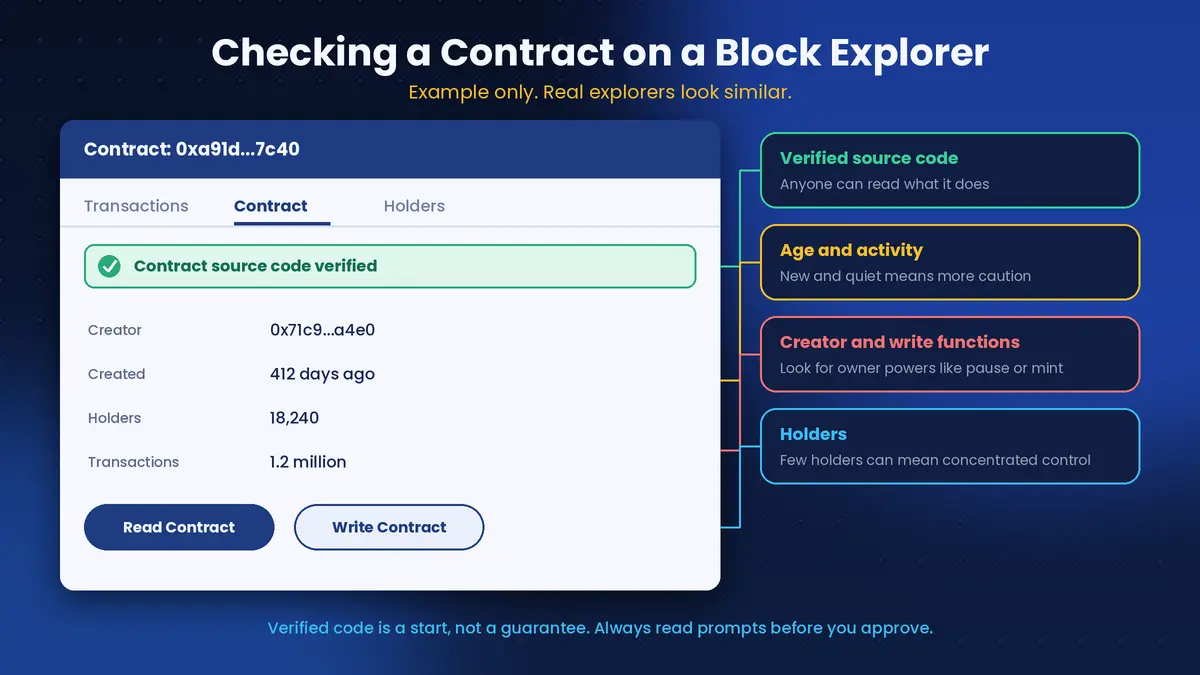
Before you ever interact with a contract, you can look it up on a block explorer. Look for:
Verified source code: it means anyone can read what the contract does.
Age and activity: very new and quiet contracts deserve more caution.
Creator and write functions: check whether the owner has powers like pause or mint.
Holders: if very few addresses hold most of a token, control may be concentrated.
Verified code is a start, not a guarantee. A scam contract can also be verified, and it can even be audited by a weak or fake auditor.
A short safety checklist
Reach the project through its official site, not a message or ad.
Look the contract up on a block explorer and check it is verified.
Read approval prompts, and reject unlimited access.
Search for independent reviews and complaints.
Never use money you can't afford to lose.
If you feel rushed, stop. Real projects don't punish patience.
Quick recap
A smart contract is code that runs automatically when conditions are met
Think vending machine: pay, check, deliver
The code does what it says, not what the marketing says
Risks include bugs, owner powers, rug pulls, fake copies and bad approvals
Audits help but never guarantee safety
Check contracts on a block explorer before you interact
Final thoughts
Smart contracts are one of the most important ideas in crypto, and also one of the most misunderstood. They remove middlemen, but they also remove the safety net that middlemen sometimes provide. That's why a little knowledge goes a long way. What would you like me to explain next? Tell me in the comments and I'll write it.
Support this blog
If this guide helped you, you can tip me. Every bit helps me keep creating free guides for students. Thank you!
Next: what a DAO is, and how online communities make group decisions. Follow so you don't miss it.






