INTRO
Almost every crypto beginner hears the same advice: "get a wallet." But the word is confusing. A crypto wallet isn't like a leather wallet that holds your money. Understanding what it really is makes it much easier to stay safe, because most losses in crypto come from mistakes with wallets, not from the technology itself.
This article is educational only and is not financial advice. Crypto is risky, and you can lose everything you put in.
A wallet holds keys, not coins
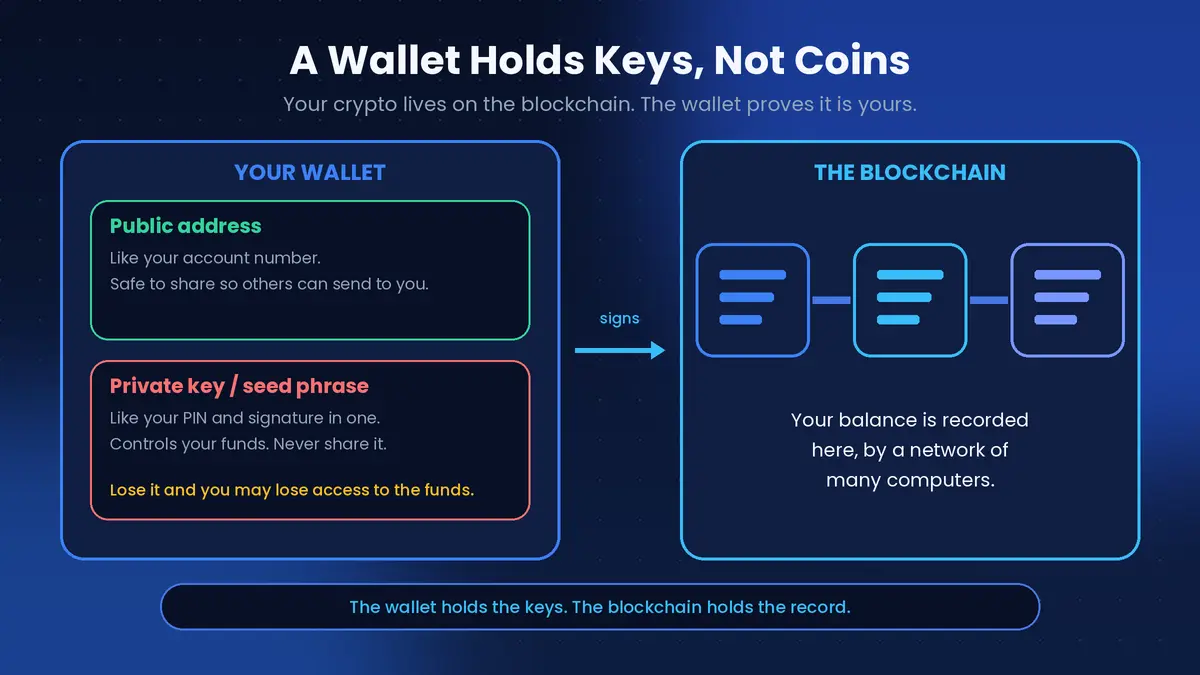
Your crypto doesn't sit inside the wallet. It's recorded on the blockchain, a shared record kept by a network of many computers. What your wallet holds are keys that prove the funds are yours.
Public address: like your account number. It's safe to share so others can send you funds.
Private key or seed phrase: like your PIN and signature in one. Whoever has it can control your funds, so you never share it.
When you send crypto, your wallet signs the transaction with your private key. If someone else gets your key, they can sign too, and there's usually no way to undo it.
Hot wallet vs cold wallet
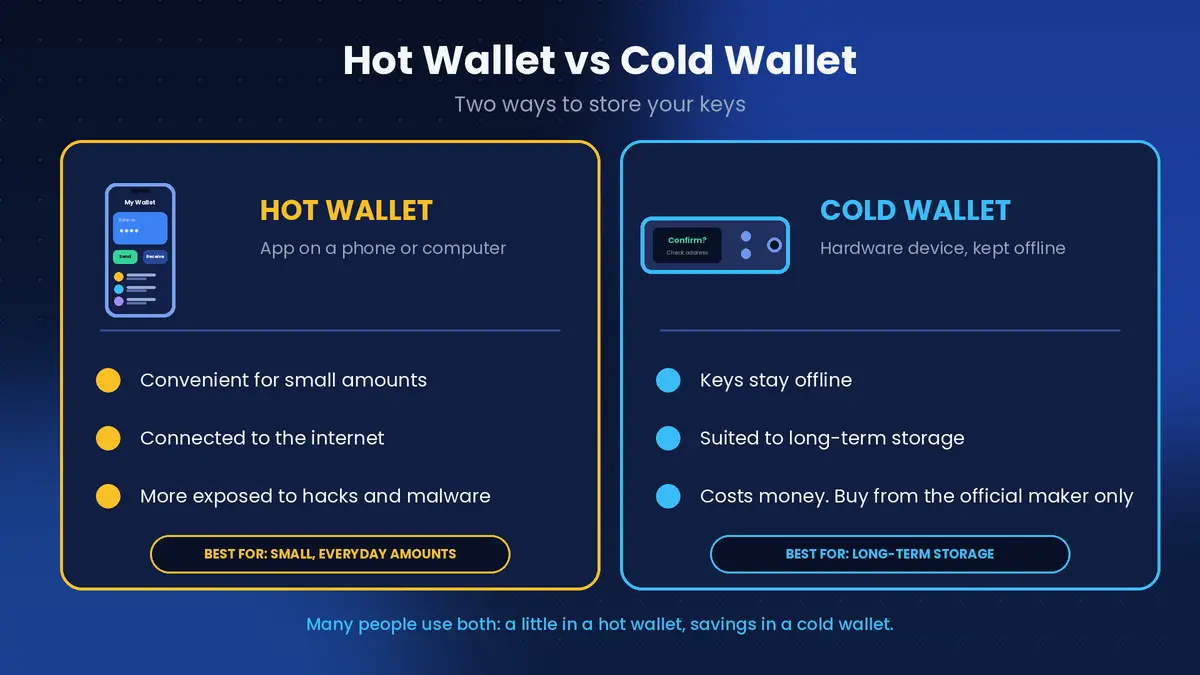
Hot wallet: an app on a phone or computer. It's convenient for small amounts, but it's connected to the internet, so it's more exposed to hacks and malware.
Cold wallet: a hardware device kept offline. The keys stay offline, so it suits long-term storage. It costs money, and you should buy it only from the official maker, never from a random seller.
Many people use both: a small amount in a hot wallet for convenience and larger savings in a cold wallet.
Who holds your keys?
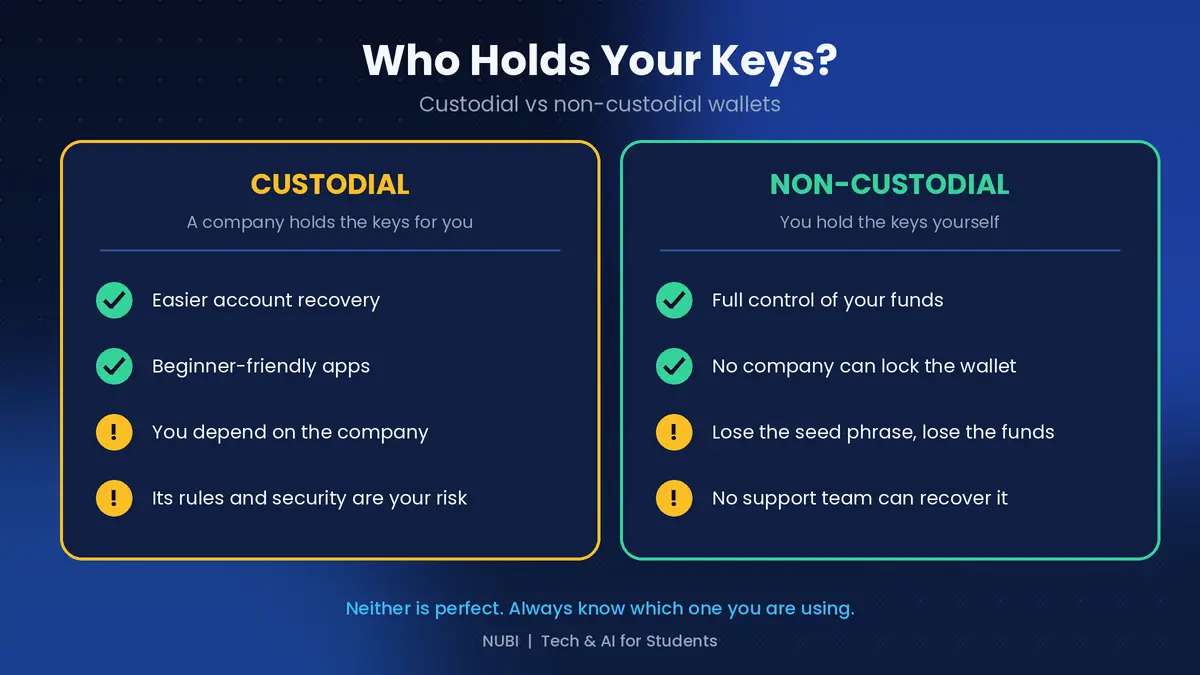
Custodial: a company, such as an exchange, holds the keys for you. Recovery is easier and the apps are beginner-friendly, but you depend on the company's security and rules.
Non-custodial: you hold the keys yourself. You have full control and no company can lock your wallet, but if you lose your seed phrase, no support team can recover your funds.
Neither is perfect. What matters is that you know which one you're using and what each one asks of you.
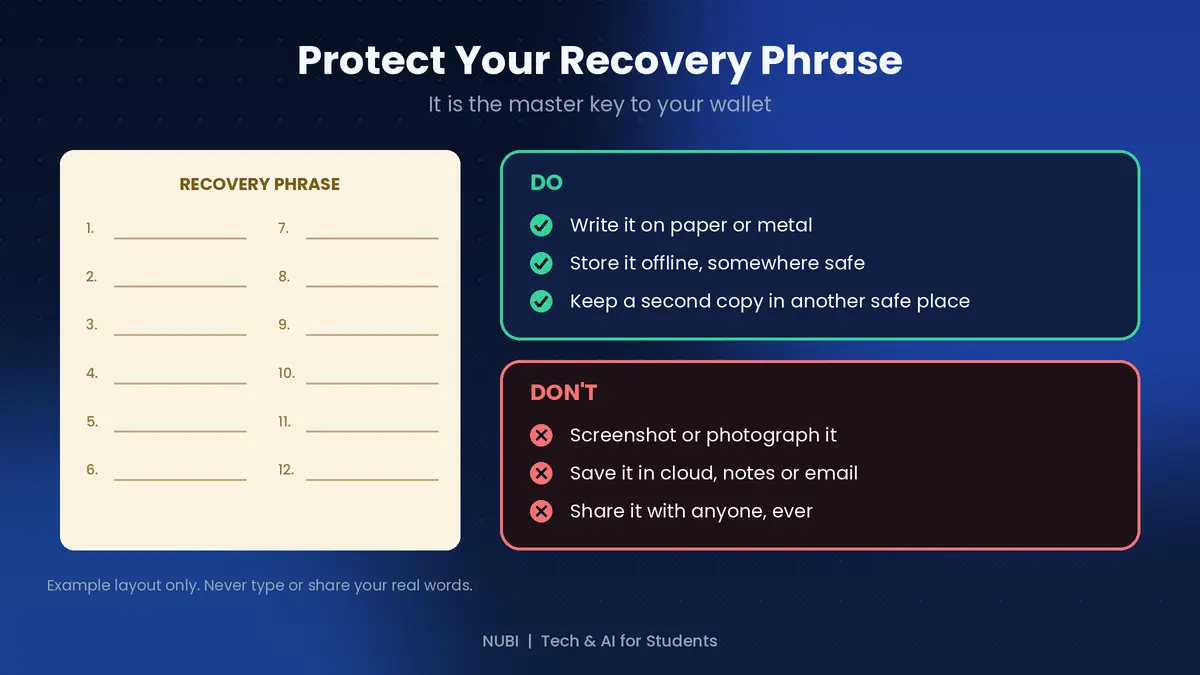
Protect your recovery phrase
When you create a non-custodial wallet, you're given a recovery phrase, usually 12 or 24 words. It's the master key to everything in that wallet.
Do write it on paper or metal, store it offline somewhere safe and keep a second copy in another safe place.
Don't screenshot or photograph it, save it in the cloud, notes or email, or share it with anyone, ever.
No real support team, developer or "admin" will ever ask for it. Anyone who does is trying to steal from you.
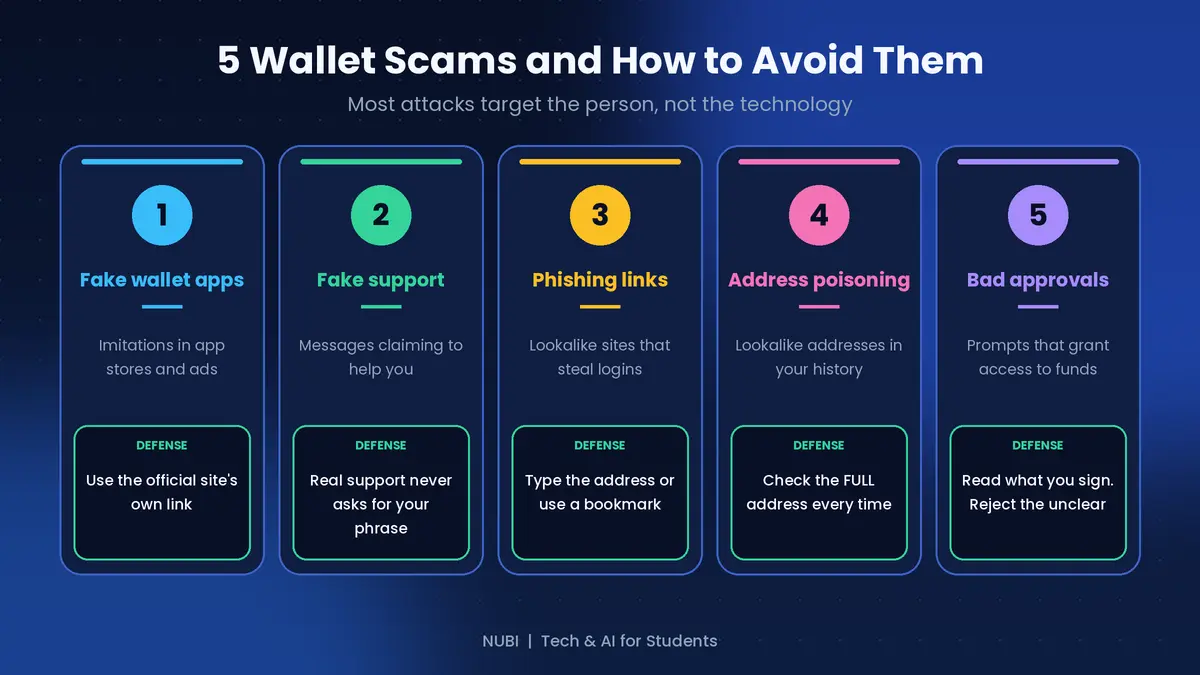
5 common wallet scams
Fake wallet apps. Imitations appear in app stores and ads. Use the official site's own link.
Fake support. Messages claiming to help you. Real support never asks for your phrase.
Phishing links. Lookalike websites that steal your logins. Type the address yourself or use a bookmark.
Address poisoning. Scammers send tiny transfers from addresses that look like ones you use, hoping you'll copy the wrong one from your history. Check the full address every time, not just the first and last characters.
Bad approvals. Prompts that give a site access to your funds. Read what you're signing, and reject what you don't understand.
Notice that most of these attack the person, not the technology. They rely on rushing you, so slowing down is your best defense.
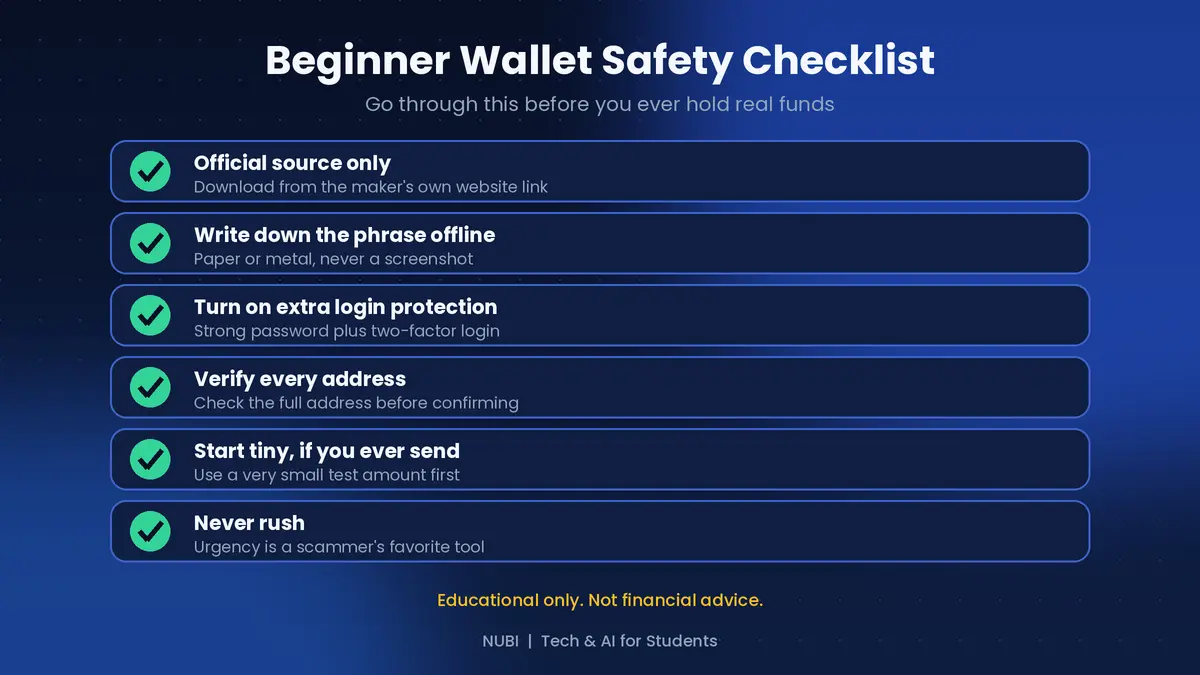
Beginner safety checklist
Use the official source only for any wallet app or device.
Write down your recovery phrase offline.
Turn on extra login protection: a strong password and two-factor login.
Verify every address, the full address, before confirming.
If you ever send funds, try a very small test amount first.
Never rush. Urgency is a scammer's favorite tool.
Quick recap
A wallet holds keys, while your crypto lives on the blockchain
Never share your private key or recovery phrase
Hot wallets are convenient, cold wallets are more secure
Custodial means a company holds your keys, non-custodial means you do
Most scams rely on rushing you, so slow down and verify
Final thoughts
You don't need to be technical to stay safe, but you do need to be careful. Learn how wallets work before you hold any real funds, and only ever use money you can afford to lose. What's your biggest question about crypto wallets? Tell me in the comments and I'll cover it in a future guide.
Support this blog
If this guide helped you, you can tip me. Every bit helps me keep creating free guides for students. Thank you!
Next: how crypto exchanges work, and how to avoid common beginner mistakes. Follow so you don't miss it.