
Meta description: How the most common crypto scams work, with real examples, warning signs, an eight-scam cheat sheet and what to do in the first 24 hours if you are targeted.
Intro
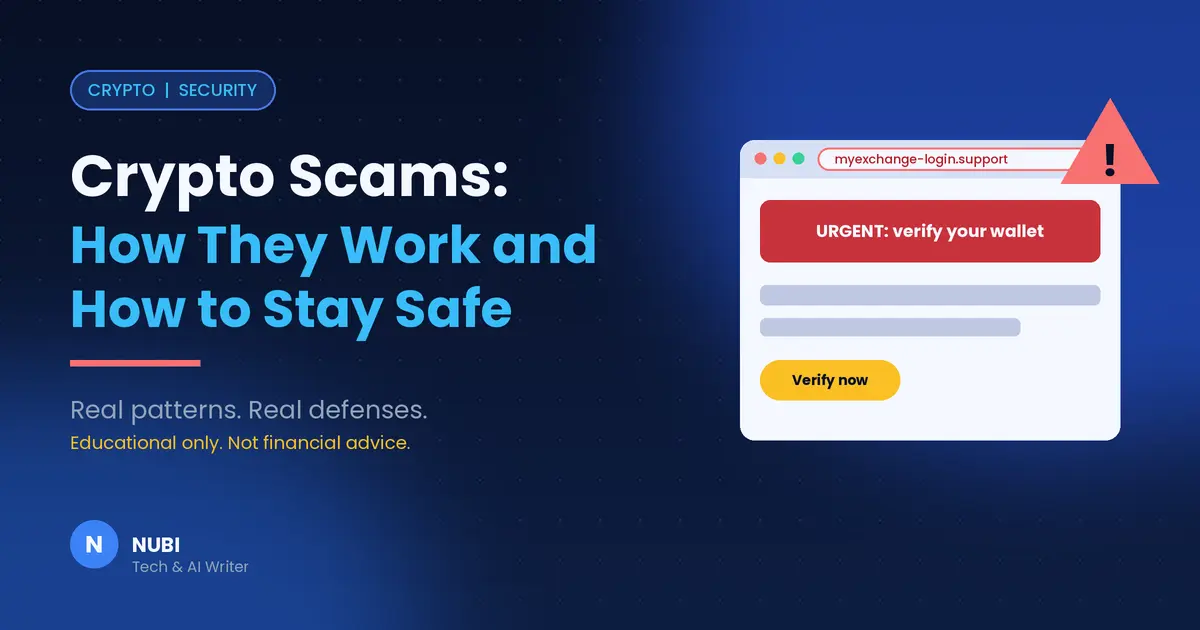
Crypto scams are not rare accidents that happen to careless people. They're an industry, and they target beginners, students and anyone who's excited about new technology. This guide explains how the most common scams work, so you can recognize them before they reach you.
This article is educational only and is not financial advice.
The scale of the problem
The FBI's 2025 Internet Crime Report found that cryptocurrency-related complaints reached 181,565 and totaled $11.366 billion in losses, making crypto the most costly category in the report. Within that, crypto investment fraud alone accounted for $7.2 billion in reported losses, the highest of any category. (bitcoinmagazine) (foxbusiness)
These figures come from reports by Americans, so they show the scale in one country, not the whole world. Scammers operate across borders, and the same tricks appear everywhere.
Scam 1: the fake link
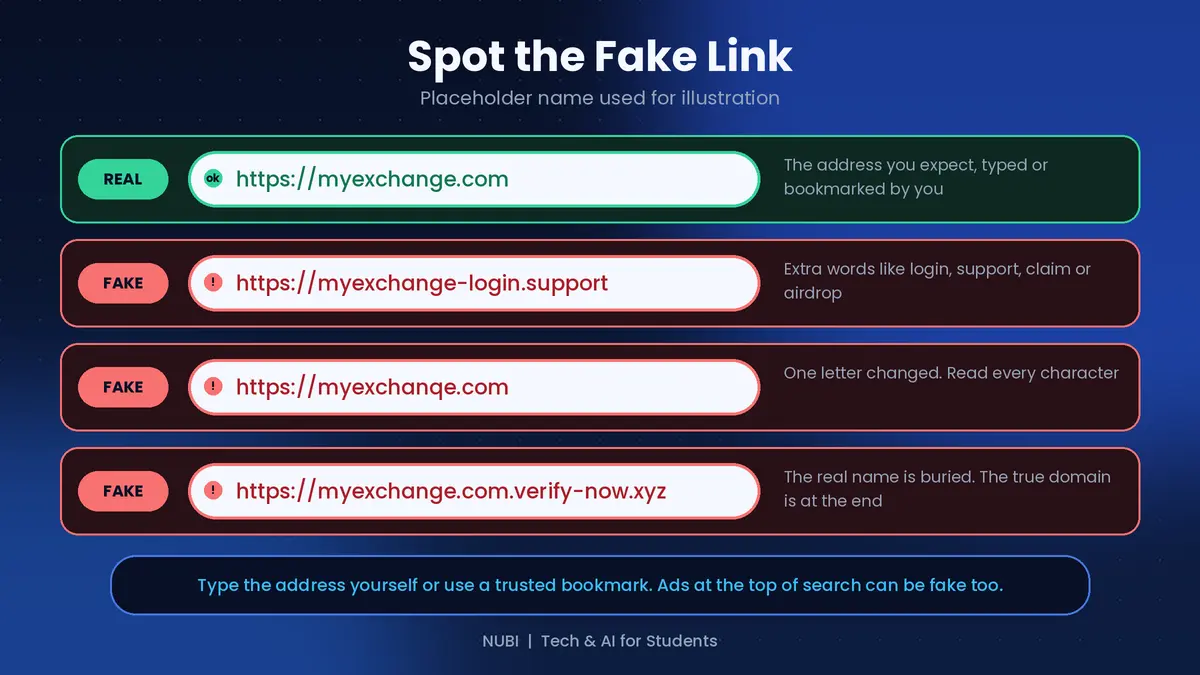
Many scams start with a link: a fake exchange, a fake wallet site or a fake "claim your reward" page. Scammers register addresses that look almost right:
extra words like "login", "support", "claim" or "airdrop"
one letter changed, such as a "q" instead of a "g"
the real name buried at the start, while the true domain is at the end
Type the address yourself or use a trusted bookmark, and remember that ads at the top of search results can be fake too.
Scam 2: the long con
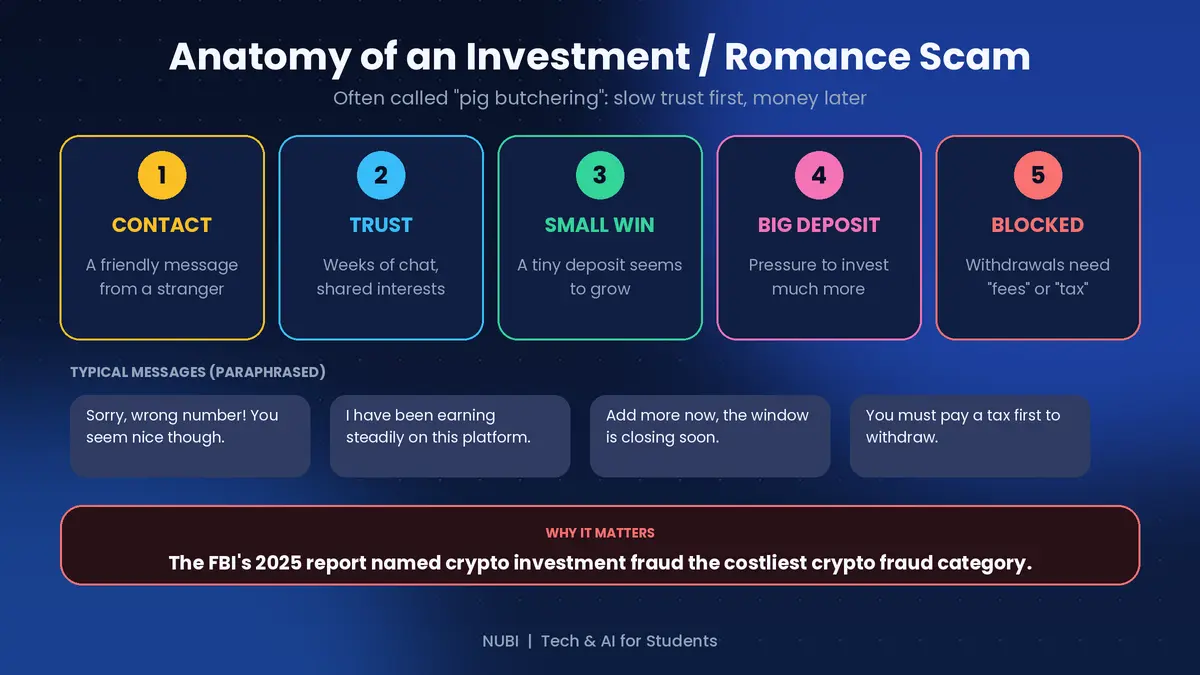
This is often called "pig butchering". A friendly stranger contacts you, builds trust over weeks and eventually introduces an "investment platform". A small deposit appears to grow. You're pushed to deposit much more. When you try to withdraw, you're told to pay a "tax" or "fee" first, and then the money is gone.
It works because it feels like a relationship, not a scam. And many victims don't realize what's happening: the FBI notified 3,780 victims of crypto investment fraud in 2025, and 78% of them were unaware they were being scammed. (foxbusiness)
The rule: never invest through a platform recommended by someone you only know online.
Scam 3: fake support
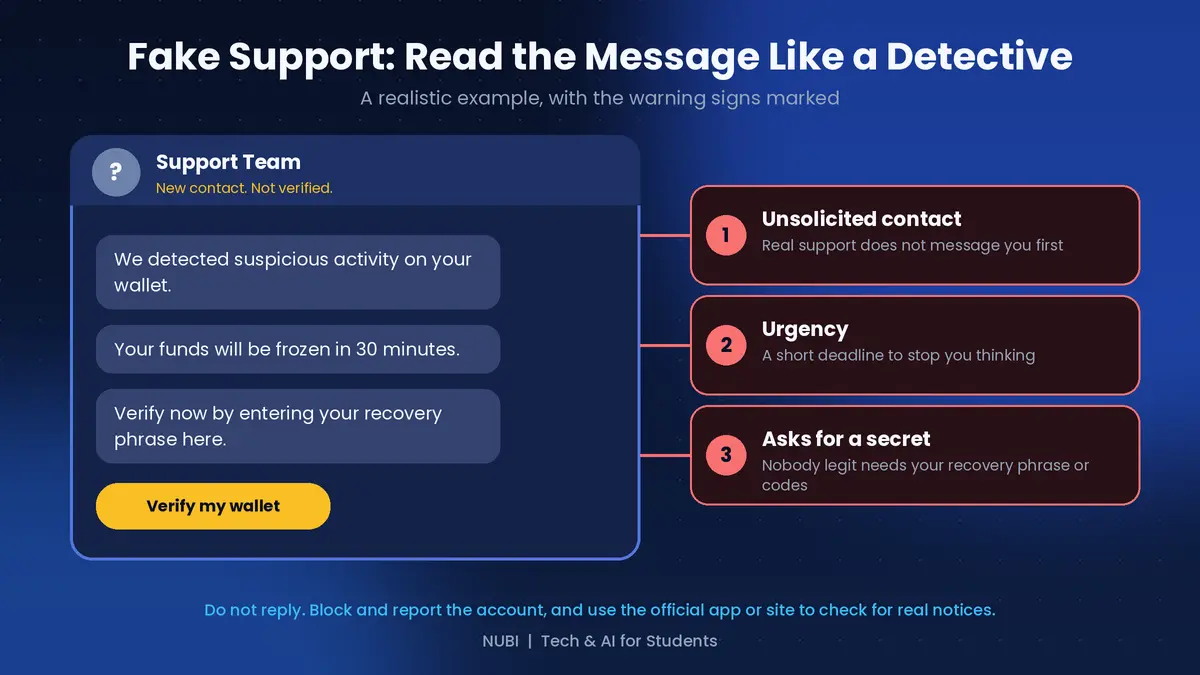
A message appears claiming to be support. It says your wallet is at risk, gives you a short deadline and asks you to "verify" by entering your recovery phrase.
Three warning signs appear in almost every case: the contact is unsolicited, there's urgency, and it asks for a secret. Real support doesn't message you first, and no one legitimate ever needs your recovery phrase or two-factor codes. Don't reply. Block and report the account.
Scam 4: the approval trap
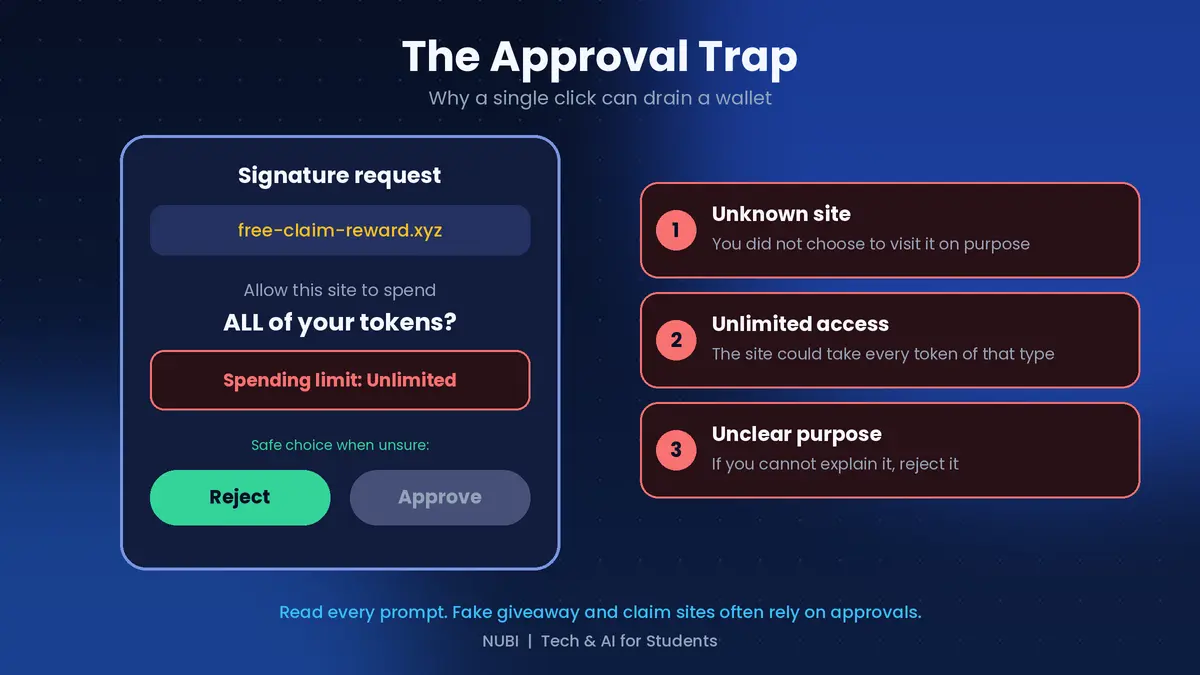
Some scams don't ask for your keys at all. They send you to a site that asks you to "approve" a transaction. If you approve unlimited spending, the site can take every token of that type from your wallet.
Before you click approve, ask three questions: do I know this site, what exactly am I allowing, and can I explain why? If you can't answer, press reject.
8 scam types and your defense
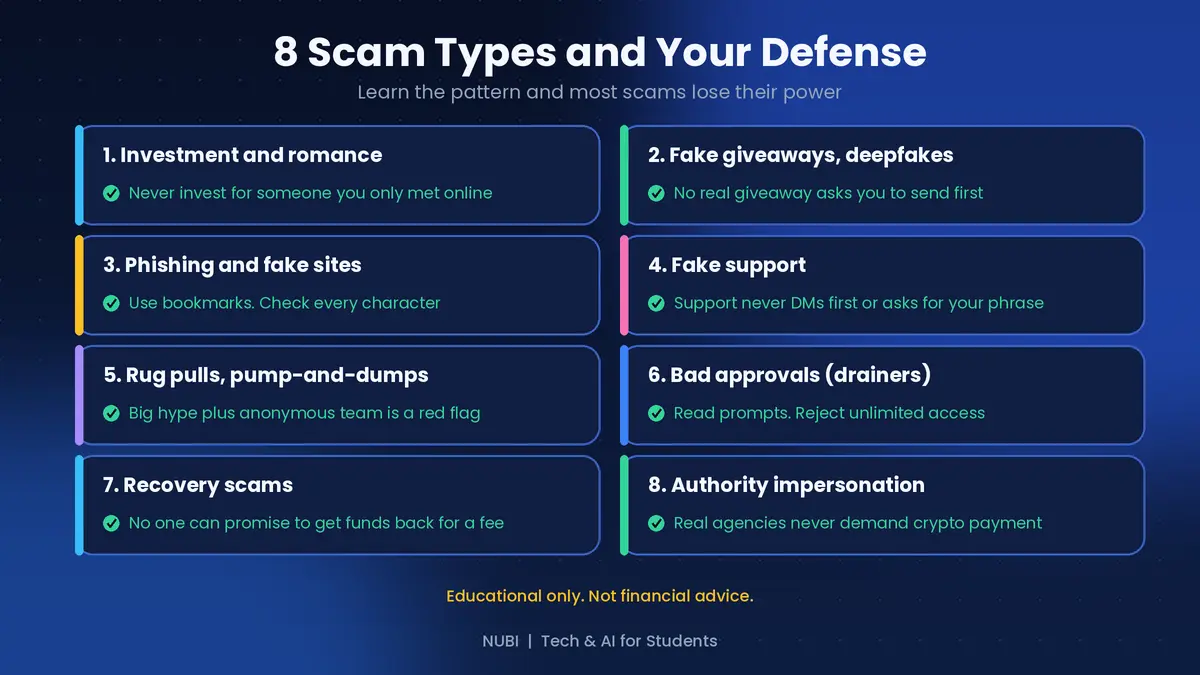
Investment and romance: never invest for someone you only met online.
Fake giveaways and deepfakes: no real giveaway asks you to send first.
Phishing and fake sites: use bookmarks and check every character.
Fake support: support never messages first or asks for your phrase.
Rug pulls and pump-and-dumps: big hype plus an anonymous team is a red flag.
Bad approvals (drainers): read prompts and reject unlimited access.
Recovery scams: no one can promise to get your funds back for a fee.
Authority impersonation: real agencies never demand crypto payment.
AI makes scams more convincing
Scammers now use AI to write convincing messages, clone voices and create fake videos. The FBI report noted that losses in investment complaints with a reported AI connection passed $632 million, but overall investment scam losses exceeded $8 billion, which suggests many victims don't realize how much AI is involved. Don't trust a message just because it sounds polished or a voice sounds familiar. Verify through a second channel you already trust. If you missed it, Day 10 covers spotting fake AI content in more detail. (asisonline)
If you've been scammed: the first 24 hours
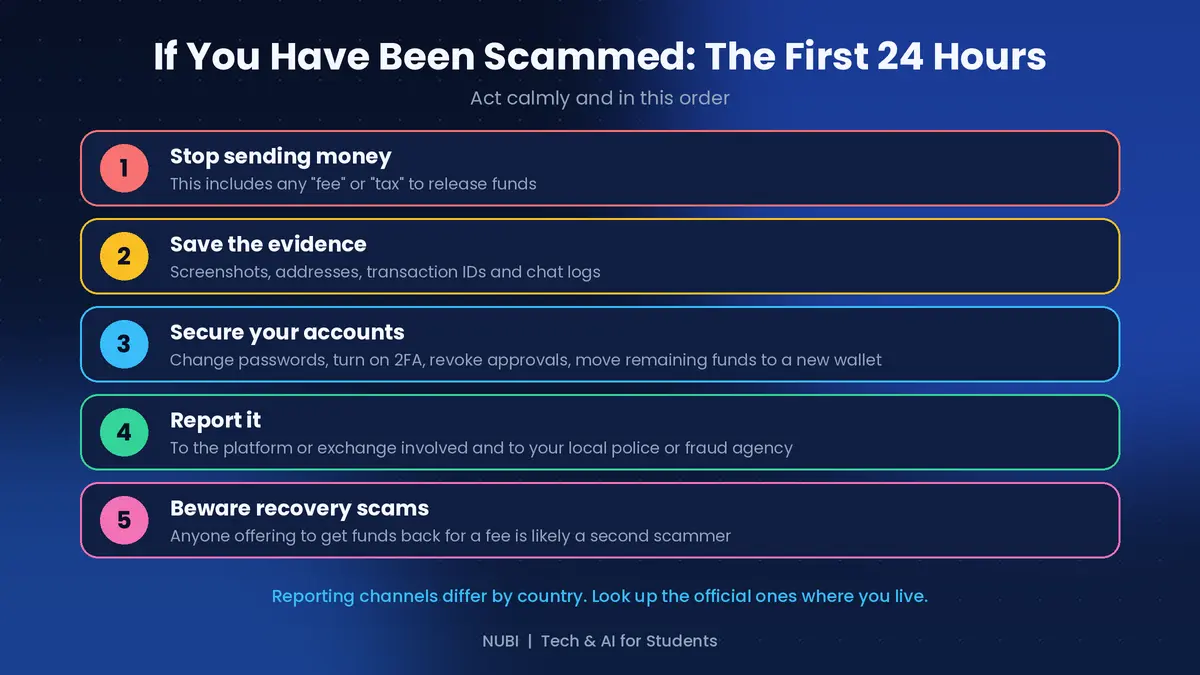
Stop sending money. This includes any "fee" or "tax" to release your funds.
Save the evidence. Screenshots, wallet addresses, transaction IDs and chat logs.
Secure your accounts. Change passwords, turn on two-factor login, revoke wallet approvals and move any remaining funds to a new wallet.
Report it. Tell the platform or exchange involved, and your local police or fraud agency. Reporting channels differ by country, so look up the official ones where you live.
Beware recovery scams. Anyone offering to get your funds back for a fee is likely a second scammer. The FBI's report logged more than 10,500 complaints about recovery scams, with estimated losses of $1.4 billion. (asisonline)
Being scammed isn't something to be ashamed of. These operations are professional, and reporting quickly gives you the best chance of helping yourself and others.
The pause rule
The one habit that defeats most scams is to pause. The FBI itself urges people to "take a beat" to look for the red flags of a scam. Scammers depend on speed, emotion and secrecy. If something makes you feel rushed, excited or afraid, stop, step away and check with someone you trust before you do anything. (hstoday)
Quick recap
Crypto fraud is large, organized and growing
Check every link, and use bookmarks
Never invest through a stranger's platform
Real support never asks for your phrase or codes
Read every approval prompt, and reject what you don't understand
If scammed, stop paying, keep evidence, secure accounts and report
When in doubt, pause
Final thoughts
You don't need to be an expert to stay safe. You need a few firm rules and the patience to follow them. Share this guide with a friend who's new to crypto, because scams spread fastest through people who haven't been warned. Have you seen a scam like these? Tell me about it in the comments, without sharing personal details, and I'll cover it in a future guide.
Sources: FBI IC3 2025 Internet Crime Report, as reported by Bitcoin Magazine, Fox Business and ASIS Security Management.
Support this blog
If this guide helped you, you can tip me. Every bit helps me keep creating free guides for students. Thank you!
Next: how to set up a crypto portfolio tracker safely, with no wallet access needed. Follow so you don't miss it.






