

INTRO
Crypto is everywhere: in the news, on social media and in group chats. Many students hear big claims about it but never get a clear explanation. This guide covers the basics in plain English, including the risks, so you can understand it before you ever consider using it.
This article is for education only and is not financial advice.
What is crypto?
Cryptocurrency is digital money that exists on a network of computers instead of being controlled by one bank or company. Bitcoin was the first and is still the best known. Thousands of others have been created since, and they differ a lot in quality and purpose.

How a transaction works
You send. Your wallet signs the transfer using your private key.
The network checks. Many computers confirm that the transfer is valid.
The block is recorded. The transaction is added to a shared record called a blockchain.
The receiver gets it. The funds appear in their wallet.
There's no bank in the middle to call if you make a mistake. Most crypto transfers are hard or impossible to undo, so always double-check the address before sending.

5 terms every beginner needs
Blockchain: a shared digital record kept by many computers.
Wallet: an app or device that holds your keys and shows your balance.
Private key: the secret that controls your funds. Never share it.
Exchange: a platform where people buy and sell crypto.
Volatility: prices can rise and fall sharply in a short time.
If you understand these five, most beginner guides will make sense.
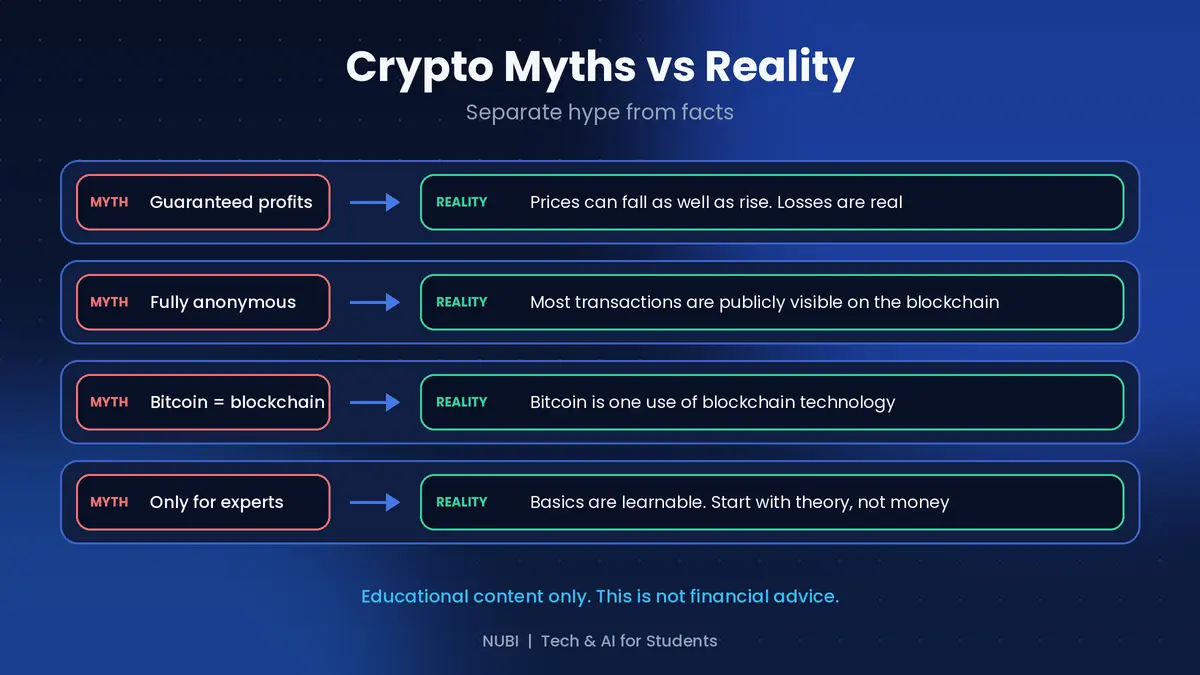
Myths vs reality
"Crypto guarantees profit." No investment does. Prices can fall as well as rise, and many people lose money.
"Crypto is fully anonymous." On most public blockchains, transactions are visible. They are linked to addresses, not names, but that is not the same as being anonymous.
"Bitcoin and blockchain are the same." Bitcoin is one use of blockchain technology, which has other uses too.
"Crypto is only for experts." The basics can be learned by anyone. Start with understanding, not with money.

Your safety checklist
Learn first. Understand the basics before using any money.
Risk only what you can afford to lose. Never use money meant for school fees, rent or food, and never borrow to invest.
Protect your accounts. Use a strong, unique password and two-factor authentication.
Guard your seed phrase. It's the master key to your wallet. No real support team will ever ask for it.
Be careful with promises. Guaranteed returns, "double your money" offers and pressure to act fast are classic signs of a scam.
Where to learn more safely
Stick to well-known educational sources, read more than one opinion, and be skeptical of anyone who makes money by convincing you to buy. If you want to practice, many learning platforms let you explore the concepts without real funds.
Quick recap
Crypto is digital money run by a network, not a single bank
Learn the five key terms first
Transfers are usually irreversible, so check every address
Never share your private key or seed phrase
Treat promises of guaranteed profit as a warning sign
Final thoughts
You don't have to use crypto to benefit from understanding it. Knowing how it works helps you spot scams, follow the news and make better decisions, whatever you choose. Do you have questions about crypto? Tell me in the comments and I'll answer them in a future guide.
Support this blog
If this guide helped you, you can tip me. Every bit helps me keep creating free guides for students. Thank you!
Next: how to use AI to learn a new skill faster. Follow so you don't miss it.






