
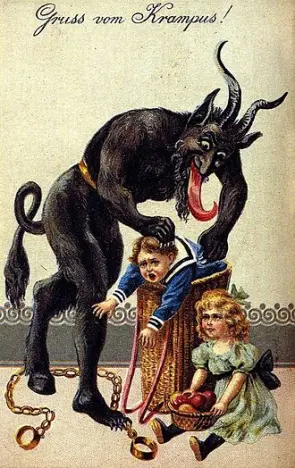
Today is December the 5th 2019. #KrampusKnacht or #KrampusNight.
I'm sure most folks by now have pulled out their Bitcoin and crypto currency and shopped for Yule and Christmas gifts on Black Friday to catch the great sales.
I would like to share this creepy shadowy figure of Saint Nicholas called Krampus.
This is a wild time for children in Europe. I thought the Boogeyman was scary as a child but Krampus is scary enough to knock kids socks off.
So Be good for goodness sake. ;)
Tonight in several places in Europe, Krampusnacht is celebrated.
Its Christian counterpart is also known as St. Nicolas Feast held on December the 6th.
Naughty or Nice?
According to Alpine folklore, Krampus is a horned, anthropoid. It is described as “half-goat, half-demon”, who, during the Yule or Christmas season, hands out punishment to naughty children who have misbehaved, opposite of Saint Nicholas, who rewards the well behaved children with gifts. Krampus is a companion among others of Saint Nicholas.
In many countries including Austria, Bavaria, Croatia, Czech Republic, Hungary, Slovenia, South Tyrol and parts of Northern Italy.
The origin of this dark figure is unclear; some folklorists and anthropologists have postulated its pre-Christian origin.

Krampusnacht:
On the evening of 5 December, Krampus Night or Krampusnacht, the wicked hairy devil appears on the streets, sometimes accompanying Santa Klaus handing out gifts to children or sometimes he grabs children and tussles them about just for fun. Trust me the children love it.
The next night on December 6th The Feast of St. Nicholas is well celebrated in several parts of Europe.
Krampuslauf:
Tradition dictates an offering of a Krampus schnapps, a strong distilled fruit brandy. These runs may include Perchten, similarly wild pagan spirits of Germanic folklore and sometimes female in representation, although the Perchten are properly associated with the period between winter solstice and 6 January.
Krampuskarten:
Europeans have exchanged greeting cards featuring Krampus since the 1800s.
Sometimes introduced with Gruß vom Krampus (Greetings from Krampus), the cards usually have humorous rhymes and poems. Krampus is often featured looming menacingly over children like the one at the top of the page.
Merry Krampus Night!
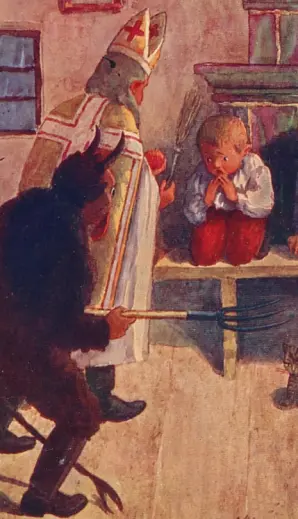
Below painting of St. Nicholas, Krampus and child. Wikimedia.org in Public Domain
All Nifty Buckles Folklore Fun posts Copyright 2017-2020 All Rights Reserved.
Source & Reference:
- atured photo of Krampus In Sexten Italy (2016) by Luca Lorenzi Wikimedia Commons Public Domain.
- Krampus on Page: Perchtenlauf Klagenfurt WikimediaCommons.org (Public Domain.)
- Brunner, Christian (17 August 2015). Mountain Magic: Celtic Shamanism in the Austrian Alps. Lulu.com. ISBN 9781312995192.
- Siefker, Phyllis (1997). Santa Claus, last of the Wild Men: the origins and evolution of Saint Nicholas.
- Jefferson, North Carolina: McFarland and Co. pp. 155–159. ISBN 0-7864-0246-6.
- Basu, Tanya (19 December 2013) “Who is Krampus?” National Geographic Magazine.






