
Introduction
Welcome to the world of Nexus: an innovative and ambitious project with the potential to revolutionize the entire crypto industry. In this community-written article, we aim to introduce you to Nexus's vision, mission, and technology. As you read on, you'll discover how Nexus provides a unique opportunity to be a part of a greater movement towards a decentralized future.
The crypto landscape is filled with various projects aimed at a better world, and the Nexus community is thrilled about that. However, we believe Nexus stands out among the rest due to its ambition and scope. Nexus has the potential to make a tremendous impact. We firmly believe that Nexus is a (r)evolutionary technology that can change not only the crypto industry but also the world as we know it.
What is Nexus?
In 2014, Nexus was founded by Colin Cantrell, a visionary software engineer, musician, and son of SpaceX co-founder Jim Cantrell. Colin and his team drew inspiration from the emergence of Bitcoin and aimed to create a fast, secure, and decentralized internet that would be truly controlled by the people and therefore unstoppable. Their goal was to 'rebuild the internet from the ground up,' and to achieve this, they initially consulted and collaborated with some of the founding fathers of the early internet, such as Dino Farinacci and his LISP technology.
Over time, Nexus has created its own type of blockchain that combines the safety and speed of blockchain technology with a flexible and expandable registry system. Instead of storing data in a straight line like the UTXO system of other blockchains, Nexus uses a unique three-dimensional chain structure. This new way of doing things effectively solves the problem of balancing security, scalability, and decentralization, ‘the blockchain-trilemma’, while also being resistant to future quantum computing threats.
Nexus is currently developing LX-OS, which will be a proprietary operating system and a vital component of its seven-layer software architecture. LX-OS will offer users an alternative to traditional operating systems like Windows or MacOS. Once released, users will be able to access LX-OS in their secure virtual spaces, known as "signature chains," from any computer worldwide. These ‘signature chains’ will assign each user a unique identification (DID) while still allowing them to remain anonymous. This significant development is a step forward in addressing some of the challenges facing the internet today.
In 2019, Nexus embarked on an ambitious plan to launch a satellite as the first step to establish its infrastructure of Low Earth Orbit (LEO) satellites and ground station mesh network. This collaboration with Vector, a small-load rocket launch company, aimed to develop proprietary virtualization software called Galactic Sky, which would provide compute management capabilities to LEO satellites. Although Vector suffered a downfall, and Lockheed Martin acquired Galactic Sky, Nexus remains committed to its vision of a 'people-owned,' decentralized telecom infrastructure and has made progress in its’ development.
Nexus unique tech
One of Nexus's distinguishing features is the signature chains (Sigchains). This system enables login credentials to serve as a "key" to a quantum-secured virtual space owned by users. With Sigchains, each login generates a new key that can only be used once, rendering it virtually impossible for hackers to reuse stolen private keys. Unlike traditional login systems that require physical storage devices like Ledger or Trezor, Sigchains allow users to store their keys in their memory, providing a convenient and secure alternative. As a result, cumbersome hardware wallets may become obsolete technology in the future.
Another notable feature of Nexus is the Lower-Level Library (LLL), which includes three primary components: Cryptography (LLC), Database (LLD), and Protocol (LLP). The LLC comprises a collection of useful cryptographic functions, including Quantum Resistant algorithms. These kinds of innovations are crucial for keeping blockchain technology secure with the emergence of quantum computers. The LLP facilitates the rapid development and deployment of high-performance binary or hyper-text protocols, while the LLD operates in constant time, meaning that it does not slow down with time, even when handling large datasets. Compared to Google's LevelDB, which is used by BTC and ETH, Nexus's LLD can handle a Virtual Machine instruction in just 33 nanoseconds, whereas LevelDB takes 1.7 million nanoseconds. This impressive capability will soon be implemented in the mobile wallet.
The Nexus wallet is another unique feature of the platform. Both the desktop and mobile wallets function as nodes that communicate directly with one another, eliminating the need for intermediaries like Infura, a centralized node infrastructure provider for Ethereum. In addition to staking and invoicing capabilities, the wallets enable P2P trading, communications, tokenized markets, and token creation. The upcoming mobile wallet will operate as a smart contract platform on a phone, a goal that Ethereum plans to achieve by 2030. The wallet will also allow for remote login, providing users with a secure and convenient alternative to traditional login methods like Gmail.
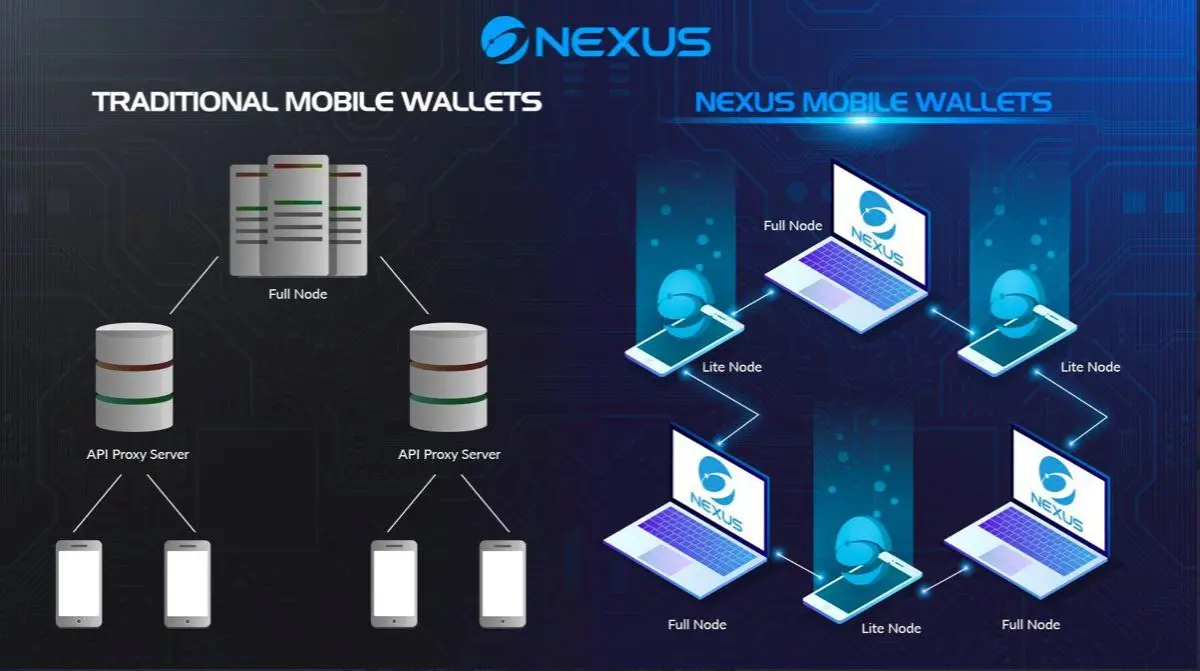
In summary, Nexus stands out from other cryptocurrency projects due to its range of unique features, and its all-encompassing approach makes it much more than just another blockchain platform.
The Nexus Community
The Nexus community is a diverse group of individuals from various backgrounds, all united in their pursuit of furthering the vision of a decentralized world. It's not just about the technology, it's also about the "human tech"- the way we come together, organize, and collaborate. Instead of emphasizing independence, the community celebrates interconnectivity in their social structure. This is reflected in the upcoming Social stack code, which will facilitate future development of the Nexus architecture and ecosystem.
Drawing inspiration from the book "The Starfish and the Spider," Nexus is exploring the concept of a Decentralized Autonomous Organization (DAO). Within the Nexus Embassy US, a 501(c)(4) non-profit organization, three branches operate: Legislative, Executive, and Judicial, each with specific responsibilities. Following the starfish model, each branch has five arms that specialize in their respective area, aiming to have all essential organs required for Nexus's existence.
The arms of an actual (biological) starfish constantly communicate to determine the best course of action: eating, fleeing, exploring. Similarly, the five arms of the Executive branch of the Nexus DAO are in constant communication to maximize resources and optimize efficiency. This structure encourages collaboration. However, if one branch feels restricted by the others, it has the option to detach and regrow four new arms to become a complete starfish once again. Likewise, if four arms would like to detach themselves from the fifth, they could do so and later regrow a new one. The "Linckia laevigata" starfish, found in the Indo-Pacific region, functions similarly.
Overall, the Nexus Starfish DAO is created with the dual purpose of fostering the overall growth of the organization while maintaining a truly decentralized structure.
The Nexus project owes much of its progress to its passionate community, many of whom are volunteers. These individuals have devoted countless hours to various aspects of the project, including code development, drafting a Constitution, Wiki, building a DAO, and raising awareness. Despite many having been with Nexus for many years, we do not necessarily identify as "de-gens" or "OGs." Rather, we are motivated by a belief in the technology, community, and the potential impact that Nexus could have on the world. As long-term hodlers, stakers, and miners, we remain committed to the project's vision and the positive changes it could bring about.
We in the Nexus community are passionate about the technology and the impact it can have on the world. NXS is currently available for purchase and trade on several exchanges, including Bittrex International, TradeOgre, and Coinstore, with plans for more global on-ramps and additional exchanges in the works. The community is also eagerly anticipating the launch of a decentralized exchange (DEX) being developed by Nexus, which is expected to be available soon.
Nexus in Numbers
Network Health:
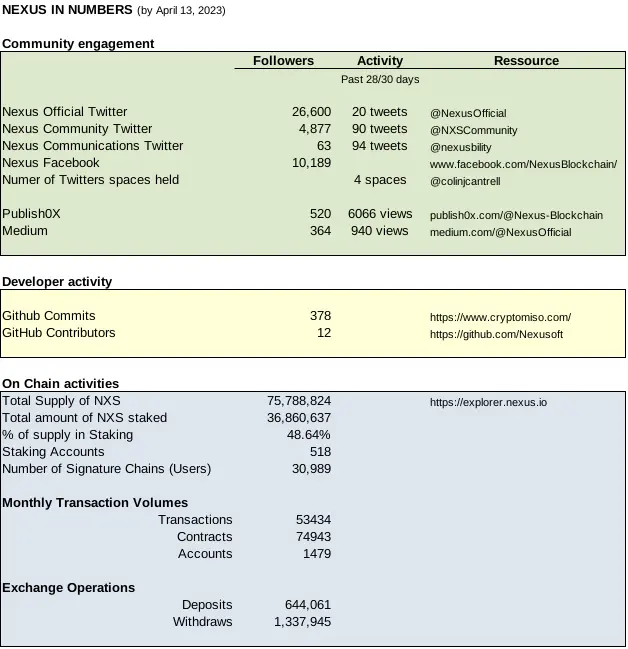
The health of the Nexus network can be measured by the number of active nodes. As of mid-April 2023, there are approximately 1,770 active nodes, with 472 operating 24/7, and numerous connection requests and addresses reeling. The average daily contract volume of around 2,500 contracts is indicative of robust daily usage of the network.
Over the past week, more than 572,000 Nexus coins have been withdrawn from exchanges, and in the previous month, an astounding 1.4 million coins have been taken off exchanges. This trend is favorable as it suggests that people are taking charge of their assets. Currently, only about 8% of all NXS is held on exchanges, with the majority held in individual wallets which reflects the trust and confidence that people have in the project.
Nexus employs a unique hybrid consensus mechanism that combines Proof of Work (PoW) and Proof of Stake (PoS) to enhance network security and prevent centralization. The network has a thriving and autonomous mining community, with approximately 518 accounts staking close to 50% of the entire supply of NXS. The stake volume is impressive, with around 87,000 Nexus being deposited into stake trust accounts and taken off the market daily, and about 200,000 deposited this month alone.
Staking with Nexus not only earns you passive income but also actively contributes to network security and decentralization. As you stake, you accumulate "trust" over time, currently standing at an impressive 9.7 billion seconds. This trust score reflects your long-term commitment to the network and unlocks future benefits and opportunities within the ecosystem. With Nexus, staking is a way to actively participate in building a more secure and decentralized future, rather than just earning rewards.
System Metrics:
The Nexus system has a robust set of metrics that highlight its strength and versatility. As of mid-April 2023, there are 218,000 total registers on the network, comprising 42 global names, 62,000 local names, 30 namespace names, and 15 namespaces. The network has 93,356 active accounts, with 128 on-chain assets, 52 tokenized assets, and 139 tokens. Additionally, there are 31,041 crypto object registers, 850 read-only state registers, and 30,995 sighashes. These numbers demonstrate the diversity and complexity of the Nexus ecosystem and the ability to create a wide range of decentralized applications on top of the network.
Developer activity:
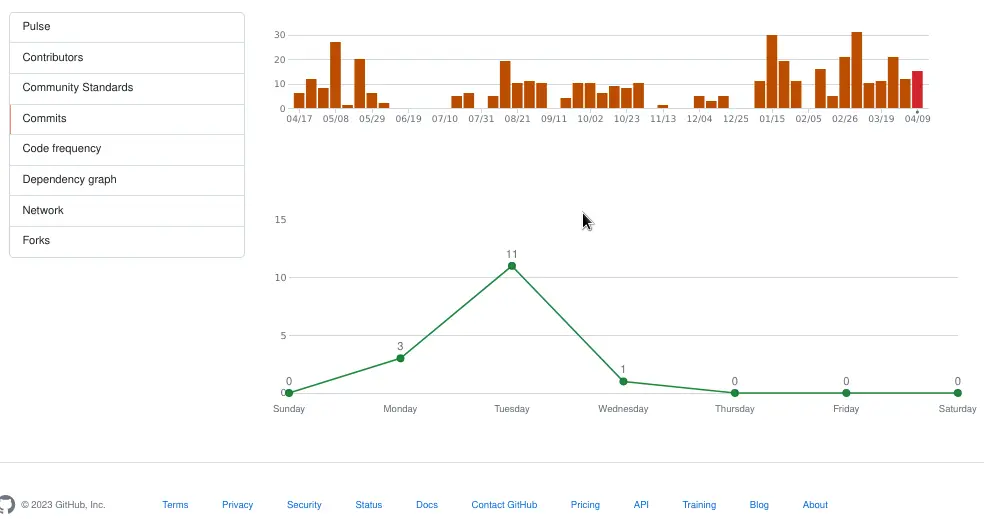
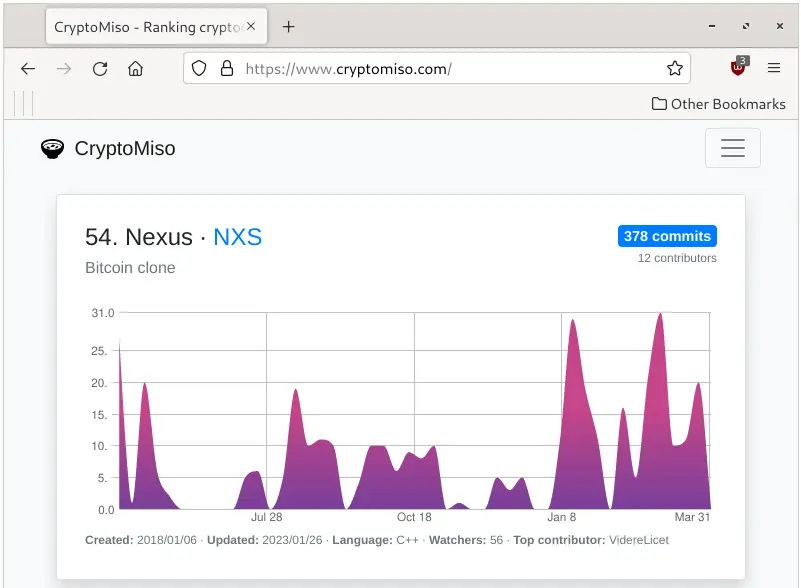
Developer activity is a crucial aspect of any successful blockchain project, and Nexus boasts an exceptional level of engagement in this area. Cryptomiso's data as of April 13, 2023, shows that Nexus ranks as the 54th most active project globally, with 378 commits and 12 dedicated contributors. The recent upgrade to Tritium++ 5.1 added an impressive 114k lines of code to the platform. It's worth noting that Nexus has a relatively low market cap, which often makes it go unnoticed by major players in the industry, making this level of developer activity all the more impressive.
In addition, several exciting projects are building on Nexus and eagerly awaiting upcoming platform upgrades, such as BEF.earth, an all-in-one solution for carbon markets, and Free and Equal, a cutting-edge Election Assistant App designed to promote transparency and empower voters. These projects show the diversity of use cases for the Nexus platform and highlight the innovative thinking of the developers involved
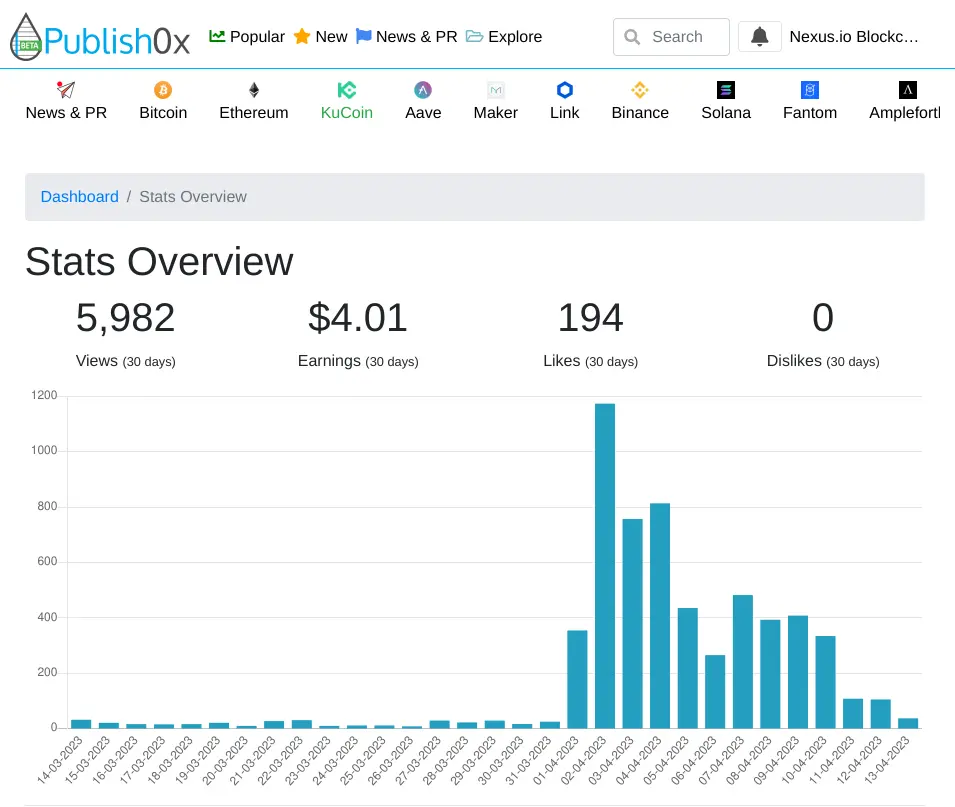
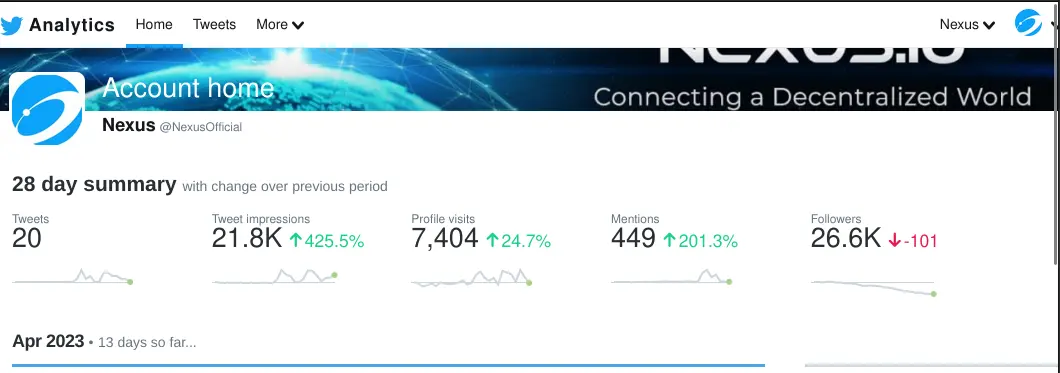
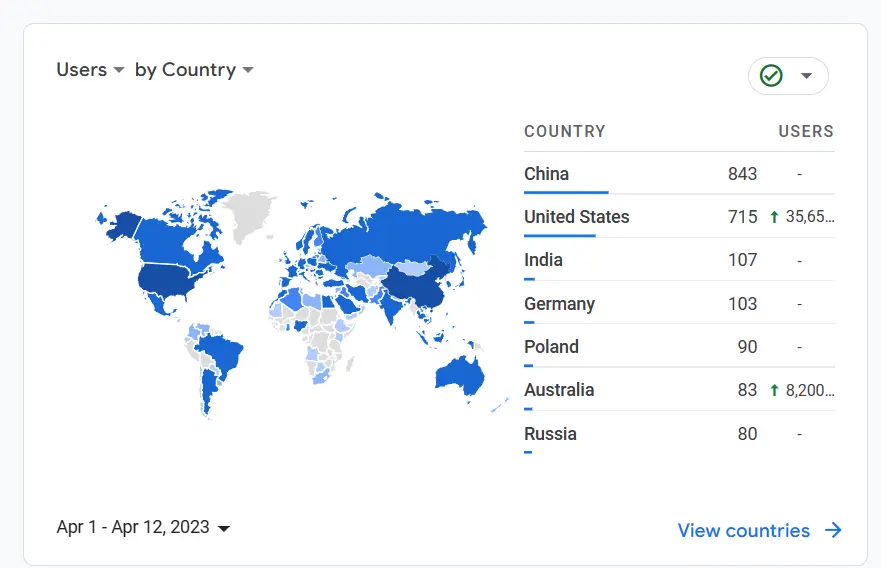
Below follows some additional and current statistics to show the developer, community, and on-chain activity of Nexus.
OTHER NUMBERS OF INTEREST
Commits on Github:
Cryptomiso ranking:
Nexus Publish0X Stats:
Nexus Twitter Stats:
Website visitors:
For more info about Nexus, visit: https://www.nexus.io






