
RedStone Finance - A Modular Oracle, For The Future
With it's unique set of features, adaptability and hindering of front-running RedStone will get integrated onto many dApps
RedStone Finance is a oracle just like the "The Graph", "Pyth" or "ChainLink", but not really. RedStone has clearly analyzed the needs of DeFi and how important oracles is for the proper function of any dApp who relies on information from outside the blockchain. ChainLink for example is one of biggest oracles (or was), sure it has worked quite okey. But ChainLink is to centralized and price oracles can be tampered with from the inside, even doh that possibility is small it's there.
With ResStone is that security risk smaller as there will be many "node provider" with will serve as "data feed providers", that aggregates "data" from several sources and provide a signed data package of the medium value or the aggregated data from the different sources, making sure to provide packages with the newest data from several sources, then the median value of those. Providing so close a correct price you can on a certain asset.
RedStone features other cool functions not provided by any other oracle as you also can decide how often the price should get updated, a parameter that's set by other oracles and not changeable. But to the most exciting part the "modular" part. RedStone is first of it's kind, this will both save money in the end for dApps themselves and end-users in the end, as these two goes quite hand-in-hand. The easiest way to provide information on-chain is just basically to put it into storage but storage is expensive.
For those who don't know so can smart-contract both contain temporary/arbitrary data needed for a specific operation and if it's no longer needed it's not stored in storage. You only store the necessary variables and data needed to be stored for later on the smart-contract, this to save GAS. As storing data in storage is much more expensive and on some chains the transaction fee's (GAS) is already high enough. So this is a tactic to save the protocol and end-users GAS expansives. But RedStone is providing another awesome solution, making smart-contract able to fetch real-time data directly from the data availability layer used, so as soon a smart-contract need some pricing on some token for a swap for example it can directly pick this up from DA-layer. This is what's makes it truly modular as it can fit into nearly any dApp, as long it has a DA-layer.
Rolling back a bit...to the Nodes witch anyone can run!
I will get into a topic I touched in the beginning, which is the "nodes" who provides the "data feeds", these can in the future be replaced by automated smart-contracts, but for now this solution is the way forward until that solution is battle-tested and ready for deployment. If you want can you run such a "node" yourself, it's an easy deployment thru Docker and it's hardware requirements is nearly zero compared to many other solutions with "nodes" were you need a 16 core machine with 68gb of ram and 4 TB SDD, joke a side but the hardware requirements from some and not just oracles, is like they did on purpose so only people with money can run those. Unfortunate do not RedStone take more "nodes" at the moment, but why soure could in the future a demand increases, so keep an eye open if you're interested in that.
But here do you simply need 1gb of ram, a reliable & stable internet connection and approximately 30gb free storage space. So you can can nearly run it on an old desktop with Windows 98. So let's put up that old notebook of your and run a node! Click here for the guide on how to deploy it. (As told they not take new data feed providers" or "nodes" now, but keep an eye open as told as they might in the future)
The nodes provide the signed data packages to Streamr Network, which is a own project built for "decentralized data broadcasting", or your node can also provide the data directly to the RedStone's open-source gateways. The data are later "pushed" on-chain by various dApps who needs it, dedicated relayer or end-users interacting with a dApp (smart-contract). So RedStone can both provide direct access to data thru their gateways or as a solution built upon Streamr Network, to further aggregate and decentralize the service.
Here below can you see an image describing the relationships and how the data flows thru the beginning of the nodes who pick data from sources provide it to RedStone who either use their own gateways or Streamr Network's gateways & also how the data is being stored if there is any data who needs to get stored and how it flows out to the dApp who needs it (smart-contracts). This action can be triggered automatically thru smart-contracts or other smart-contracts triggering other smart-contracts, manually (as RedStone leave a few parameters adjustable, and not static and already set by other oracles as default value not changable ) or by an end-user calling a smart-contract function. Look the image below, me explaining this, well... the image does it better.
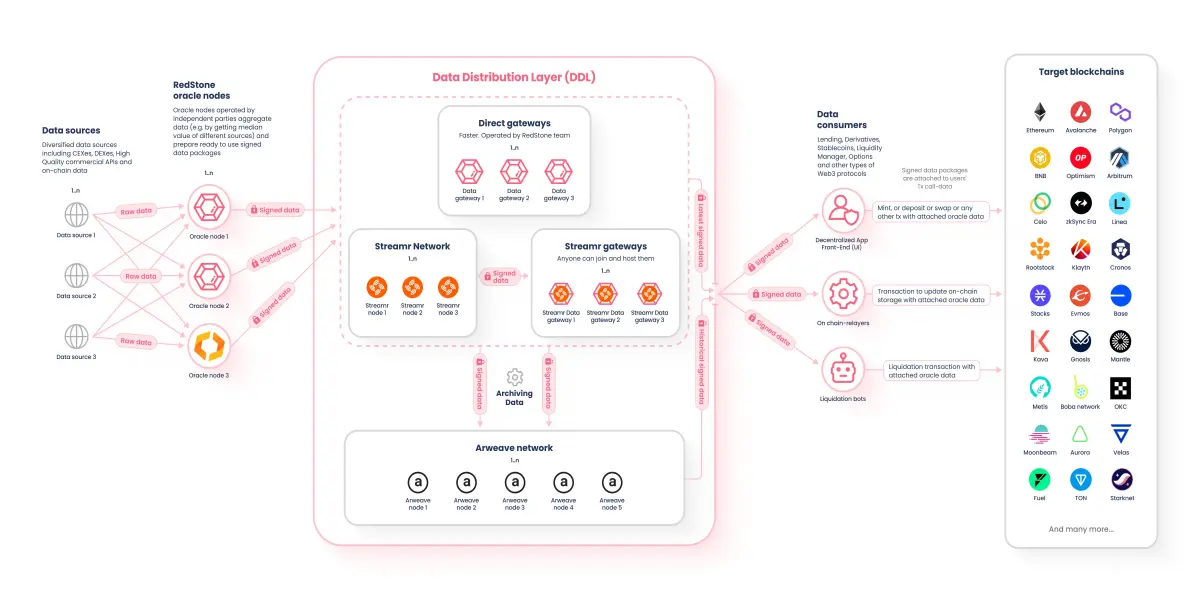
As you see, the modular-design make use of existing services too, for further decentralization & reliability of the oracle, thus preventing tampering of the oracle-price from a ingle-point of failure. This design approach is much better as far oracles goes, the modularity doesn't only support well the "modularity" but also indirectly the security of the network, making it much harder for hackers to tamper with oracle prices to their advantage. A modular design in most areas is and will probarly "next" within web3 as solutions will need it to be truly interoperable with each other.
The Data & Sources
So were is all this aggregated data coming from?, well from several sources. RedStone has of now 162 different sources it aggregates data (eg, prices of tokens, liquidity and such). This is sources like CoingGecko, CoinMarketCap, Coinbase, ByBit, KuCoin, Kraken, Gate, Uniswap, OKX, Curve, Velodrome, Pancakeswap just to mention a few sources both decentralized and centralized ones. For the full list of were aggregated data comes from check the list here.
As told before, the "nodes" aggregates that from several sources than take the median-value of them, this together with techniques like TWAP & LWAP to provide for example a price of a token more correctly and exactly. This is implemented with other safety measures to hinder outliers (if some source is providing a price of a token that's way off from what the other sources provide). The signed packages from the nodes get inside the RedStone unpacked and uses cryptography to verify it's correctness (timestamps, right format and origin it comes from), so several safety measures are provided to hinder any exploiting of oracles which we have seen in the past draining liquidity pools for example.
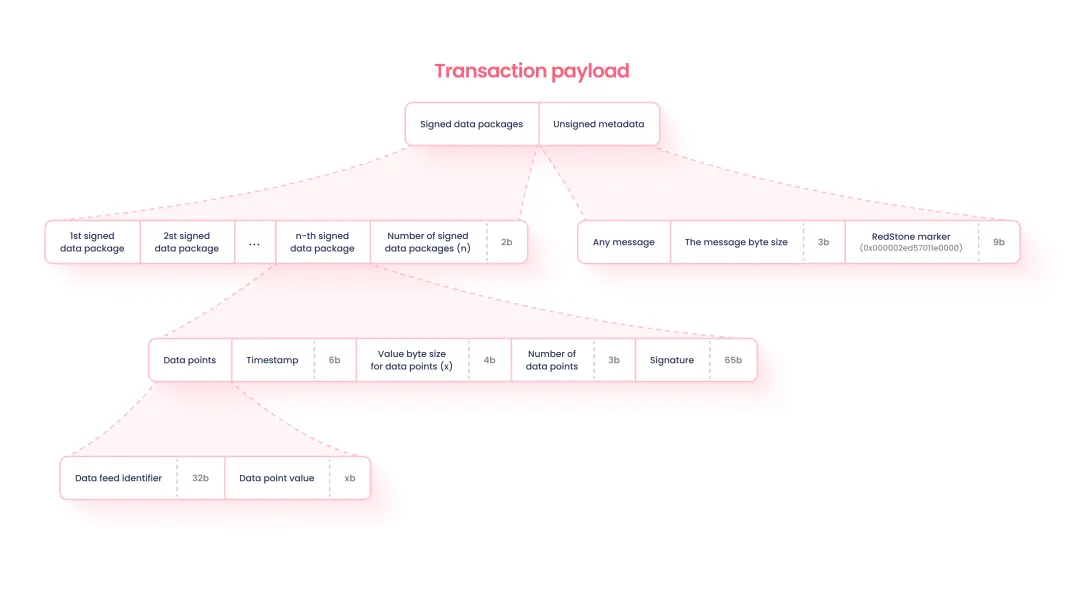
Oracles is one of the most important infrastructures in web3 and blockchain as a whole as outside data needs to be verified correctly and pushed into the blockchain and various protocols on it, so the security, decentralization, immutability and reliability of a oracle is critical for proper blockchain functionality that's in need of outside data. Below do you see the payload(data) from the nodes into RedStones layer were they control the data provided thru different measures some described above.
The Three Main Services;
As RedStone provides a modular Oracle, it also provides the user/chain/infrastructure/institutions/builders with more customization, those are;
- RedStone Classic (Push) --> Compatible with various classical oracles, here can the protocols/dApps also get full control over different update conditions & sources, providing tailored customization for the needs of that protocol/dApp.
- RedStone Core (Pull) --> On-demand service, using the lowest GAS-costs with that comes a few seconds of latency as the dApp-user provide the signed package to the destination(which is whatever blockchain and dApp, using RedStone)
- RedStone X (Zero-latency) --> This is specifically tailored for the needs of dApps with more complex nature like perpetual swaps, futures-trading & options. As they need reliable data fast with as low latency as possible with as high correctness as possible, this for proper function of it and make the trading more similar to ordinary CEX-trading. This have been a problem as a few seconds could be enough for a trader who is trading future with very high leverage thereby is the liquidation price very close to the opening-price of the trade. If this lacks to many seconds due to latency, a big trade could be ruined for the end-user.
Below can you see some of the blockchains that RedStone support, but they support even more if you expand the list of their website. But just to show you some. RedStone is available in many places with it's modularity cross-chain, on optimistic layer-2's and ZK-chains but even on blockchains using rollup-as-a-service.
 You have the full list here if you want to see it:
You can interact with the project in many ways, help out, have the latest news and chat in Discord with mods and this will maybe lead to a future airdrop from RedStone or other rewards who now?, and we have seen in the past that oracles when they airdrop retroactively that the sums can be really high, this is not just an extraordinarily project revolutionizing oracle forever and how they will work in the future, but you also have a chance to get a slice of that cake if it might happen in the future, in that you proparly would have been doing those Zealy quests RedStone has, chatting in Discord, making quests on Galxe and such. All will be linked below for you, regarding both the h RedStone as a project and all links to were you can do "missions" to learn and help spread the information about RedStone. This kind of interactions might just lead you to future rewards.
But understanding RedStone and what it will do is the most important, as the project is revolutionizing, the summary above describes the magic of RedStone and is broad spectrum of integration in various layers of the blockchain. RedStone is yet an uncut diamond, that will flourish greatly as time goes.
This was a little summary over RedStone Finance, as a Oracle and what happens under the hood, this oracle will pioneer oracles in a new direction so if I were you I would keep an close eye on RedStone and interact with it, and help out if you like it, remember this might give you future rewards and if not will RedStone be integrated into many many protocols, which can easily be a airdrop requirement for future projects, to have been interacting with RedStone.
Useful links to learn, interact and collect points within the project:
- Website click here
- Join their Discord for the latest news and campaigns, click here
- Do RedStone's Zealy quests for gathering Discord-roles, point and maybe (future rewards), click here
- Interact with RedStone at Galxe , click here *No active campaign now at publish, but keep an eye open might come one anytime
- Follow RedStone on Twitter (X), here
- Follow RedStone's own blog, here
- You find the code on their Github repository, here
Thank you for reading, hope you learned something new & liked it, have a great day!






