The considerable oeuvre of the 16th-century English composer John Sheppard hardly deserves its current obscurity, though it may pale in comparison with the sumptuous and timeless sacred music of his better-known older contemporary Thomas Tallis. Admitting that his polyphony falls frequently into formulae, one cannot deny his craftsmanship and idiosyncratic voice.
Imitative, typically richly ornamented vocal counterpoint characterizes his "Responds", such works always undergirded by the steady and familiar melodic contour of the Roman Catholic plainchant. Where the renowned Tallis aims for melodic austerity, Sheppard often weaves lines more ornate, even labyrinthine, but this is not to suggest that our composer refused simplicity entirely.
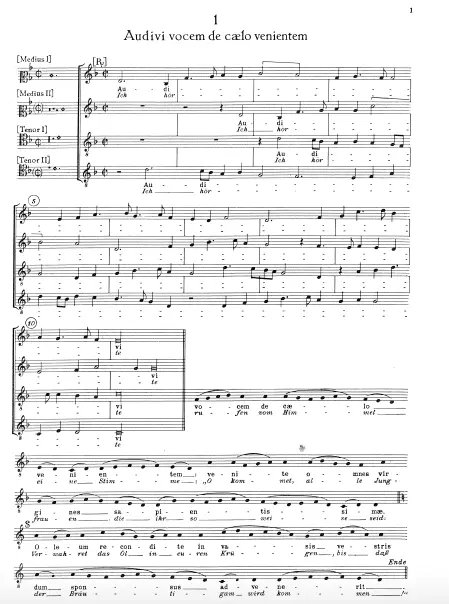
First page of the engraved score of "Audivi vocem de caelo venientem", first of John Sheppard's "Six Responds for Four and Six Voices"
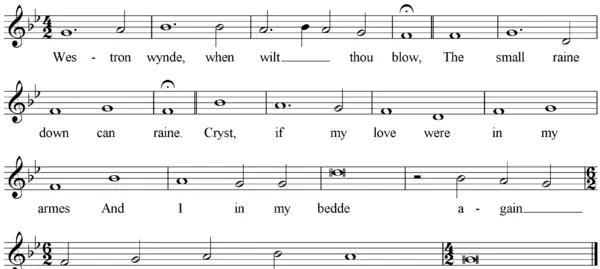
Indeed, greater constraint and concision, sometimes wrongly mistaken for an absence of skill or even taste, prevails in his Western Wynde Mass. This work constitutes one of many mass settings of its time employing the popular melody "Westron wynde when wyll thow blow" as a cantus firmus (i.e., an ever-recurring melody providing structural unity and coherence to the work as a whole). In an age where imitative counterpoint reigned supreme, where variation subordinated itself to the necessities of polyphonic procedures, prior to the rise of more complex musical scaffolds (e.g., ritornello, fantasy, sonata-allegro), one cannot overestimate the significance of the cantus firmus as a structural adhesive as well as an expressive and communicative mechanism.
Popular tune "Westron wynde when wyll thow blow", cantus firmus used in mass settings by Tye, Taverner, and Sheppard
A reduction in sequential passages, thus mitigating tendencies toward note-spinning that afflict this musical idiom, distinguishes this work from Sheppard's older contemporary John Taverner's own Western Wynde Mass setting. Likewise, triplet passages do not overstay their welcome, and their relative rarity in contrast to Taverner's setting might invest them with greater structural effect and thus more considerable expressive power.
Consequentially, Sheppard proves himself both worthy artisan and artist, satisfying ecclesiastical demands while tastefully exploiting the resources of musical expression then available to him. Our composer, on the eve of the early modern period, balances the ordered Apollonian severity of linear modal counterpoint and its myriad rules with a nascent interest in the expressive potential of harmonic development independent of contrapuntal procedures.
Where linear counterpoint ruled sovereign, harmony arose as an incident to the progress of autonomous melodic lines. But Sheppard, under the spell as it were of The Reformation's pursuit of transparent conveyance of textual meaning in sacred vocal music, paves the way for a vertical-harmonic conception of music without relinquishing his horizontal-contrapuntal conception. In this sense, though perhaps not a pivotal figure, Sheppard betrays himself as one prophetically anticipating developments well into the future.
Though a modalist, whose harmonic language typically floats in diatonic quasi-aimlessness, his is a harbinger of music to come, a flash of early modernity and of the "common-practice" game of tonal polarities we so cherish today (and that in spite of Modernist and Post-Modernist developments in the evolution of musical language that have long outstripped the predominance of major and minor, tonic and dominant, revolutions of musical grammar and syntax that could not have been foreseen by Sheppard).






