An Aequale for French Horn duet in the form of a two-part invention, an homage to the soberly "neoclassical" counterpoint of twentieth-century master composer Paul Hindemith.
The archaic (though now partly revived and appropriated) term "bicinium" (plural: "bicinia") denotes an instrumental or vocal work for two voices in counterpoint, and as a form experienced its ascendancy during the Renaissance and Baroque, undergoing decline with the prevalence of the far less polyphonic idiom of the Stil Galant during the late Baroque, which itself heralded the largely homophonic (rather than polyphonic) musical tendencies of the Classical Period. In a more academic sense, "bicinium" may specifically refer to an exercise in two-voice counterpoint, scored for two voices (vocal or instrumental), intending to sharpen the skills of the music composition pupil in the art and craft of combining independent melodic lines into a coherent and harmonious whole (the essence of the term "counterpoint" as used in music theory).
In relation to polyphonic music, we owe the term "invention" to Johann Sebastian Bach, for whom the name denoted an exploration of both imitative and non-imitative contrapuntal procedures freer than the storied forms and procedures of canon and fugue yet still constrained by those rules which regulate the motion of voices in relation to one another, the contours of their melodic lines, and the harmonies arising as a consequence of their interaction. In other words, the "invention" as a form mediates between the improvisational license of the fantasy and toccata, the contrapuntal exactitude of the fugue and canon and motet and chorale prelude, and the homophonic virtuoso melodicism of the ritornello (that progressive form heralding the later rise of the sonata-allegro during High Classicism).
The painting in the video is Vasily Kandinsky's "The Bride (A Russian Beauty in a Landscape)".
Here is the "conductor's score":


Below a perfunctory analysis on the "subject" that dominates this exercise in two-part counterpoint will proceed. For the sake of clarity, given the scoring of this duet for transposing instruments (in which notated pitch does not coincide with sounding pitch), pitch-naming will coincide with the page rather than with the pitch actually sounded by the performer.
The tempo of this work for two French Horns in F remains steady throughout until the coda, being a rapid though never aggressive molto allegro, in expression darkly humorous and slightly "Dionysian":

The first French Horn in F first states the subject in its entirety, a short-breathed theme in two phrases -- a rising and leaping antecedent, contrasted with a descending consequent in stepwise motion -- that dominates the entire piece, undergoing imitation and development and serving as the foundation for ancillary melodic material:
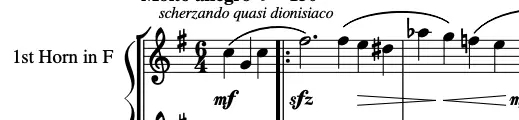
This predominant melodic sentence contains within it several distinguishing characteristics. The first four notes, forming the antecedent phrase and restricted to three pitches (G -- C -- F♯), traces the dissonant interval of a major seventh (inversion of that more dissonant interval the minor second) through a rising perfect fourth (G -- C) followed by a rising tritone (C -- F♯; augmented fourth in this instance), and if understood as an arpeggiated chord may function as a "Lydian Tonic" chord, a second inversion C "Lydian Tonic" to be precise, the F♯ essential to the function and color of the implied harmony rather than a ♯4 or ♯11 suspension yearning for resolution to the "major" third of the more conventional C Major triad:
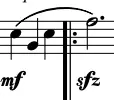
Regarding dynamics, the first note of the first phrase of this melody, the "Lydian Tonic" pitch of C, is moderately loud, played mezzoforte:

By contrast, the fourth and last note of this antecedent phrase, the F♯, incidentally also the highest and longest-held pitch of this phrase and therefore its peak (its note of greatest intensity), must emerge sforzando, meaning that it sounds more emphatically than the prior three notes in the melodic sequence:

The consequent phrase, which closes the statement of the primary theme (or "subject"), constitutes a sequence in that it consists of two essentially identical falling sub-phrases, the second starting a major fourth above the first, thus the second as loosely (not strictly) identical to the first not in pitch identity but rather in its pattern of alternating half and whole-steps (suggesting, perhaps, the symmetrical octatonic [eight-note alternating half-step and whole-step] scales):
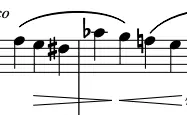
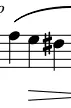
This sub-phrase suggests, perhaps, that variety of the Lydian mode featuring not just a ♯4 but also a ♯2 (a scale of exotic connotations thanks to the augmented second resulting between the scalar degrees 1 [i.e., C] and ♯2 [i.e., D♯]. From another vantage point, this passage comprised of a descending major second followed by a descending minor second may suggest a symmetrical octatonic (or diminished) scale, a scale that in essence consists of two overlapping diminished seventh chords [i.e., a C diminished seventh chord and D♭ diminished seventh chord]:
Likewise, the succeeding sub-phrase, transposed as stated previously up a perfect fourth (inversion of a perfect fifth, which besides the unison and octave the most fundamental interval in the harmonic [or overtone] series, therefore a most consonant and stable interval indispensable to the triad as the foundation of common-practice period tonality). The pitch succession A♭ -- G -- F -- E, a transposition of the immediately preceding F♯ -- E -- D♯ pitch series, but nonetheless a transposition in which the falling interval of a minor second antecedes the falling interval of a major second, may instantiate a modulation to F minor, the minor subdominant of C major and flattened minor subtonic of G major (the dominant of C major and therefore fifth mode of C Lydian). However, the direct relation of F minor to C Lydian appears more distant simply because the Lydian mode sharpens the subdominant degree (i.e., F♯), while the subdominant of C major is F and F♯ does not naturally occur within this scale. Note that this pitch series, tying up the consequent phrase and leading to the second French Horn in F's entrace, resolves to E, the third pitch (mediant) of both the C major and C Lydian scales as well as the sixth pitch (submediant) of G major (and, incidentally, of G Lydian as well). This pitch series may again derive from a symmetrical octatonic (or diminished) scale, namely the C♯ alternating half-step whole-step octatonic (or diminished) scale, containing within its eight pitch order the two overlapping diminished seventh chords of C♯ ( C♯ -- E -- G-- B♭) and D (D -- F-- A♭ -- B):
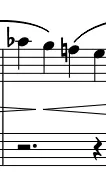
The leap of a perfect fourth (inversion of a perfect fifth) links these two sub-phrases (though enharmonically the composer spells the leap as a doubly diminished fifth). The stable consonance of this interval, in its "flipped" form foundational to the harmonic (or overtone) series that undergirds all music (particularly that of our twelve-tone equal temperament system), acts precisely as a stabilizing agent within this musical discourse of tonal ambiguity and strongly implied "inner dissonance". The presence of perfect fifths and fourths within a melody, particularly within a bass line but nevertheless within any melodic statement, may lend tonal clarity to even the most chromatically saturated melodic idea:
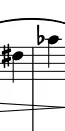
Regarding dynamics, this consequent phrase "swells" in volume, in accordance with the hairpin dynamics markings, yet returns to the original mezzoforte with the "re-entry" of the first French Horn in F stating the same subject in its own right transposed up a major third. This major-third-transposed statement of the fundamental thematic material would be highly unusual in a fugue, less rare in a canon, and it is rare that a composer assigns the answer to that same opening voice, with the secondary voice simultaneously introduced through secondary though nonetheless derivative material. Typically, a fugue's exposition (or first exposition, to be more accurate) of thematic material will constrain subsequently-entering voices to restating the primary theme on the dominant (fifth) or (more rarely) subdominant (fourth) degrees of the scale, again in deference to the stability of those intervals in the harmonic (or overtone) series and the source of the conception of the dominant and subdominant degrees as most closely related to the tonic degree in common-practice tonality upon which the tension and resolution of a large-scale tonal form depends:

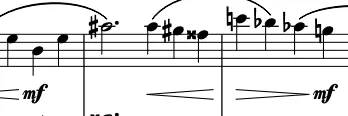
As noted above, the second French Horn in F makes its entry not with a transposed statement of the primary theme but, alongside the first French Horn in F's own transposed restatement, this second Horn introduces itself with a new theme nonetheless inextricably connected with the old:

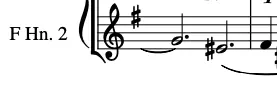
As in the antecedent phrase of the primary theme, an ascending perfect fourth leads to an ascending tritone (diminished fifth or augmented fourth), tracing out an ascending major seventh. (In counterpoint the two Horns initially meld into mellifluous minor thirds.) However, a descending augmented fifth (minor sixth) modifies this otherwise identical melodic statement, closing out the contrasting yet derivative secondary subject's antecedent phrase:
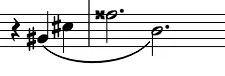

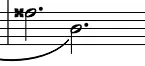
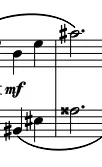
Observe that this secondary derivative subject begins at a diminished fourth (major third) distance from the opening pitch of the first statement of the primary subject. This echoes, if you will permit the term, the falling augmented fifth (minor sixth) that closes the antecedent phrase of the secondary derivative subject, as the one interval is the inversion of the other:
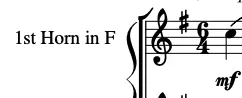

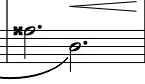
Both correspondences with, and deviations from, the primary subject's consequent phrase characterize the consequent phrase of this secondary derivative subject. Though the consequent phrase begins with alternating descending whole- and half-steps (implying either the symmetrical octatonic alternating half-step whole-step scale on G or [enharmonically] the Lydian ♯2 scale on E, or perhaps even the F minor scale of the second sub-phrase of the consequent phrase of the primary theme), this pitch series does not recur sequentially, a significant departure from the primary subject's design and contour. Instead, transparently mirroring the end of the antecedent phrase of this secondary derivative subject, this consequent phrase ends with a descending major second (enharmoncally spelled as a diminished third) resolving and in a sense "modulating" to F♯ as the first pitch of the second French Horn in F's first statement of the full primary subject:
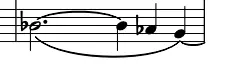
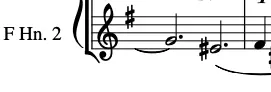
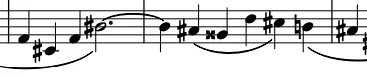
Again, compare the end of the antecedent phrase of this secondary derivative subject with the end of this subject's consequent phrase. Both endure enharmonic spellings on the page in somewhat atypical ways (still corresponding with the logic of the contrapuntal space) but nonetheless constitute fairly commonplace intervals, and though the intervals of a minor sixth and a major second are fairly distantly related, the ear still perceives them as thematically related pursuant to the principle that melodic contours remain recognizable even where the intervals widen or shrink in subsequent statements:
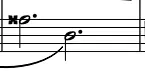
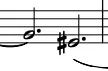
It is only in measure 6 that the composer finally privileges the second French Horn in F with a full statement of the primary subject, the second Horn's appearance in the polyphonic discourse already established by this point. In common with the first Horn's first statement of the primary subject, the augmented fourth (diminished fifth; tritone) relationship of C and F♯ returns, albeit in a different guise:
The antecedent phrase of this "answer" (as theorists term a later-entering voice's statement of the primary subject in a work of imitative counterpoint), starts on F♯, while the antecedent phrase of the melodic statement that begins this work starts on C. To reiterate, this is the interval of an augmented fourth (diminished fifth; tritone), at once the most distant interval in the harmonic (or overtone) series that undergirds common practice tonality in the twelve pitch equal temperament system and yet also constituting a series of pitches present in both the F♯ and C Lydian modes and determinative of the tonal quality of both scales. (Note that a microtonal approximate of the tritone interval does occur in the harmonic series, while strictly speaking the perfect fourth does not occur [only its inversion, the perfect fifth]). C constitutes the first (and third) note and pitch of the antecedent of the First Horn's initial statement, while it constitutes the fourth note and third pitch of the Second Horn's answer's antecedent phrase. Similarly, F♯ is the fourth note and third pitch of the antecedent of the First Horn's initial statement, while it constitutes the first (and third) note and pitch of the Second Horn's answer's antecedent phrase. Hence an ineluctable inner symmetry and correspondence reveals itself, providing a sort of "genetic" coherence beyond the immediately apparent correspondences of motivic contour and design -- albeit these internal connections exist on a plane perhaps only subconsciously recognizable, if at all, by the listener without visual aid:
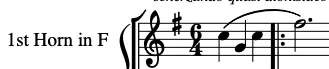
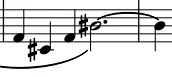


I hope that this analysis has whetted your appetites for more structural-motivic analysis, or at the very least has not alienated (let alone confounded) you entirely; expect a continuation of these inchoate investigations into the underlying structures of my own work in a Part II ...
If you enjoyed this, please consider becoming a patron at https://www.patreon.com/philipdaniel or https://www.subscribestar.com/philip-daniel






