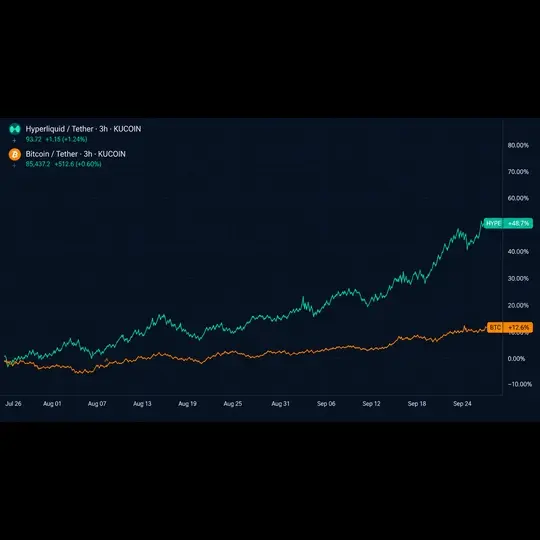
HYPE, the token behind Hyperliquid, just hit a record near $98. I opened the Hyperliquid board first this week, not the Bitcoin one. That is usually a tell. When a younger name is making more noise than the benchmark, I want the revenue before I trust the print.
Gross protocol revenue has fallen sharply from its Q3 2025 peak, from about $357 million to about $202 million in Q2 2026 — roughly 43 percent lower — while volume and open interest kept making highs. It has bounced from its August low, with about $60.6 million in protocol revenue over the past 30 days by DefiLlama's count, though trackers define revenue differently, so I wouldn't compare that number directly with the quarterly figures above. Since late 2025, outside teams can list their own markets on Hyperliquid and keep as much as half the fees. Activity is bigger, but the gross revenue the protocol captures each quarter has fallen from its 2025 peak. Meanwhile the price has nearly doubled since last August. A lot of the good news is already in the token. And because so much of the story still depends on trading, a quiet market would cut one of the main supports.
That is the part most victory laps skip.
Bitcoin still trades about a third under its record near $126,000. HYPE does not. On September 21 it cleared $95.17. Two days later it printed a high near $98. It's been sitting in the mid-$90s since, roughly 20 percent higher than it was a week earlier.
Hyperliquid runs on its own chain and lives on perpetual futures — contracts that let you take a view on price without holding the underlying. The token is worth roughly $21 to $24 billion, depending on who counts the supply. Year to date it's up more than 250 percent, the strongest run among the ten largest cryptocurrencies. That's unusual in a year when most large caps have been messy.
The latest push is easier to date than most rallies.
Borrowing went live on September 18. Collateral is HYPE or Bitcoin. You draw USDC or USDT. The first day saw $269 million borrowed. You can borrow up to 65 percent of what your HYPE is worth. Liquidation starts at 82.5 percent. Useful if you want cash without selling. Ugly if the token drops fast enough to trigger forced sales.
On September 17 the SEC issued a five-year conditional exemption so qualifying tokenized-securities venues would not automatically be treated as exchanges. Two days earlier, on September 15, the Senate had failed to advance the CLARITY Act, 49 to 50. Congress hit pause. The SEC hit play 😅 Names tied to on-chain trading and tokenization ripped higher that week. Some moved as much as 50 percent. I didn't have that sequence on my calendar.
Demand showed up in size as well. A listed firm, Hyperliquid Strategies, reports buying about 16.5 million HYPE for roughly $773 million, at an average price near $47, with a treasury of about 29.3 million tokens. Separately, one analyst's on-chain estimate puts its buying at about 4.28 million HYPE, around $385 million, in just the last three weeks. That second number is an estimate, not an audited figure, so I'd treat it as a rough guide. What isn't in doubt is the direction: a listed treasury company has been buying, and it raised its stock-sale program to $2.5 billion, which gives it room to keep buying. That $2.5 billion is capacity, not cash already sitting in the treasury.
A product people use, a regulatory opening, and a big treasury buyer. That is what is underneath the bid.
The competitive map is getting crowded too. Robinhood and Coinbase both want perpetuals. Coinbase already sells a regulated version to U.S. customers. Hyperliquid's main interface still shuts Americans out, so those firms get first crack at that flow. Payward, the parent of Kraken, has a plan to wrap Hyperliquid-based perps for U.S. accounts. Approval isn't in hand. A former SEC lawyer has put the wait at 10 to 12 months.
I don't know whether fees catch up to the price from here. I don't know whether HYPE can keep making new highs either.
What I do know is what I'm watching now: fees first, open interest second, price third.
Because a token can make new highs long before the underlying business proves those highs deserve to stay.
When a coin keeps printing records, what do you check first — the price, the product, or the revenue?