Since ancient times, trust has been something that only a few were able to earn. Oracles, priests, judges, kings and other authorities were given the responsibility of interpreting reality according to their will!
They were making decisions and settling disputes when there was no obvious answer. Society has always needed someone to decide what happens when two sides disagree. Modern technology has changed much of that.
Smart contracts pushed things further by enabling trustless computation, where predefined rules could execute automatically without requiring someone to oversee every transaction.
Blockchain introduced trustless money, allowing people to transfer value without relying on a central authority but the emerging agentic economy introduces a completely different problem! Who decides when reality itself is ambiguous?
AI agents are increasingly capable of negotiating deals, signing contracts, interacting with protocols, moving capital and making decisions on behalf of users. As these systems become more autonomous, disagreements are inevitable.
An agent might interpret information differently from another agent, a real-world event might be unclear, or the terms of a transaction might require judgment rather than simply executing predefined code.
That creates a major weakness and a crack in the trust layer of the industry! If the final decision is left to a single company, validator or AI model, we simply replace one trusted intermediary with another.
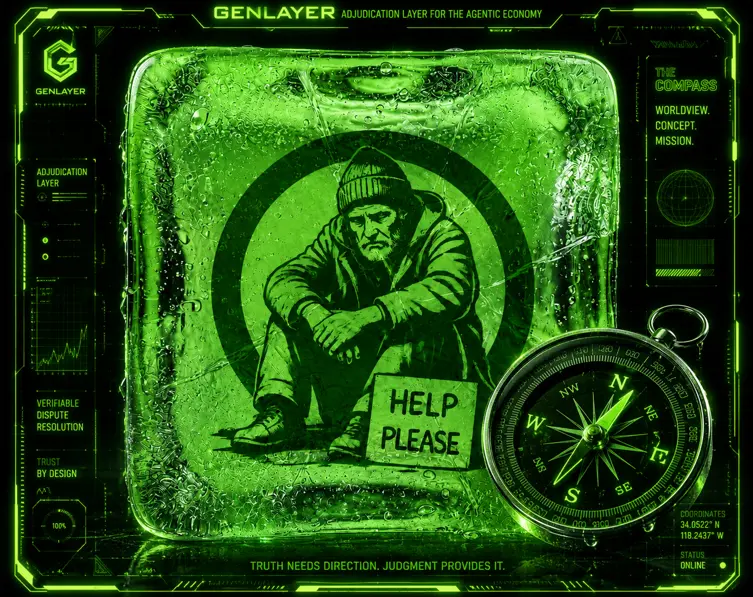
The system may be decentralized in appearance, but the point of judgment becomes a centralized point of failure. This is why I find The Compass particularly interesting, and how it changes the status quo!
GenLayer is working toward what can be described as a trustless adjudication layer for the autonomous economy, addressing the part of the stack that existing infrastructure doesn't fully solve!
Resolving disputes when deterministic computation isn't enough. Agents need a mechanism for dealing with ambiguity, disagreement and subjective real-world information without simply asking one centralized authority to make the final call.
The Compass lays out the broader vision behind this approach: building infrastructure where agents can interact economically while having access to decentralized mechanisms for determining what should happen when things go wrong.
To me, this is one of the more important pieces of the agent economy puzzle. We already have increasingly capable AI agents, programmable money and decentralized infrastructure. The next question is what happens when those agents disagree.
The idea matters because autonomous commerce cannot operate purely on instructions and code. That is where trustless adjudication could become critical. The agentic economy isn't just going to need agents that can act.
It will need systems that can judge between them when reality gets messy... and that could be the gap The Compass is trying to fill. It may be the missing piece of the puzzle, or just a decent try to change things!

Cool stuff I want to share:
Claim your Zerion XP!
Play2Earn: Splinterlands & Holozing
PVM The Author - My Amazon Books