
From accounts, phone numbers, and email addresses to government-issued identity documents, the digital world has always used different ways to prove “who you are.”
But as Web3, RWA, DeFi, digital assets, and global digital services continue to develop, one question is becoming increasingly important: If identity is becoming more important, who should actually control it?
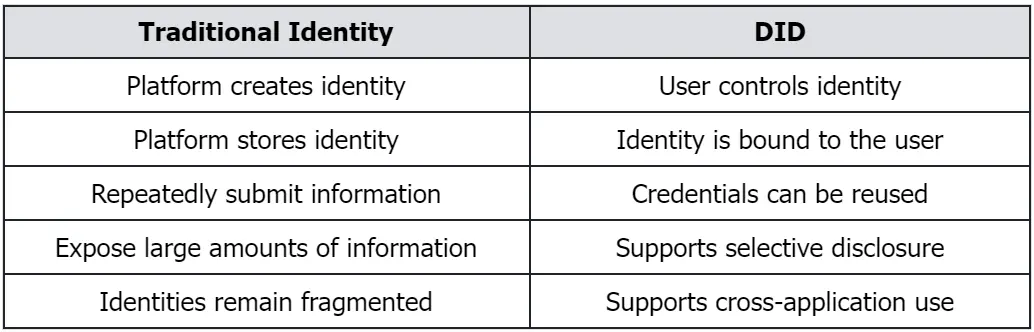
Traditional identity systems typically rely on centralized institutions such as platforms, companies, or governments to create, store, and verify identities. Users can use their identities, but they do not necessarily truly own or control their identity data.
Decentralized Identity (Decentralized Identifier, DID) seeks to change this model by shifting identity from “managed by institutions” to “controlled by users.” At the same time, technologies such as Verifiable Credentials and cryptography make it possible to verify identity without exposing complete personal information every time.
So, what problems do traditional identity systems face? How does DID address them? And how does ME ID build the next generation of digital identity?
I. Why Do We Need Decentralized Identity?
Traditional internet identity systems primarily solve one problem: allowing platforms to know “who you are” and giving you access to their services.
This has given us email accounts, phone numbers, social accounts, bank accounts, and other identity systems. But these solutions also share a common problem:
Identity often belongs to a platform’s management system rather than being a digital asset truly controlled by the user.
1. Identities Are Fragmented
Users have different accounts across different platforms. Even if a user has completed KYC on Platform A, they usually need to submit their information and complete identity verification again when using Platform B.
Identity therefore becomes an “island” between different platforms.
2. Users Have Limited Control Over Their Identity Data
In traditional identity systems, platforms or institutions are responsible for storing, verifying, and managing user information.
This limits users’ control over their identity data, while the centralized storage of large amounts of personal information also increases the risk of data breaches.
3. Identity Verification Often Exposes Too Much Information
Many applications only need to verify one piece of information but require users to submit complete personal data. For example, an application may only need to know: “Is the user at least 18 years old?”
Traditional KYC, however, may require a complete identity document. Digital identity therefore needs to solve an important challenge: How can you prove something without exposing information that is not necessary?
4. Web3 Also Needs to Address Sybil Attacks
In Web3, one wallet address does not necessarily represent one real person. Users can create large numbers of wallets to participate in airdrops, voting, and incentive programs.
Web3 therefore needs to answer another question: Is there actually a real and unique person behind this wallet?
This is the problem that Proof of Personhood (PoP) aims to address.
Therefore, the next generation of digital identity needs to answer several questions at once:
Who owns the identity? How can it be verified? How can a real person be proven? How can privacy be protected? How can the identity be used across different applications?
II. How Does DID Solve the Identity Problem?
DID, or Decentralized Identifier, is a new type of identity identifier designed for creating and managing digital identities.
Its biggest difference from traditional accounts is simple: Instead of allowing platforms to own your identity, DID puts control of the identity back in the hands of the user.
1. DID: Establishing an Identity
DID can be understood as a decentralized identity entry point in the digital world. It does not need to directly contain sensitive information such as a name or national ID number. Instead, structures such as a DID Document record information related to identity control and verification.
A DID can represent:
- Individuals;
- Organizations;
- Devices;
- Digital assets;
- Other verifiable entities.
2. VC: Making Identity Verifiable
Having a DID does not prove “who you are.” Therefore, DID is typically combined with Verifiable Credential (VC).
For example, a user may have credentials showing:
- KYC has been completed;
- The user is over 18;
- Membership in a particular organization;
- A professional qualification;
- Ownership of a certain type of asset.
Users can choose which proof to provide based on different scenarios. Identity is therefore no longer simply an account, but a composable and verifiable identity credential system.
3. Holder, Issuer, and Verifier
A DID system typically includes three core roles:
- Holder: The user who owns the DID and identity credentials and decides whether and to whom they are presented.
- Issuer: An institution or service provider responsible for verifying identity information and issuing credentials to users.
- Verifier: An application that needs to verify a user’s identity or a specific identity attribute.
The basic process is: User → Requests a credential from the Issuer → Receives a VC → Provides proof to the Verifier → Verifier verifies it.
This allows users to avoid handing over their complete identity data to every application. Instead, they can selectively provide the proof required for a specific scenario.
4. DID Changes Who Controls Identity
But DID still needs to address another question: How can DID, PoP, KYC, privacy protection, and blockchain be truly integrated?
This is exactly the direction ME ID seeks to explore.
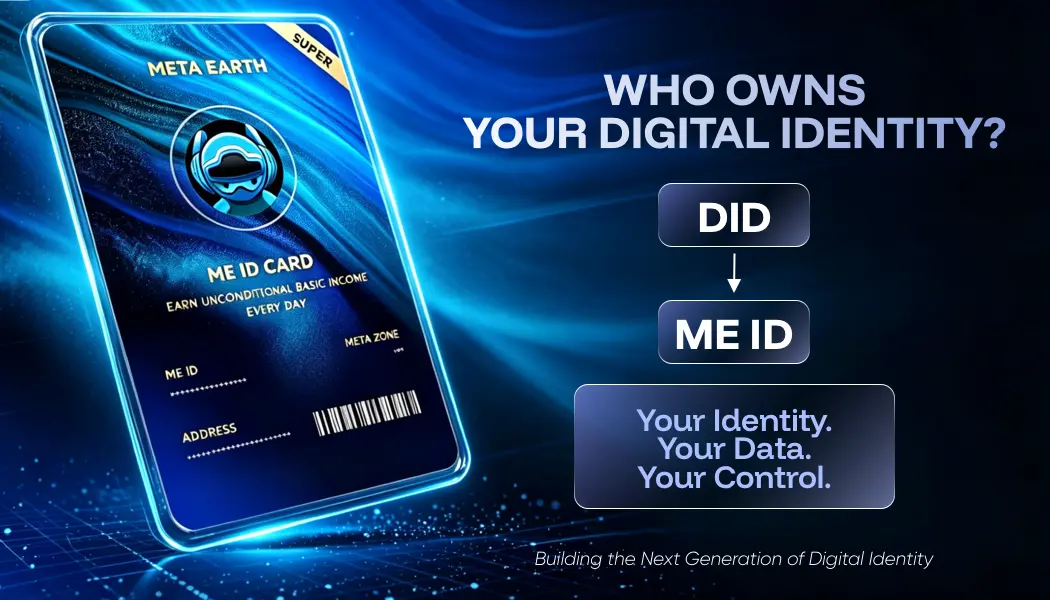
III. How Is ME ID Building the Next Generation of Digital Identity?
ME Network does not simply replicate the traditional DID model. Instead, based on the practical needs of Web3, it combines DID + PoP + KYC + privacy protection + blockchain to build the Meta Earth DID Protocol (ME ID Protocol).
Among them, ME ID is the first application built on the ME ID Protocol. Its goal is not to create a single identity verification tool, but a universal identity infrastructure connecting “the real world → digital identity → Web3 → on-chain applications.”
1. DID: Giving Users Ownership of Their Identity
The core goal of ME ID is to give users their own digital identities and control how their identity data is used.
Users can decide:
- Which identity credentials to accept;
- Who to present their identity to;
- Which credentials to present;
- Which information can be verified.
Identity is therefore no longer simply a record in a platform database, but a digital identity that users can manage and use over the long term.
2. PoP: Proving “This Is a Real Person”
ME ID is not only concerned with “what the identity is,” but also with a more fundamental question: Is there a real and unique person behind this identity?
Therefore, PoP is an important component of ME ID.
After completing the relevant verification, users can receive a public SBT bound to their wallet address. It can prove that the address has completed the required verification and serve as public proof of a unique human identity. Because the SBT does not need to reveal specific sensitive identity information, it can verify identity eligibility while reducing privacy exposure.
3. VC + ZK: Proving Information Without Exposing It
For identity information such as age, qualifications, and compliance status, ME ID uses VC for management. At the same time, privacy technologies such as Zero-Knowledge Proofs allow users, in certain scenarios, to prove a specific claim without revealing their complete information.
For example: Prove that “the user is at least 18 years old”
Instead of: Revealing the user’s complete date of birth
This moves identity verification from “submit all information” toward minimal information disclosure.
4. Blockchain: Establishing Trusted Identity Status
ME ID Protocol uses the blockchain infrastructure of ME Network to record identity- and credential-related states, including:
- Issuer / Holder registration information recorded on-chain;
- VC Hash roots recorded on-chain;
- VC / SBT status recorded on-chain;
- SBT issuance recorded on-chain;
- ME DAO governance.
The core idea is not to put all personal data on-chain. Instead: Publicly verifiable states are recorded on-chain, while sensitive identity data remains with users and compliant identity service providers.
5. The Core Advantages of ME ID
Overall, ME ID aims to establish five key capabilities:
- Personal Sovereignty: Users own and control their digital identities.
- Trusted Personhood: PoP and KYC establish a foundation for real and unique identities.
- Privacy Protection: VC and Zero-Knowledge Proofs enable granular information disclosure.
- Cross-Application Use: Identities and credentials can serve different DApps, Rollups, and Web3 applications.
- Connecting the Real World: KYC, AML, and other capabilities support RWA, compliant finance, and other real-world applications.
Therefore, ME ID is not simply solving the question: “How do you create a Web3 account?”
It is addressing a much bigger question: “How can a real person own a digital identity that can move across different applications, scenarios, and the real world?”
Conclusion | From “Proving Who You Are” to “Controlling Your Identity”
The development of digital identity is, at its core, a process of changing who controls identity. Traditional identity systems solved the problem of “how to identify users,” while DID takes the next step by asking: Who should control the identity?
When DID is combined with VC, PoP, KYC, Zero-Knowledge Proofs, and blockchain, digital identity evolves from a simple “account” into infrastructure connecting individuals, applications, and the real world.
ME ID is built around this direction: DID establishes identity, PoP verifies personhood, KYC establishes trusted connections with the real world, VC manages identity credentials, privacy technologies protect data, and ME Network provides the underlying infrastructure.
The digital identity of the future should not simply be about “proving who you are.” More importantly: Your identity belongs to you. Your data is controlled by you. Your credentials are chosen by you. And your identity can move with you across different digital worlds.
This is the direction ME ID seeks to explore — making personal sovereign identity the infrastructure connecting the real world with Web3.
Follow Meta Earth on the channels below for daily updates!
Website | X | Telegram | Discord | Instagram | YouTube | TikTok | LinkedIn





