
A practical guide to spotting candidates, reading wallet signals, and separating an interesting alert from an expensive distraction.
A fresh ticker appears in a Telegram feed. Three accounts mention it. The chart starts moving. Suddenly, doing five minutes of research feels like being five minutes late.
That pressure is exactly why an early discovery process needs rules. A monitor can help you notice a token sooner. It cannot tell you whether the attention is independent, whether the liquidity supports an exit, or whether the token gives its creator dangerous permissions.
1. Define what “early” actually means
Early can mean recently launched, still relatively unnoticed, or close to the price at which a particular wallet entered. Those are different conditions.
A token may be ten minutes old and already have made its largest price move. Another may be several days old and only now attract wider interest. Token age alone does not establish an attractive entry.
For each candidate, record the chain, exact contract or mint address, alert time, current valuation, liquidity, and the caller’s entry. Keep market capitalization and fully diluted valuation separate: they can represent different supply assumptions. Compare equivalent metrics from the same source.
2. Use discovery tools for different jobs
Different feeds answer different questions. A new-pair feed helps discover launches. A wallet monitor helps identify transactions. A social callout feed shows what people are publicly discussing. A filtered feed narrows the volume of material you need to inspect.
The CrossMeme guide that inspired this article describes Onchain Circle’s Latest Callouts, Hot Callouts, Recommended Callouts, and Hot Coins feeds. Its distinction between a broad stream, trending attention, filtered selections, and multiple callers is useful for organizing research.
Those product descriptions come from CrossMeme; this article does not independently verify the monitors’ speed, scoring quality, or results. A filtered alert is still a selection made by somebody else’s rules.
3. Read the wallet’s actions alongside the headline
“Several traders bought” sounds convincing until you ask whether those traders are connected. Multiple addresses are not necessarily multiple independent opinions. Shared funding, similar timing, and repeated interactions deserve further investigation, although none alone proves common ownership.

Focus on four questions:
- When did the caller enter? A public alert may arrive well after their purchase.
- What remains in the position? A displayed holding should be checked against recent transactions where possible.
- How meaningful was the purchase? Dollar size alone does not establish conviction without context about that wallet.
- What happened after previous calls? Review losses and quiet failures as well as highlighted winners.
Unrealized profit is especially easy to overread. A position valued at the latest quoted price may not be sellable for that amount in a shallow pool. A screenshot of a gain is not evidence of an equivalent realized return.
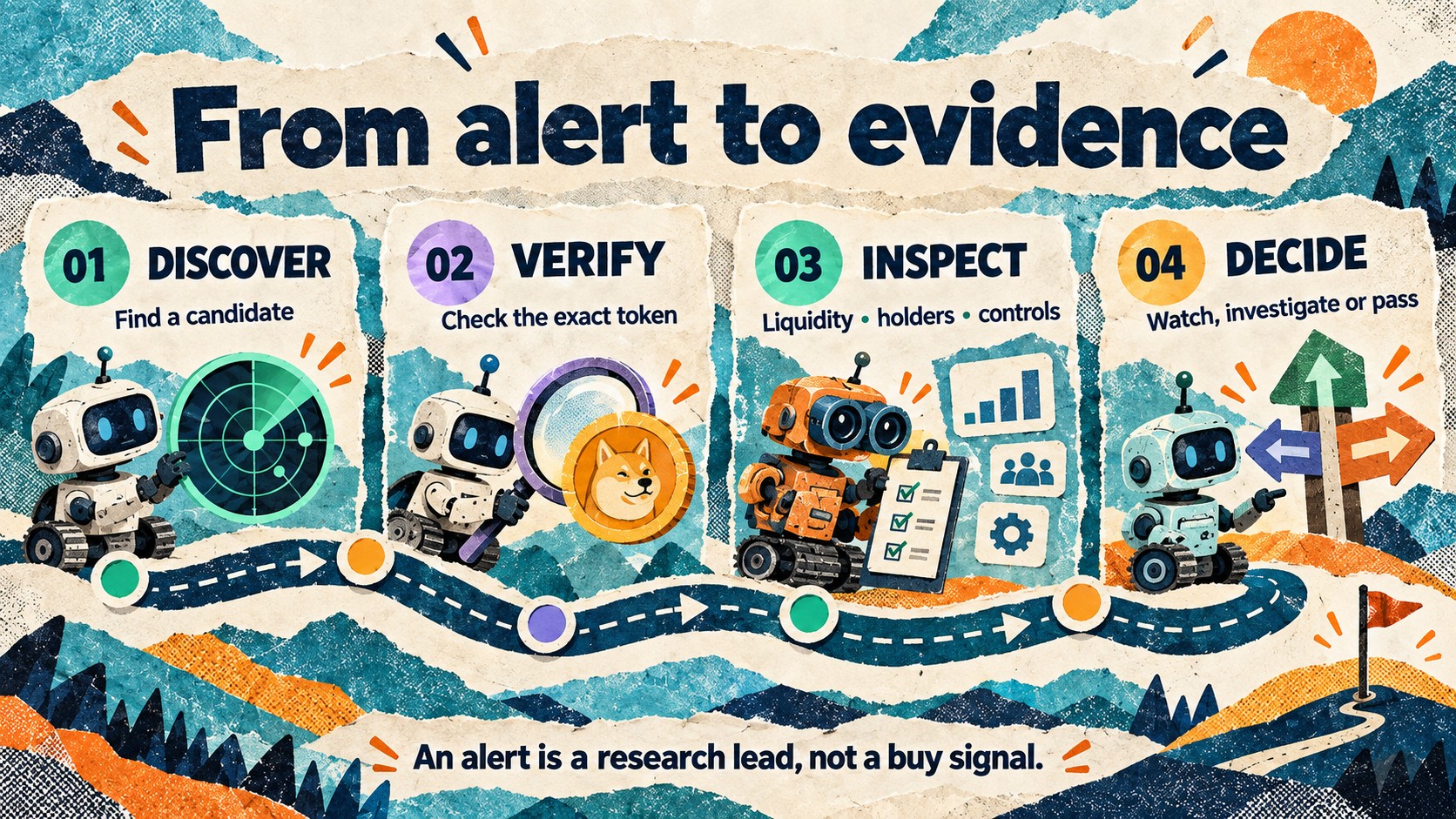
4. Put token checks ahead of convenience
A buy button can remove steps from execution. It does not remove the need to identify the asset or understand its controls.
- Identity: verify the chain and full address. Names and symbols can be duplicated.
- Liquidity: inspect the relevant pool and the expected price impact for the size being considered. Market cap is not cash available for sellers.
- Ownership: examine large holders, while distinguishing pool, burn, and other infrastructure addresses from ordinary wallets. A tidy holder list can still hide related accounts.
- Permissions: inspect minting, freezing, transfer restrictions, and other controls appropriate to the chain and token standard.
- Activity: examine trade size, timing, and participating wallets. Large headline volume alone does not prove broad demand.
On Solana, for example, mint and freeze authorities are distinct permissions, and extension-enabled tokens can introduce additional controls. Solana’s documentation describes these authority types. Removing one permission does not establish that every other risk has disappeared.
5. A worked example: the alert is early, but are you?
The following numbers are invented for illustration and do not describe a live token.
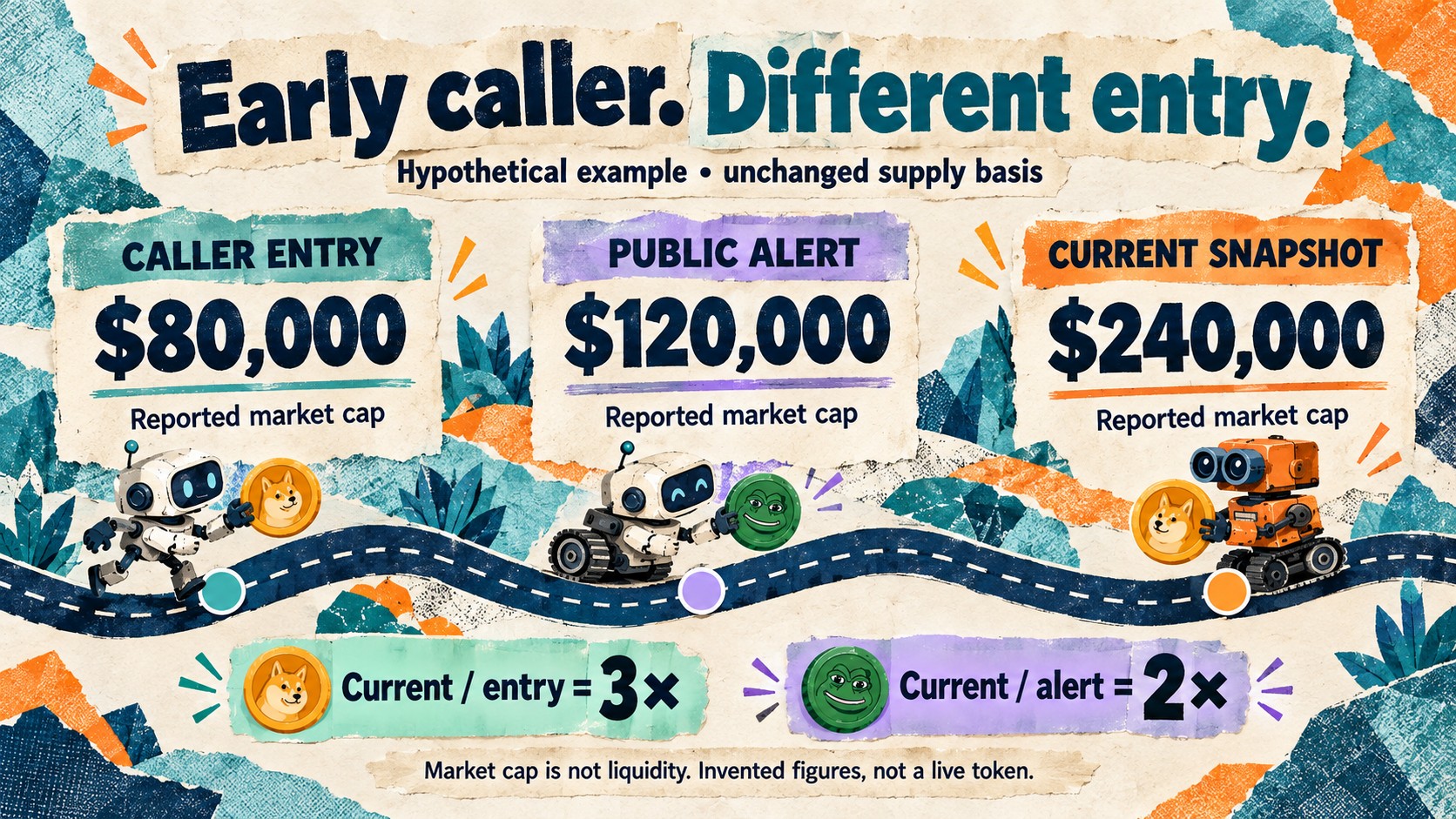
Suppose a caller entered at a reported $80,000 market cap, posted at $120,000, and the token now shows $240,000. Assume the supply basis is unchanged.
The current valuation is twice the valuation at the alert and three times the caller’s entry. You discovered the token through an early caller, but you are evaluating a materially different price.
Now suppose the pool shows only $18,000 in liquidity and the largest ordinary wallets hold substantial supply. Neither figure supplies a universal buy-or-sell threshold. Together, they create concrete questions about price impact and potential selling pressure.
A sensible research note might read: “Attention is increasing, but the price has already moved sharply. Investigate wallet connections and liquidity before drawing a conclusion.” The monitor did its discovery job. The evidence has not yet justified an action.
6. Build a repeatable review routine
- Start with a manageable feed. A shorter list leaves time to investigate each candidate.
- Capture the evidence. Save the address, timestamp, source, and relevant figures before they change.
- Check independently. Use an explorer and pool data alongside the alert.
- Write the unresolved question. What information could change your view?
- Assign a status. Watch, investigate further, or pass. Buying is not a required outcome.
- Review rejected candidates too. This helps reveal whether the process is useful or merely memorable when something wins.
If you eventually choose to trade, consider potential total loss, fees, slippage, and how execution could fail. A planned exit price is not a guaranteed fill.
The habit that matters
Finding a token sooner is useful only when you can explain what you found. Which wallet acted? At what price? What changed afterward? What could prevent an exit?
Use discovery tools to collect leads, then let verifiable evidence determine which leads deserve more attention. Missing a move costs an opportunity. Acting on misunderstood evidence can cost capital.






