
“We detected the payload… but the breach started three weeks earlier.”
That was the opening line in my report after investigating a ransomware incident where the encryption event was just the final act — not the breach itself.
After 20+ years in cyber threat intelligence and red teaming, I’ve learned one thing:
🔐 Ransomware is not just malware. It’s a business model. A campaign. A process.
In this article, I’ll break down:
- Why most defenses detect ransomware too late
- How attackers really operate
- What defenders should focus on instead
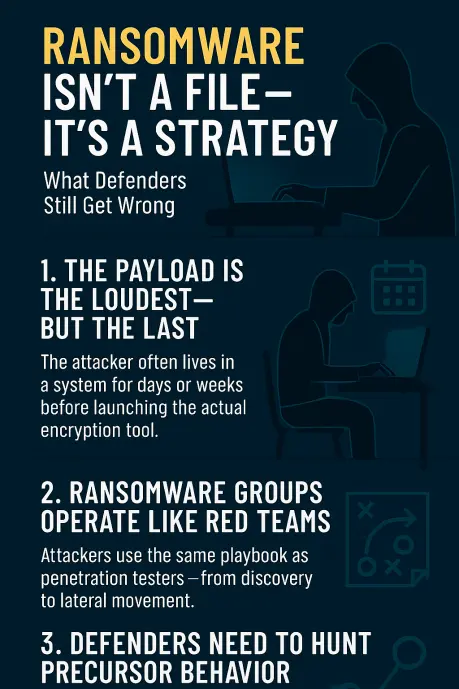
💣 1. The Payload Is the Loudest — But the Last
In most of the ransomware cases I’ve worked on, the payload (the actual encryption tool) was the noisiest part of the operation.
But it wasn’t the beginning.
✅ Initial access came through:
- Phishing with PowerShell macro
- RDP brute force
- Misconfigured VPN
The attacker lived in the system for days to weeks, often escalating privileges, mapping shares, and deploying backup scripts before launch.
🕵️ 2. Ransomware Groups Operate Like Red Teams
You’ll recognize the techniques if you’ve worked on red team or penetration test engagements:
- Discovery with
net viewandwhoami /all - Credential dumping using Mimikatz or LSASS
- Lateral movement via PsExec or RDP
- Scheduled tasks to persist C2 and backup toolkits
They follow MITRE ATT&CK like a playbook.
🛡️ 3. Defenders Need to Hunt Precursor Behavior
You’re not going to win by detecting ransomware binaries.
You’ll win by detecting what comes before:
- Suspicious PowerShell activity in user temp folders
- Unusual service installs
- Remote WMI execution
- SMB enumeration from user workstations
- Sudden spike in internal RDP connections
These are defender gold.
📘 Learn More
In my book Inside the Hacker Hunter’s Toolkit, I go deeper into real ransomware investigations and how to:
- Detect C2 before damage is done
- Use memory forensics and timeline analysis
- Map attacker movement using Windows artifacts
- Set up a SOC that thinks like an attacker
📗 Grab it on Amazon: https://www.amazon.com/dp/B0FFG7NFY7
📘 Want the mindset behind the tools? https://a.co/d/2aiwlPn
🧠 Final Thought:
“If your first alert is the ransomware payload, you’re already too late.”
#CyberSecurity #Ransomware #DFIR #ThreatHunting #IncidentResponse #SOC #BlueTeam #HackerHunter #AhmedAwad #Nullc0d3 #InfoSec #CyberDefense




