On-chain forensics from the FANR2 voting contract: 96% of the voter pool was fed by 15 apex wallets, the 3rd-place winner's deployer was the largest single bot-funder, and the Casper Association itself seeded both the voter pool and the project shells.
On 21 January 2026, the Casper Association announced the winners of Casper Hackathon 2026 — a contest it publicly described as having "Sybil resistance and full transparency." The on-chain record shows three things at once: the voter pool was bot-shaped, the bot operators were the winners, and the chain disagrees with the marketing.
The headline finding
The 3rd-place winner of Casper Hackathon 2026 was a project called CasperLink, which received the $3,000 prize. CasperLink's own project documentation — phase1.md in the SohamJuneja/CasperLink repository on GitHub — names the project's owner wallet explicitly:
Account Hash (Owner):
account-hash-74ab92cebdb16189b8a1d3ed5a87d6fff8df694e9ede46393b5e11bb441be597

Public Key:
02031ed02f6abebdec47e03f18bc1ee37fcae4d999e82a4f49512c8d25489dfd5302
That account hash is the same wallet that, on Casper mainnet, directly funded 106 voter wallets in the FANR2 voting contract (cbf2518437fbf7f8bdc895dad8eb1bcc5ea4fa0b7978b33721ea73366ad42428) — the contract that recorded the hackathon's "community vote." The wallet was first funded on-chain on 2026-01-15 at 22:07 UTC, eleven hours after the voting contract was deployed. Anyone with a Casper RPC and a few minutes can verify the wallet, its balance (~345 CSPR at the time of writing), and the 106 outgoing dust transfers that established its downstream voter cohort.
The contest's announced 3rd-place team owned the wallet that funded the largest single cluster of voters in the contest's own ballot. The voter pool and the winning team were not separate populations.
What Casper said
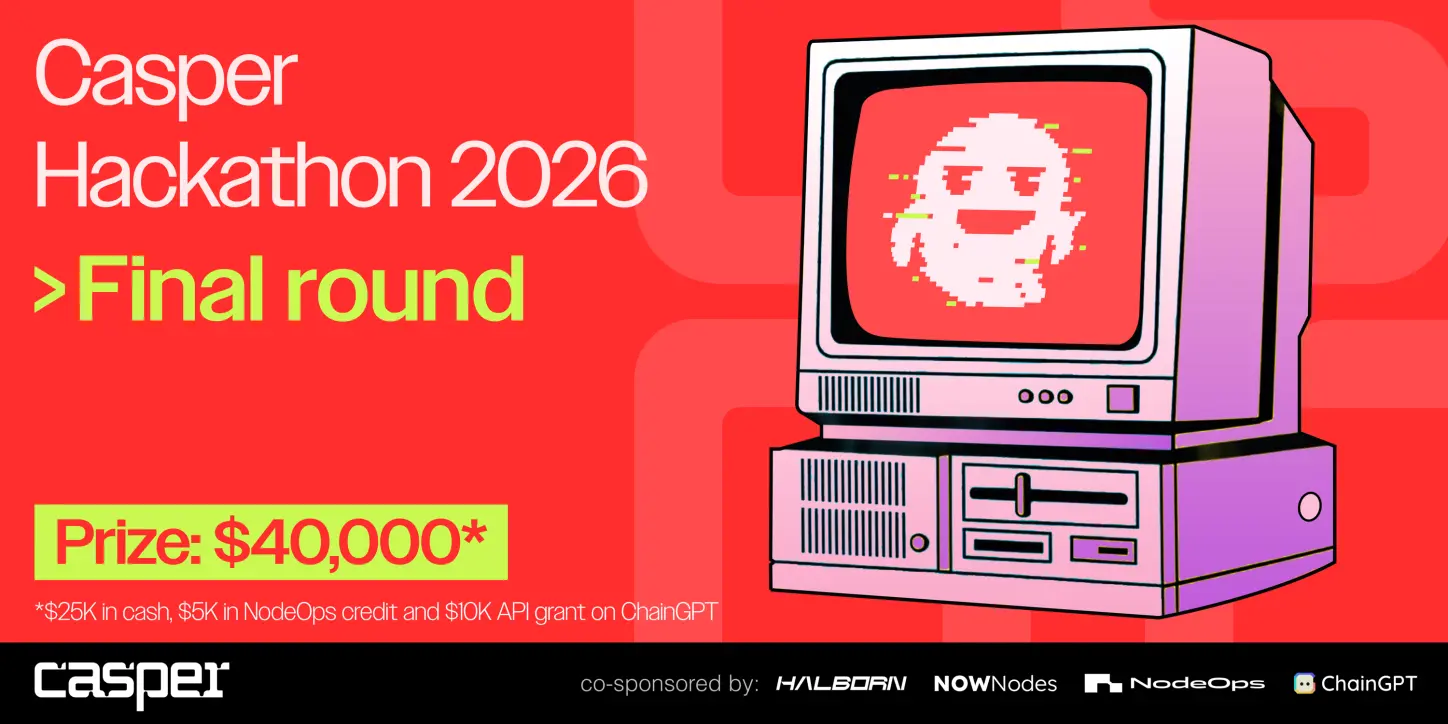
Casper's 5 February 2026 post-hackathon recap described the voting process as "on-chain via CSPR.fans" with "Sybil resistance and full transparency." Casper's own announcement of the contest in late 2025 included an explicit prize-system table: $25,000 in cash plus $5,000 in NodeOps platform credits plus $10,000 in ChainGPT API grants = $40,000 total. Halborn Security, NodeOps, ChainGPT, and NOWNodes were all listed as co-sponsors on the official Final Round marketing banner.
Casper marketed the contest as a community-decided event. The contest's official rules, published on DoraHacks at dorahacks.io/hackathon/casper-hackathon-2026, included a clause we'll call the Community Choice Fast-Track. The verbatim text:
Community Choice Fast-Track: The top 5 projects selected through community voting will also advance to the Final Round, even if they do not meet all technical expectations such as having a functional prototype, Testnet deployment, or GitHub repository.
Projects with no working code, no testnet deployment, and no GitHub repo could advance to the finals by community vote alone. That was the design. The voting power was assigned by an off-chain Telegram mini-app (CSPR.fans) where users earned points by following Casper on Twitter, watching videos, downloading the wallet, and inviting friends — a referral-compounded point-farming system in which the Casper Association's own server decided who held how much voting weight. The on-chain contract minted new vote-tokens for any signed message the off-chain server authorized; there was no on-chain Sybil resistance because Sybil resistance is impossible in a model where the central authority signs the votes.
Casper's own announcement of the contest also reserved the Casper Association's right to "support any additional projects it deems valuable, including post-hackathon grants and incubation opportunities." The override of the community vote was disclosed in the marketing copy.
The same hands on both sides of the vote
The contest was presented as three independent layers: a foundation (the Casper Association) that funded the prizes, a platform (CSPR.fans) that ran the vote, and a community that cast it. The corporate filings describe a different structure.
CSPR.fans, cspr.live, the Casper Wallet, and the CSPR.cloud indexer that this very piece sources its evidence from are all operated by MAKE — formally MAKE Group LLC, a US limited liability company, with a sister entity MAKE GROUP LIMITED (UK Companies House No. 09656022, registered at Studio 5.01, 470 Bath Road, Bristol, BS4 3AP). MAKE Group LLC's stated US contact address is 30 N. Gould Street, Suite R, Sheridan, WY 82801 — a mass registered-agent service address in Wyoming shared with hundreds of other LLCs and not the real seat of operations, which is Los Angeles, California. MAKE was founded in 2016 by Alex Kelly (CEO) and Michael Steuer (CTO). The corporate identity is published on the company's own marketing site at makegroup.io.
In 2024, Michael Steuer also became President of the Casper Association — the same foundation that funded the hackathon and announced the winners. The dual role is not inferred. The Casper Association's own news page announced his appointment as "the new Casper Association CTO" (the role title shifted to President of the Board in subsequent disclosures) and the Casper Network's own podcast aired an episode introducing him by both titles: "Michael Steuer | CTO of MAKE." The relationship is co-disclosed by both sides on their own marketing channels.
The President of the foundation that paid the prizes is the CTO of the company that operated the vote. What was disclosed in each entity's marketing was never disclosed in the contest's rules, in the announcement of the winners, or in the recap claiming the vote was "Sybil-resistant and fully transparent." The participants who entered the contest in reliance on the community-decided framing were not told that the chief technologist of the community-vote platform was also the head of the foundation paying the prizes.
MAKE's published team page lists the rest of the leadership: Tamara Wasserman (COO — the named recipient of participant complaint emails during the contest, in her MAKE capacity), Camilla Mantelli (General Counsel), and Ihor Burlachenko (VP Engineering). MAKE's Program & Community Manager Muhammet Kara is listed by Casper's own banner as the ChainGPT-sponsor contact, putting another MAKE staffer on the operations side of the contest while ostensibly representing an external sponsor.
Every line of formal authority over the voting platform and every line of formal authority over the prize allocation converges on the same C-suite — Steuer at the top of both — with no independent oversight inserted between them. This is the structural fact that contextualises every on-chain finding in the rest of this piece. The on-chain Sybil-resistance gap exists because the off-chain authorising server is MAKE's. The Casper Association wallet that directly funded 34 voters and 4 of 7 winning project shells is signed by the same individual who presides over both entities. The private recorded Zoom evaluations sent from @make.services email addresses were sent by the operator whose President is the President of the foundation paying for the contest.
The conflict is not alleged. It is published, in both entities' own marketing, in two different places that were never put side-by-side until now.
The submission deadline was extended mid-contest. Casper's published rules — still visible on DoraHacks at the time of writing — show the original submission deadline of 4 January 2026 23:59 UTC struck through, replaced by an extended deadline of 11 January 2026 23:59 UTC. The rules-text strikethrough is in their own document. Late-arriving bot wallets benefited from the extra week; the apex bot-funder wallet that this piece centers on was first funded eleven hours after Round 2's voting contract was deployed on 15 January, so the extension specifically widened the window during which fresh wallets could still be qualified for the on-chain vote.
The sponsors and their scope. Casper's Final Round marketing banner names four co-sponsors alongside the Casper Association: Halborn Security, NOWNodes, NodeOps, and ChainGPT. What each sponsor contributed is on the public record: Halborn is a Web3 security firm and its logo on a contest publicly framed as "Sybil-resistant and fully transparent" was a credibility-stamp; NodeOps contributed $5,000 in compute credits to the prize pool; ChainGPT contributed $10,000 in API grants; NOWNodes contributed CSPR Full Node and RPC access. What we have not found in any public source — and what this piece does not allege — is evidence that any of the four sponsors audited the FANR2 voting contract, signed off on the CSPR.fans points-allocation logic, operated the off-chain points system, or controlled the wallets identified below. The voter pool and the project-shell wallets were funded from the Casper Association's own treasury wallet on the Casper mainnet, not from any of the sponsors. The newsworthy fact is narrower and harder: four named brands lent their logos to a contest whose Sybil-resistance and full-transparency claim the on-chain record falsifies. Whether the sponsors were aware their names were attached to a security claim before that claim went on-chain is a question only they can answer.
there is more if your interested read more at https://www.rexintelservices.com/intel/casper-hackathon-2026-halborn-nodeops-chaingpt-nownodes-vouched-for-the-marketin-8a751869eb304381