
The birth of the Uniswap protocol in November 2018 brought about a revolutionary new way of trading ERC-20 tokens in a decentralized way.
This protocol employed a novel mechanism that solved various problems facing market makers. It didn’t take long before token trading via Uniswap was accessible thru many different dapps and wallets. This made it easier for anyone to switch their holdings from one ERC-20 token to another.
These advantages made Uniswap the top Market Maker in the Defi space, with a Total Value Locked (TVL) of 25 Million USD by March of this year. And then the first revision of Uniswap was introduced, Uniswap V2.
With V2 Uniswap introduced some great improvements:
Token to token swaps this allowed Liquidity Providers to create their own trading pairs, not necessarily including ETH. This allowed for more direct transactions in the most popular trading pairs, reducing transaction costs and times.
Price Oracles were created which help monitor token prices and reduce the possibility of price manipulation or abuse.
Flash Swaps allowed users to “borrow” tokens at a particular price as long as their returned the borrowed tokens by the end of the transaction. Akin to having a rich uncle or a limitless credit card, flash swaps provide a way of entering into a transaction without committing any funds upfront.
These three improvements all helped to confirm Uniswap as the top Market Maker protocol. Total Value Locked (TVL) in this protocol sits just shy of 1.5 Billion USD currently, after having reached a maximum of about 3 Billion USD in November. But success has not come without competition, and this year copycat Sushiswap was launched after piggybacking on Uniswap Liquidity Providers.
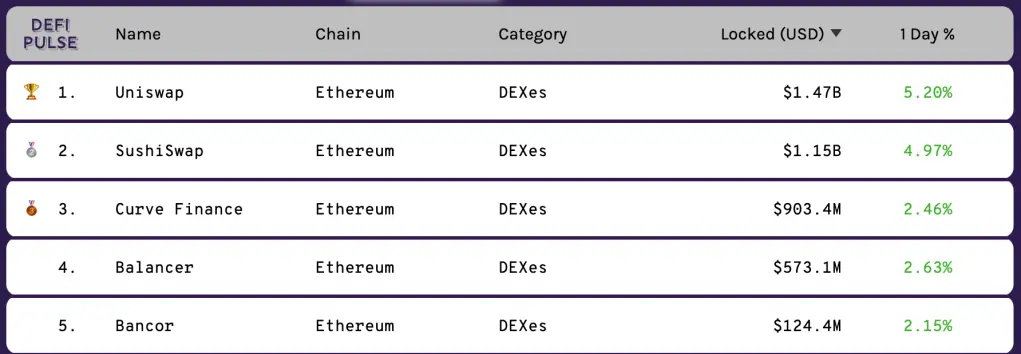
Uniswap’s lead in the sector in terms of TVL has been seriously reduced. This is possibly the result of the alliance between Sushiswap and Yearn Finance. On the other hand, this protocol's lead in terms of usage is clear as it handles roughly 250 - 300 million USD in daily transactions against 50 – 70 million USD moved by Sushiswap.
But 2021 will bring another upgrade to the Uniswap protocol, called V3. Developers are playing it close to the chest when it comes to the improvements this new iteration of the Uniswap protocol will feature, but there are some hints we have gathered.
Uniswap’s founder Hayden Adams tweeted back in February “(…) 2021: Uniswap V3 will face slippage and capital efficiency head on to prove AMMs can outcompete traditional exchanges on all fronts”. Just how they will do it is just speculation at this point.
It is generally accepted that one of the biggest disadvantages facing Uniswap in terms of efficiency is the high gas fees inherent to executing transactions on the Ethereum Mainnet. V3 will bring about the use of some second layer solution to reduce these costs and improve scalability (Optimism being the most likely candidate).
All of this is still under development, so it seems we’ll have to wait a little longer before we know what advantages the new Uniswap will bring. One thing is clear, these improvements are sorely needed, and all Uniswap users will surely benefit.






