
One of the major celestial event this year the NEOWISE comet will be passing thru its closest to Earth at a distance of 103 million kilometres (64 million miles) on 23rd Thursday July'2020. The closest approach to Sun was on 3rd July'2020.
The comet NEOWISE is officially known as 'C/2020 F3' and was first detected on 27th March'2020 by WISE (Wide-Field Infrared Survey Explorer) space Telescope under the WISE NEO (Near Earth Objects) program. WISE space telescope orbiting the Earth every 95 minutes, scans for near Earth Objects (NEO) and images them in infra-red wavelength.
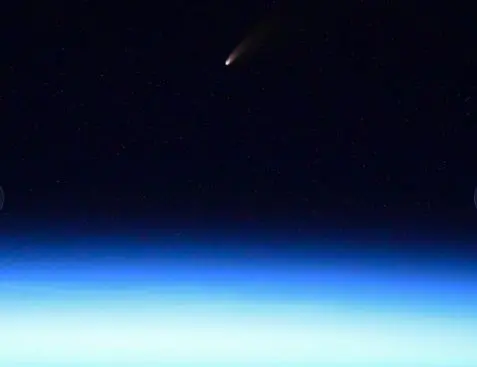
Image credit: Ivan Vagner/Roscosmos/NASA
The comet NEOWISE may be visible to naked eye under dark skies for most of the month of July with the nearest encounter being on the aforementioned 23rd July. We can watch it somewhere between 1:00 PM to 4:00PM UT or possibly longer into the night in northern latitudes.
While it will be easily visible to observers in most parts of the World in the north-west direction but in some places of low visibility one may need a basic binocular to watch this comet. Generally one can see the comet NEOWISE in the Northern Hemisphere visible with the naked eye in the night sky after sunset south of Ursa Major (The Big Dipper) Constellation.
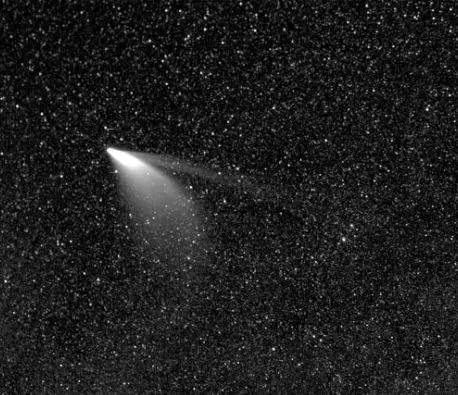
Image credit: NASA/Johns Hopkins APL/Naval Research Lab/Parker Solar Probe/Guillermo Stenborg
Having said that the comet is visible to naked eye, the binoculars would make us see its twin tails more prominently. The first tail is made up of gas & ions and is Blue in color. The second tail is made up of dust with a golden hue. Researchers also confirmed a sodium tail observed mainly in bright comets like Hale-Bopp. Like any other comet regardless of its direction the NEOWISE comet's tail flares out in opposite direction to the Sun.
The comet is currently going at 13,942 kilometres (8,663 miles) per hour.The comet is visible higher in the sky every day as it dims due to its moving further away from Sun, which provides it heat and light, thus causing its gases to escape thereby making the comet visible!
After posting this article I'll straight away head to watch this comet considering myself lucky to watch this rare once in a lifetime cosmic phenomena as NEOWISE will not be visible from Earth for the next 6800 years while it completes its orbit around the Sun!
Happy Reading!






