
All you need to know about Axelar
Introduction
We recently published a 10,000-word document comparing seven of the most well-known arbitrary messaging bridges (AMBs).
To make the doc a bit more digestible, we are breaking it up into a series of “Deep Dives”, which will also include a link to a Twitter Spaces with the AMB being covered.
Today’s AMB deep dive features Axelar! You can find an in-depth write-up below and our Twitter Spaces here:
This article will explore the design, security, and trust assumptions of Axelar, an arbitrary messaging bridge (AMB) focused on delivering secure cross-chain communication for Web3.
Here, we will cover the following:
- Axelar — An Overview
- How It Works — Transaction Lifecycle
- Security features
- Trust Assumptions
- Community & Resources
Let’s dive in!

Overview
Axelar Network describes itself as a full-stack decentralized transport layer delivering secure cross-chain messages across Web3. It provides a uniform cross-chain messaging solution for both developers and users. Developers can use Axelar gateway contracts and connect to any EVM contract on any chain without having to make any changes to their chains or UIs.
Axelar’s main selling points revolve around its extensive developer kit and its connection with Cosmos-based chains like Osmosis and Juno. Moreover, Axelar is a Cosmos-based chain itself and uses its own blockchain for validation. This feature is key in Axelar’s design and is the reason for many of its strengths and some trade-offs.
Some of Axelar’s best features include:
- “Plug-and-play” integration with simple SDKs and APIs — Axelar takes a universal approach to building and enabling developers to go cross-chain. It offers universal composability of programs with any-to-any cross-chain capability, allowing dApps to tap into different blockchain ecosystems frictionlessly. Moreover, it offers comprehensive documentation and tools like Axelarscan, which make building on Axelar a good experience.
- Axelar as the translation layer — Axelar is consensus agnostic, allowing it to connect with all chains. It is interoperable with EVM chains, Bitcoin, and Cosmos-based chains. The consensus agnostic characteristic of Axelar gives the team the flexibility to add any new chains seamlessly. At the network layer, this enables any new connection to the Axelar Network to benefit from all the previously interconnected ecosystems. Thus, Axelar acts as the translation layer that unifies unique languages of different types of blockchains.
- Reduced costs for users — Users only pay fees in the asset being transferred on the source chain, and all the other fees (finalization, relay) are taken care of in the backend. The Axelar Foundation also subsidized transfer costs in case of gas price fluctuations in the destination chain. Moreover, Axelar uses batched transactions to further reduce costs and plans to add more code-level gas optimizations in the future.
- Single validator signatures — Axelar Network requires only a single signature to authorize transactions. This signature represents the collective decision of the majority of validators and enables Axelar to scale as it keeps the transactions small, reduces costs, and makes it easier for Axelar to connect and interconnect other chains.
- Scalability through IBC — Multiple application or chain-specific forks of Axelar can be spun up. This enables Axelar to scale to an arbitrary number of applications or networks. In the future, all these forks can be secured through Cosmos’ Interchain Security.
Additionally, the Axelar Network enjoys the following network effects:
- Connection with the Cosmos community — The project has deep roots in the Cosmos ecosystem and has seen active involvement from the community in terms of development and governance. It connects to several Cosmos-based and non-EVM chains like Terra Classic, Osmosis, Secret Network, and Junø, among others, and facilitates significant amounts of bridged volumes to these ecosystems.
- Strong presence on EVM Chains — Axelar has also established itself on EVM chains such as Polygon, Avalanche, Fantom, Near, and Polkadot (Moonbeam), supporting significant cross-chain transactions to and from them. For instance, Axelar’s axlUSDC/USDC pool on Polygon is consistently among the top 3 pools by daily volume on Curve. Moreover, Axelar has strong partnerships with major dApps on NEAR protocol’s Aurora.
- Network Connectivity — As of September 2022, Axelar supports 23 chains: Ethereum, BNB Chain, Avalanche, Polygon, Fantom, Moonbeam, Aurora, Cosmos, Osmosis, e-Money, Juno, Crescent, Injective, Terra, Secret, Kujira, AssetMantle, Evmos, Fetch.ai, KI, Regen, Stargaze, and, of course, Axelar.
- Partnerships and integrations — A wide range of applications and blockchain ecosystems leverage Axelar’s tech to offer cross-chain features. For example, dApps like Prime Protocol, Astroport, Cosmos app chains like Osmosis Kujira, Avalanche subnets like Heroes of NFT, Pocketworlds, and NFT projects such as MintDAO, Omnisea, among others.
- Experienced team — Axelar has an established core team with expertise in cryptography, consensus, and distributed systems. Sergey Gorbunov and Georgios Vlachos, the co-founders of Axelar, are also founding team members of Algorand and have years of experience in building blockchain infrastructure.
- Funding — It has raised over $65 million in funding, most recently raising $35M at a $1B valuation in its Series B round.
How It Works — Transaction Lifecycle
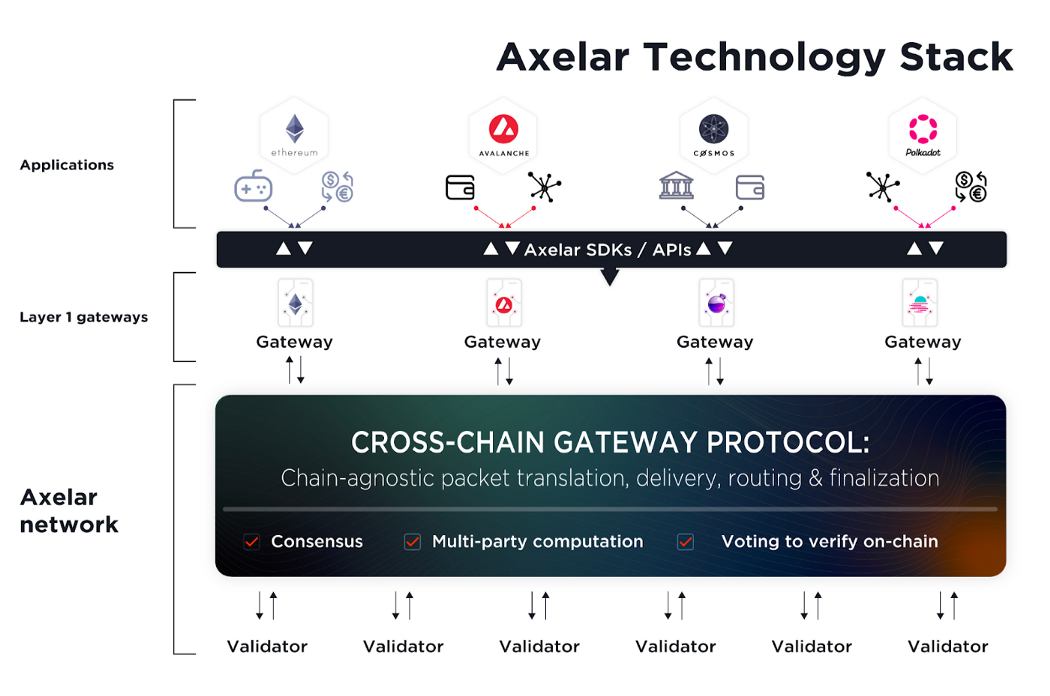
The Axelar Network has two functional layers:
- The Core Infrastructure Layer — This layer consists of Axelar Network itself, which is maintained by a set of validators executing transactions. Additionally, this layer also consists of gateways that act as smart contracts to connect the Axelar Network with the other blockchains. Validators maintain the operations of the gateway protocol. They read incoming transactions from the source chain gateways, reach a consensus, and then write to the gateway on the destination chains to execute a transaction. Once this process is complete, the funds are locked on the source chain, and an equal amount of canonical assets are minted on the destination chain.
- The Application Development Layer — This layer consists of SDKs/APIs, which make the core infrastructure layer of Axelar available for developers to go cross-chain. The APIs enable developers to send generalized messages across chains which opens up a world of possibilities in terms of cross-chain actions. For instance, developers can lock/unlock and transfer crypto assets across chains or execute cross-application triggers.
Here’s how Axelar works at a high level:
- Step 1 — A user requesting a cross-chain transfer of information waits for either the token deposit or action to be confirmed by Axelar Validators on chain A.
- Step 2 — Axelar Validators observe their chain A nodes and cast votes on whether the transaction occurred on chain A.
- Step 3 — If the number of Axelar Validators surpasses the set threshold, the chain A transaction s confirmed by the Axelar Network.
- Step 4 — Using multi-party cryptography, the Axelar validator set signs off on a list of commands confirmed by the votes. If the signatures cross the set threshold by the quadratic voting power of validators, a signed batch of commands is prepared.
- Step 5 — The signed batch of commands is relayed to the Gateway on chain B by Axelar microservices (or anyone else; the service is permissionless), which secures the transportation of tokens/data across chains.
Security
Axelar offers the following security features:
- Leverages IBC’s security — Axelar leverages IBC, the gold standard for cross-chain security, to communicate with other IBC-compatible chains.
- Isolated module functionalities — Axelar reduces the risks of different network connections from spilling over by isolating functionalities in modules at the Cosmos SDK level. This allows Axelar to isolate chains from each other. For example, there are separate modules for EVM chains and IBC-enabled chains.
- Ability to freeze transfers — Axelar can use a special command to freeze transfers from one or all chains in cases when a particular chain is under attack, or there is an ecosystem-wide black swan event. This allows Axelar to pause all the incoming and outgoing processing requests related to a specific chain.
- Reduced extent of stolen funds through rate-limit functionality — To minimize attacks, Axelar’s ERC-20 contracts have a rate-limit functionality that reduces the amount of funds that can be stolen at the time of an attack.
- Security through AXL token economics — Axelar aims to use the AXL token to enhance the security and decentralization of the system. The AXL tokenomics have been designed to incentivize honest activity among the validator set by giving them healthy staking rewards. Moreover, the team seeks to decentralize the validator set and increase the active members in community governance through the wide distribution of the AXL token.
- Unbounded number of validators — Axelar relies on decentralized proof-of-stake consensus. As a result, it can support as many validators as required. In the current set, there is a maximum of 50 validators. This value can be increased via on-chain governance.
- Audits and bug bounties — Axelar has had a significant number of audits, particularly recurring audits that review any changes to the protocol. Axelar also offers a $2.25M bug bounty on Immunefi.
Once Cosmos’ Interchain Security launches, the security offered by Axelar will increase manifolds. Axelar would then be able to leverage the economic security offered by the Cosmos Hub’s validator set.
Trust Assumptions
Axelar makes the following trust assumptions:
- External verification by a set of validators — Axelar uses a validator set with 50 validators (48 active at the time of writing) to execute transactions. A message must be signed by ⅔ of the validators to be passed by their quadratic voting power. As a result, the security of an application using Axelar is more secure than Axelar’s consensus. Additionally, Axelar offers application-based security as it allows applications to customize their codebase as per their requirements. For instance, applications’ governance can elect their own permissioned set of validators and relayers, which can then be used for validating transactions by spinning up a fork of Axelar.
- Skewed voting power — Out of Axelar’s 48 active validators, about 10 hold less than 1% of the voting power. If the voting power were to become more concentrated, this could reduce the actual security of a proof-of-stake system such as Axelar, by skewing voting power in favor of an elite group of validators. However, once the AXL token is live, the voting power is expected to be distributed more evenly. Moreover, Axelar has implemented quadratic voting to validate and process cross-chain transactions. Quadratic voting makes Axelar’s network more decentralized and significantly improves the skewed voting power concern. Read more here about quadratic voting and Axelar’s security approach, and view validators’ share of stake and their quadratic voting power on the Axelar block explorer, axelarscan.io.
- Progressive decentralization — Upgrades on the Axelar network are already enforced by an on-chain decentralized governance mechanism. However, smart contract upgrades use a governed multisig. While governed multisigs are a bottleneck for decentralization, this allows Axelar to offer features such as the rate limit functionality. As Axelar progresses on its roadmap, it aims to have the validator set jointly approve smart contract upgrades to decentralize the network further.
- Possible liveness issues as validators can choose which chains to support — For a new chain to be added, Axelar requires 60% of the validators by their quadratic voting power to run a node for that chain. While validators have the choice to maintain a certain EVM chain, the vote majority threshold is still 60% of the quadratic voting power of the total validator set. So, if an EVM chain doesn’t have enough supporting validators, only liveness is affected, not security. Moreover, these thresholds can also be increased via on-chain governance.
Community & Resources
You can learn more about Axelar and stay updated about its community through the following:
Get Started with LI.FI Today
Enjoyed reading our research? Please clap for the blog and show us your support! To learn more about us:
- Head to our link portal at links.li.fi
- Read our SDK ‘quick start’ at docs.li.fi
- Join the official Discord server
- Subscribe to our newsletter on Substack
- Follow our Telegram Newsletter
- Follow us on Twitter & LinkedIn
or try our any-2-any swaps NOW at transferto.xyz






