
How I wish I could say ‘C for China, C for Crypto!’ But not yet.
China is not yet synonymous with Crypto, but rather with Crypto Crash.
Ever since the existence of cryptocurrency, China has always acted as a catalyst for a crypto crash.
Where did it start from?
China’s notorious history of clubbing crypto over the head dates back to December 5, 2013.
On this date, China’s central bank, People’s Bank of China (PBOC), published a statement on its official website:
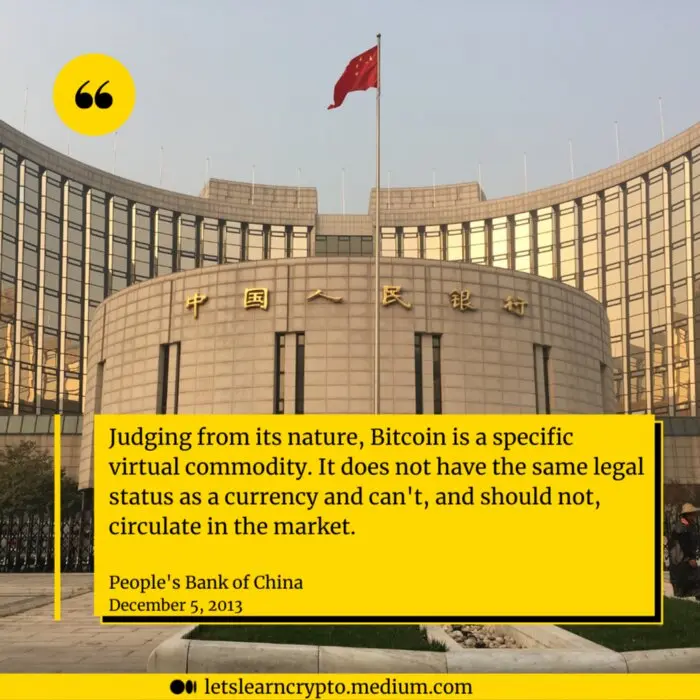
Along with four more government authorities- the China Securities Regulatory Commission, the China Banking Regulatory Commission, the China Insurance Regulatory Commission and the Ministry of Industry and Information Technology, PBOC published a joint statement barring financial institutions from trading, settling and market-making deals using Bitcoin.
The joint statement also instructed websites providing Bitcoin-related services to register with the country’s telecommunication authorities.
This move was China’s first restrained step towards regulating the digital currency, or let’s just say- towards clubbing crypto over the head.
What feared Chinese authorities was the fact that Bitcoin’s price had skyrocketed by around 800% over the past two months, and bitcoin market participants were mainly Chinese nationals who held an outsized share of the total number of bitcoins in circulation. During that year, Shanghai-based BTC China had become the world’s biggest Bitcoin exchange by volume.
Since then, China has always found a way to cause a crypto crash.
Fast forward to 2021, the whole crypto market crashed as Bitcoin plummeted to $39,600 on September 21, 2021.
However, to everyone’s surprise, this time it was not directly China’s fault.
In fact, the main reason was the Evergrande Crisis.
Evergrande Crisis
Evergrande is China’s second largest property developer. It was founded by Xu Jiayin in 1996.
In 2009, it went public after raising a whopping $722 million in its initial public offering on the HongKong stock exchange.
The Evergrande crisis began when the Evergrande group became aggressively ambitious. If it had stuck to its core business of real estate, Evergrande would have never seen such a day.
However, it displayed its interest in expanding its territory to sports, tourism and recreation, food and agriculture, automotive, health, entertainment and finance.
In the due process, Evergrande collected debts amounting to a staggering $305 billion.
Recently, Evergrande has been struggling to cut costs and to find investors to buy some of its assets. This has resulted in a heightened cash-crisis.
It has already disclosed that it could make no ‘material progress’ in its search for investors to buy part of its stakes in its electric vehicle and property service businesses.
When Evergrande announced in a stock exchange filing in Hong Kong that it had enlisted financial advisors to evaluate the liquidity of the group and explore all suitable solutions, the matter escalated and suddenly everyone’s eyes were on Evergrande.
Evergrande luckily managed to make a $36 million payment on its outstanding debts. But it missed its $83.5 million interest payment for which it received a one-month grace period. If Evergrande fails to make the payment before the grace period expires then it will be in deep trouble.
To ensure liquidity is maintained during the looming Evergrande crisis, China’s central bank, the People’s Bank of China (PBOC) pumped $18.6 billion into the banking system through reverse repurchase agreements.
However, if Evergrande fails to make the bond payments within the scheduled time period, no one will be able to avoid the stock market crash and simultaneously the crypto market crash.
We may be on the verge of seeing one of the biggest crypto crashes perhaps not due to the China government, but due to a China-based property developer.






