
Before the banks and financial institutions emerged, repayments and loans were based on the peer-to-peer model. People used to trust each other without the involvement of third parties. However, trust began to break down gradually with time, and intermediaries and additional trusted authorities were added to the system.
Though intermediaries served as a layer of protection, it added extra costs and additional layers of regulation and complexity to the lending and borrowing process.
Blockchain emerged as the solution to reconstruct the lending and borrowing process by removing third-parties or intermediaries from the system, thereby reducing cost. The decentralized nature of the blockchain makes it possible to transfer ownership of any asset from one person to another without the involvement of a central authority.
Blockchain P2P lending can benefit specifically small-to-medium enterprises and individuals because access to credit is difficult for them traditionally.
Currently, people need intermediaries such as loan officer, loan processor and underwriter to establish trust. Another biggest challenge is that it sometimes takes weeks to months to process the loan amount or credit to the borrower's account.
Rates of interests are also different for different countries. For example, the rate of interests for a loan in Argentina, Algeria and the United States is 31.2%, 8% and 4.8% respectively.
With Blockchain and Smart Contracts, lenders can validate the transactions, check the borrower's profile and transfer credit directly to the borrower.
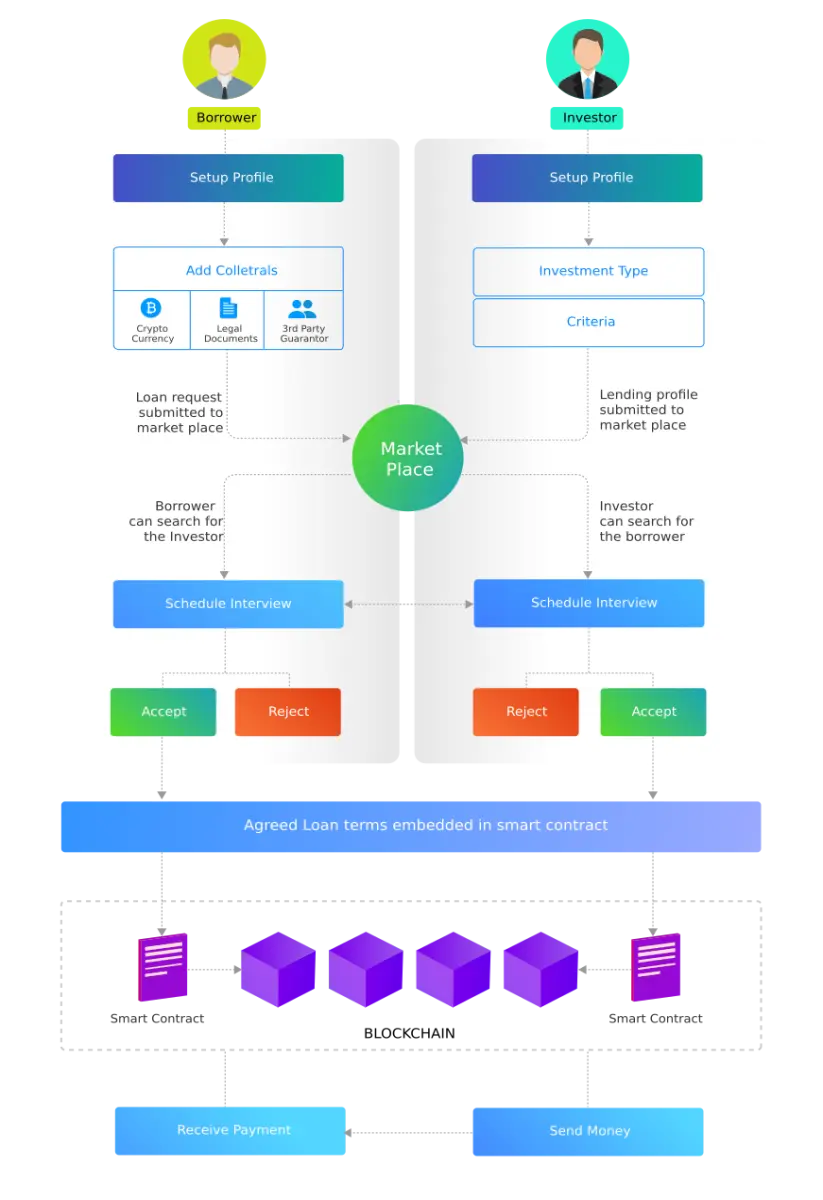
Image Source: LeewayHertz
P2P Lending Blockchain could bring the following benefits in the lending and borrowing ecosystem:
-
Quick Process
By adding the regulations in the smart contracts, blockchain based lending platform could reduce the time to transfer the credit to borrower's account. -
Reduced Cost
Since the borrowers can directly deal with lenders through smart contracts, P2P lending blockchain platform can reduce costs associated with multiple intermediaries. -
Rate of Interest
Unlike the current lending systems, blockchain lending platform could generate a rate of interests automatically based on the profiles of the borrower via smart contracts.
How P2P Blockchain Lending Platform could work
-
Borrowers and Lenders sign up on the P2P blockchain lending application with providing essential information such as AML/KYC identification and income verification.
-
Once the registration is done, lenders can add the type of investments they want to make and set up rates of interests according to the worthiness of a borrower.
-
If you are a borrower, you should also add collaterals to show that you are eligible for a loan or credit.
-
Once the profiles are listed on the application, a borrower can find the lenders providing an investment of their choice. Borrowers can send the loan request to the lenders and bid on the rate of interest offered by the lender.
-
Lenders can approve the borrower's request by looking at their profiles and credit-worthiness score generated through smart contracts.
-
Once the lenders agree on the bids, the amount requested by the borrower gets transferred to their account automatically in a few hours through smart contract execution.
-
Smart contracts ensure that the lenders get payments on a timely basis. In case, if a borrower does not pay their installments timely, smart contracts add a late fee to the original amount of installment.
In this way, the lending process could become simple and quicker with the help of blockchain technology. Many companies have already started building lending applications on the top of the blockchain.
Here are some of the real examples of P2P Lending Blockchain Platforms
- SALT
SALT is a peer-to-peer lending platform that allows cryptocurrency holders and traders to get a loan by keeping their crypto assets like Bitcoin, Litecoin, Ethereum, USD Coin or Dogecoin as collaterals. The users of the SALT platform can borrow money from a vast network of lenders who identify the eligibility of borrowers based on the crypto assets they hold. - ETHLend
Built on the Ethereum platform, ETHLend is a decentralized marketplace for lenders and borrowers from all over the world where they can create peer-to-peer lending agreements on their own terms. Borrowers can use their digital assets as a guarantee to get a loan in one click. -
Ripio Credit Network
It is a peer-to-peer global credit network protocol using blockchain technology and smart contracts. The platform connects financial institutions, fintech companies, decentralized finance service providers and creditors for building a frictionless and transparent credit/debt markets. -
Lendoit
Lendoit is a P2P lending platform that allows borrowers and lenders to interact directly without the need of any third party or trusted party. Smart contracts generate a smart scoring based on the borrower's profile which helps them to get a loan in their accounts instantly.
Since the financial industry currently fights to overcome the traditional lending and borrowing system, a lot needs to be done to enhance the adoption of digital assets. Quick verification and reduced costs has pushed investors to take the smart contracts based P2P loans.






