

The Lazy Summer promise: Do Less
At its core, Lazy Summer makes a simple but profound promise: Do Less.
The protocol handles the complexity so you can automatically access the highest-quality yields from the top protocols across DeFi.
Regardless of market conditions, the protocols number one priority is solving the intense fragmentation across protocols, chains, and yield sources.
Irrespective of a liquid token, the number one priority of the Lazy Summer Protocol is solving the intense yield source fragmentation across protocols, yield sources, and networks.

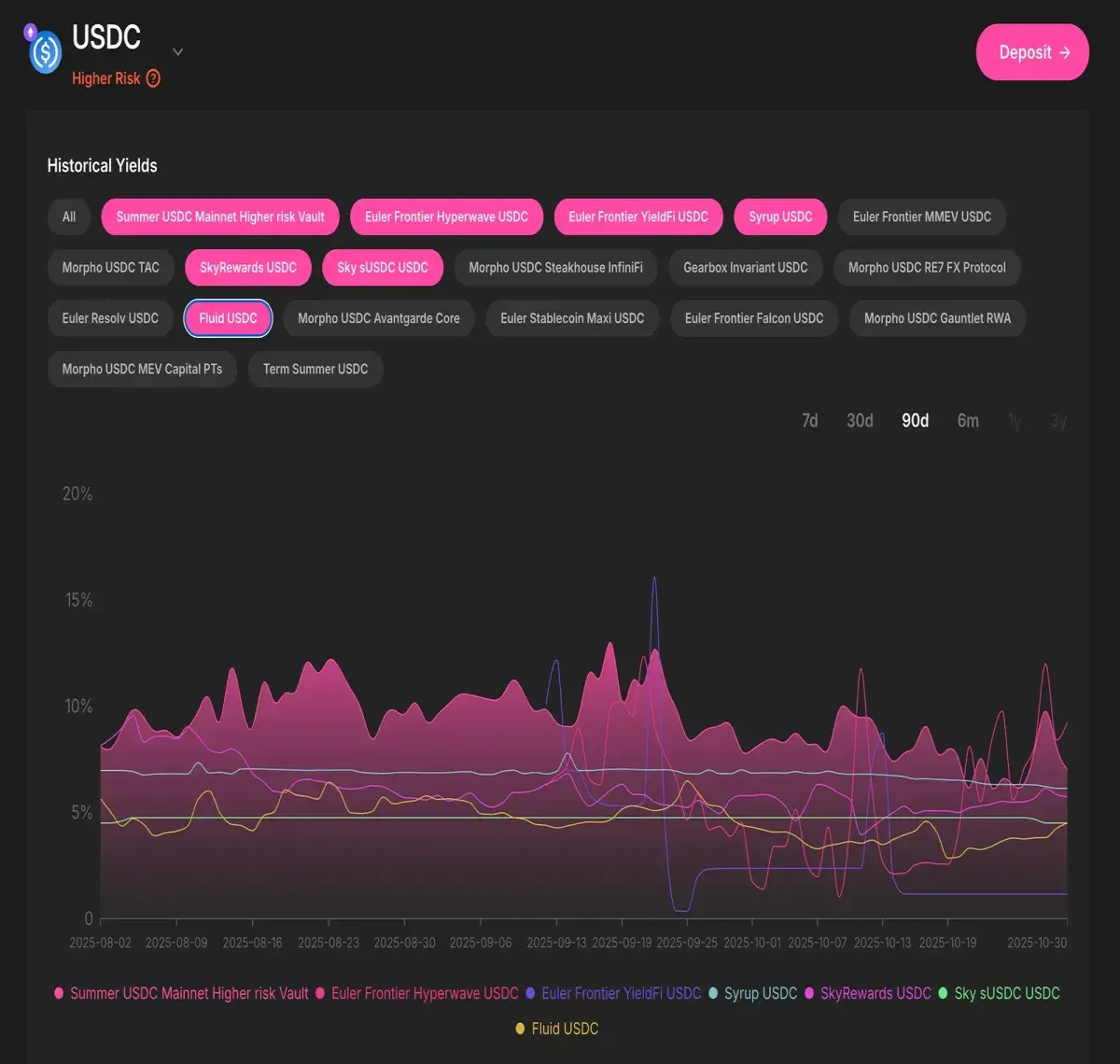
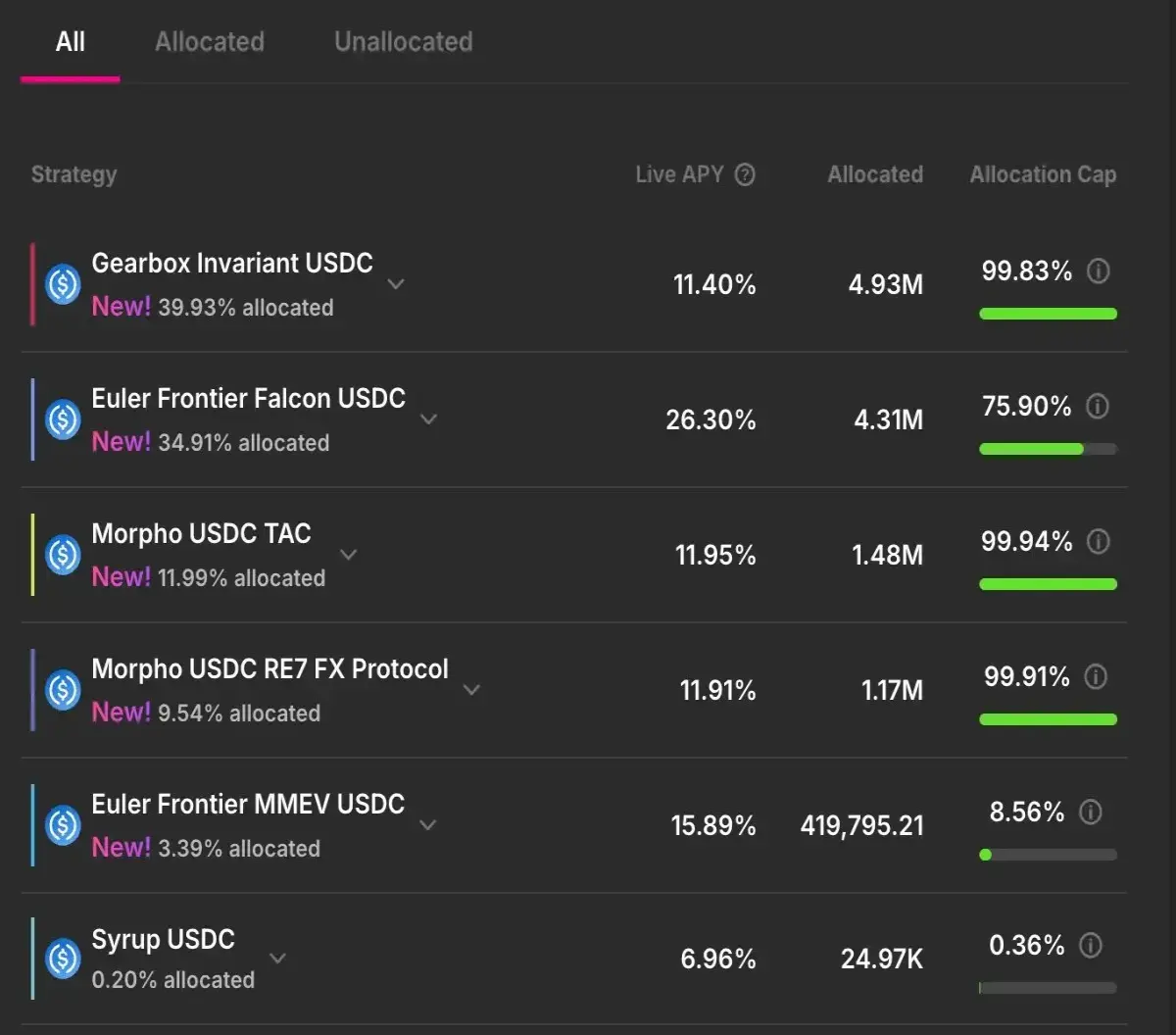
An example of Lazy Summer Protocol Yield Source Diversification
Practically, this means Lazy Summer users can always expect:
- Above-Benchmark Yields: diversified exposure that consistently beats static deposits
- Risk Curation: access to new yield sources inside a strict, governed framework
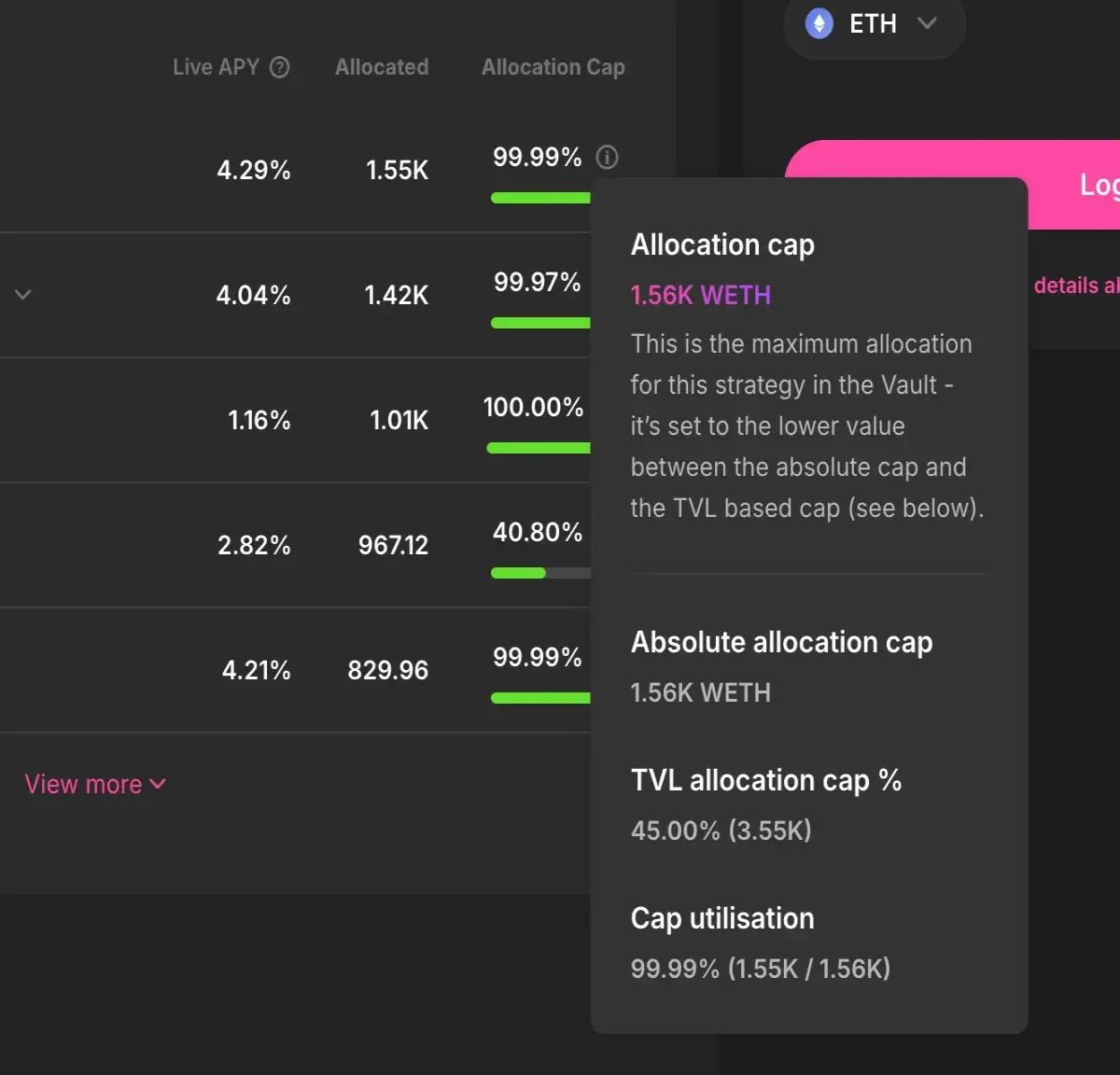
- No Yield Chasing: Automation, governance and risk experts handle capital rotation discipline including both new yield sources updated constantly, and fluctuating APYs / Risk profiles of established yield sources.
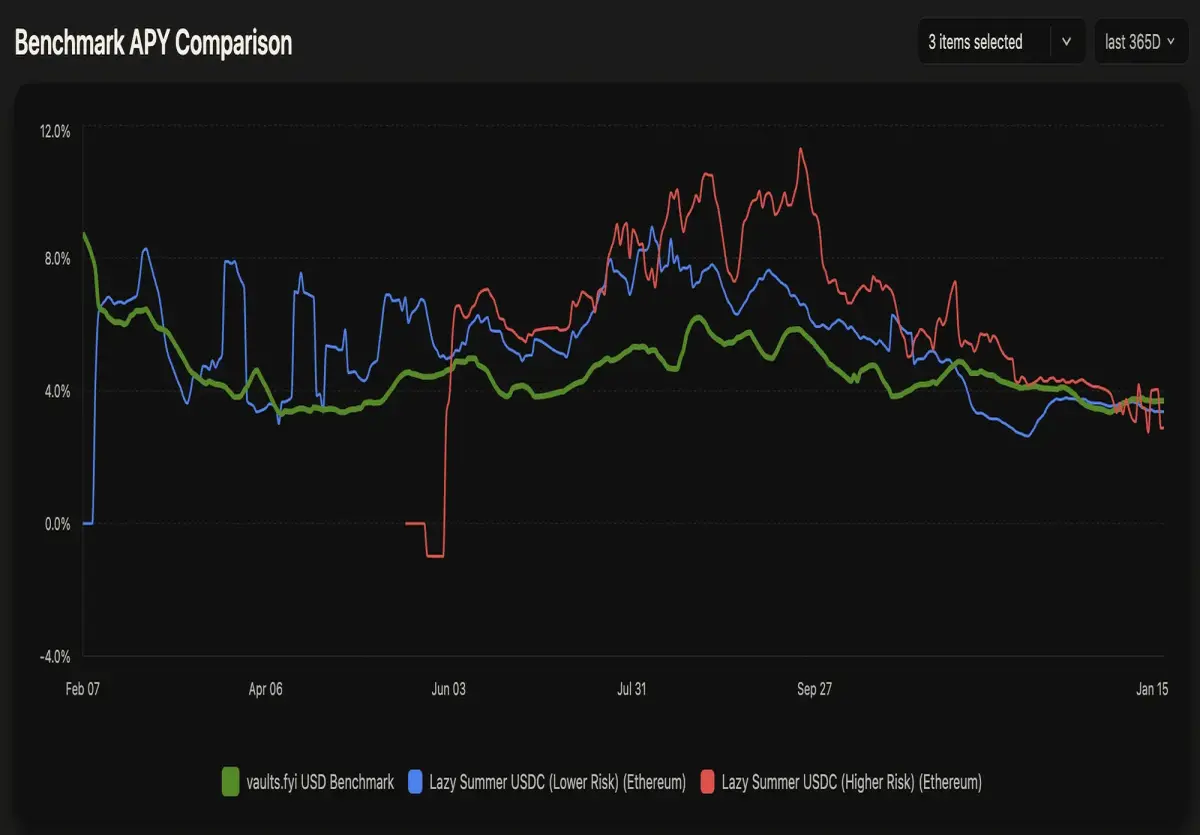
To date, Lazy Summer has executed on this promise well. Specifically, Lazy Summer has produced above benchmark returns on the vast majority of all available vaults.
Understanding Lazy Summer returns vs benchmarks
Consistent alpha over benchmark yields
The profound advantage for depositors that Lazy Summer enables is for your capital to be opportunistic.
- USDC and ETH vaults have beaten static deposit rates in almost all available vaults on Summer.fi
- During favorable markets: significantly above-benchmark APYs through opportunistic positioning in higher yielding strategies.
- During market stress: automatic rotation to bluechip safety, maintaining at-minimum benchmark yields
- Over 75,000 automated rebalancing actions in the past year, each one optimizing your position
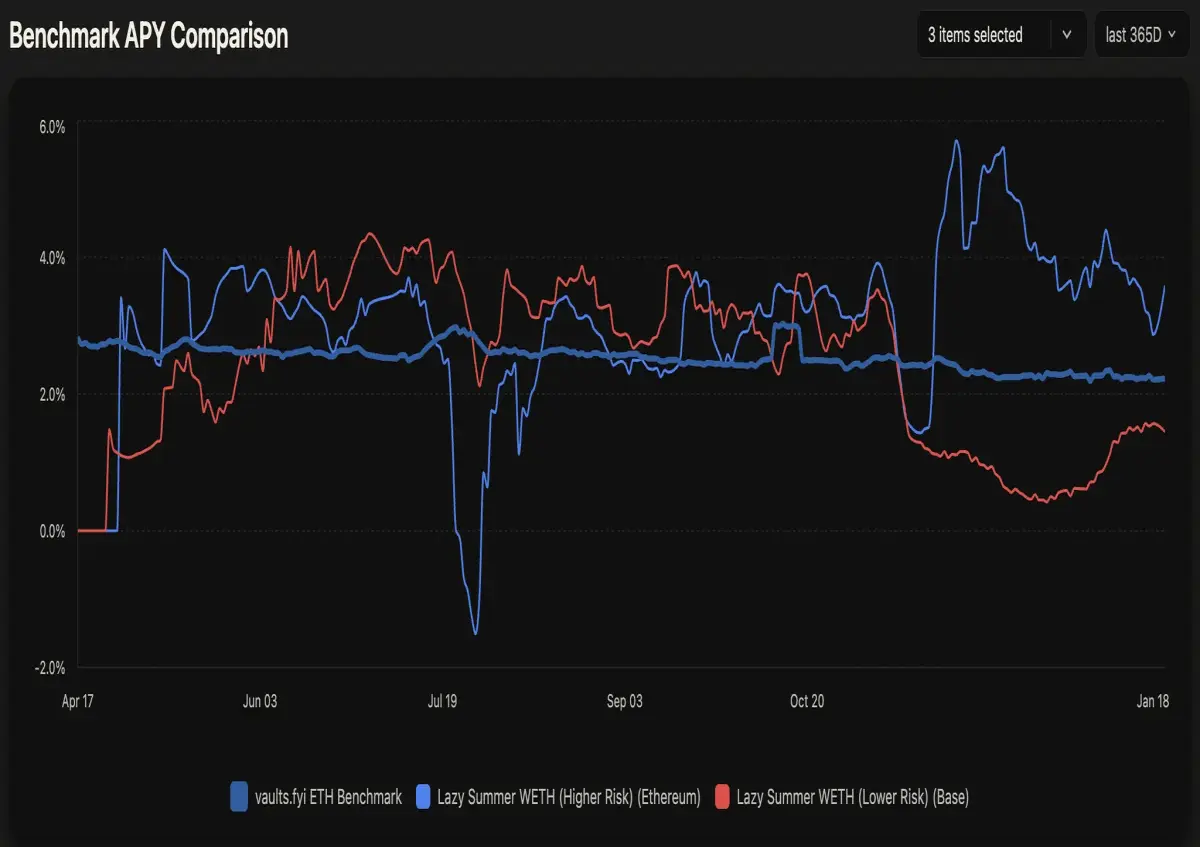
This is "Set and Forget" DeFi in its truest form, but why does this happen? The answer is threefold.
Why Lazy Summer vaults outperform: Three structural advantages
The answer to that is three fold.
1. Yield source depth and diversity
Lazy Summer can onboard new yield sources in days, not months. Today the protocol supports:
- ~70 yield sources
- Across 5 networks
- Across ETH, USDC, and USDT
- From 16+ major protocols
- Including Morpho, Euler, Aave, Spark, Fluid, Maple, Gearbox, Origin, Sky, Silo, Midas, and more
In November 2025 alone, Lazy Summer provided automated exposure to 98 distinct yield sources. And it doesn’t stop there, each week more yield sources are proposed to Lazy Summer governance to be onboarded into the protocol.


- Best in class risk curation through dynamic risk caps
Every depositor benefits from institutional-grade risk management. Practically, Block Analitica systematically updates:
- Deposit Caps: Managing TVL scaling velocity.
- Allocation Constraints: Ensuring diversification across Arks.
- Liquidity Buffers: guaranteeing withdrawals and rebalances.
- Rebalance Thresholds: Preventing over-trading or lagging reactions.

You can read more about how exactly how Block Analitca manages risk here.
- Automated rebalancing at scale
Lazy Summer is able to give depositors the ability to Do Less and get automated access to all of DeFi most high quality yields because of automated rebalancing. The rebalancer has already executed 75,000+ automated reallocations.

Keepers monitor all yield sources 24/7 and, within governance-approved risk constraints:
- Exit underperforming venues
- Allocate into higher real yield
- Respect liquidity and cooldown rules
- Preserve withdrawal readiness
- Avoid over-trading and tail-risk
All this while onboarding some of DeFi’s best yield sources, giving users diversified exposure to both emerging and extremely well established protocols and strategies.

Why now - The generational setup for SUMR
Fundamentally, Lazy Summer is about access to high-quality onchain yield. Gradually, and then suddenly, DeFi yields have matured into a critical financial primitive not just in DeFi, not just in crypto, but soon also global finance.
We believe 2026 will be the year of the onchain vault. Specifically, this particular evolution of blockchain technology, building on smart contracts and stablecoins, is the onchain financial primitive that makes all other sub-categories accessible to the world, similar to the advent of ETFs in tradfi.
Three massive trends are converging right now to create a once-in-a-decade opportunity:
1. Tokenization Is Eating Finance
Real-world assets are flooding onchain at an unprecedented pace:
- The tokenized RWA market (excluding stablecoins) grew 85% year-over-year to reach $15.2 billion by December 2024
- BlackRock's BUIDL fund attracted over $500 million within months of launch
- Larry Fink called tokenization "the next generation for markets and BlackRock is betting billions on it

2. Yield-bearing stablecoins are exploding
The numbers are tell the story:
- Yield-bearing stablecoin market cap: up 300% year-over-year
- Supply surged 13-fold from $666M (August 2023) to $8.98B (May 2025)
- Total stablecoin market doubled to $250B, projected to hit $2 trillion by 2028
- Dollar-backed stablecoins purchased $40B of US T-bills in 2024, matching the largest government money market funds.
3. DeFi Credit markets have matured
The lending infrastructure is here:
- DeFi lending TVL: $50 billion +
- AAVE alone: $24.4 billion TVL across 13 blockchains
- Total TVL and outstanding loans quietly surpassed 2021-2022 DeFi Summer highs, reaching $65B TVL and $25B in active loans
- Tokenized private credit: $17.5B, up 32% in 2025
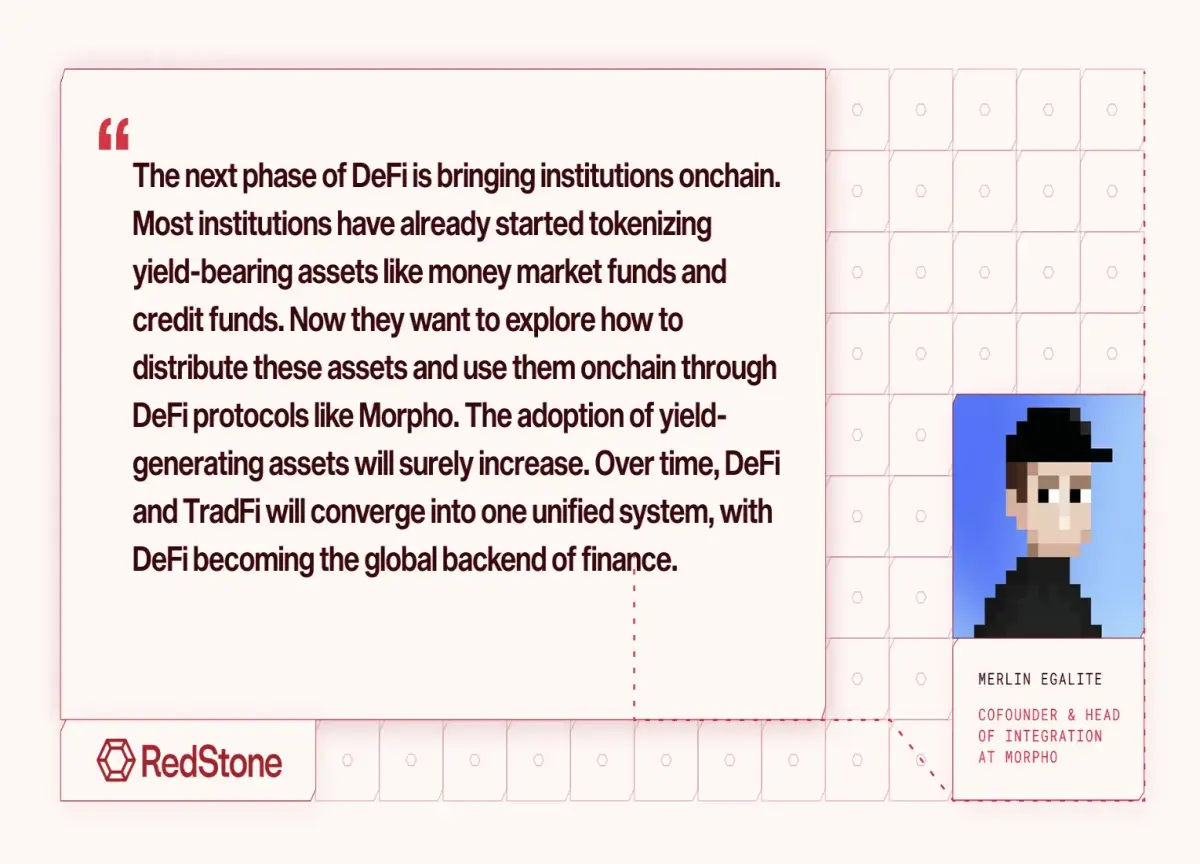
Institutions are here. Morpho, Maple, and Euler are building stronger, institutionally aligned venues. This isn't just retail anymore, it's institutional infrastructure.
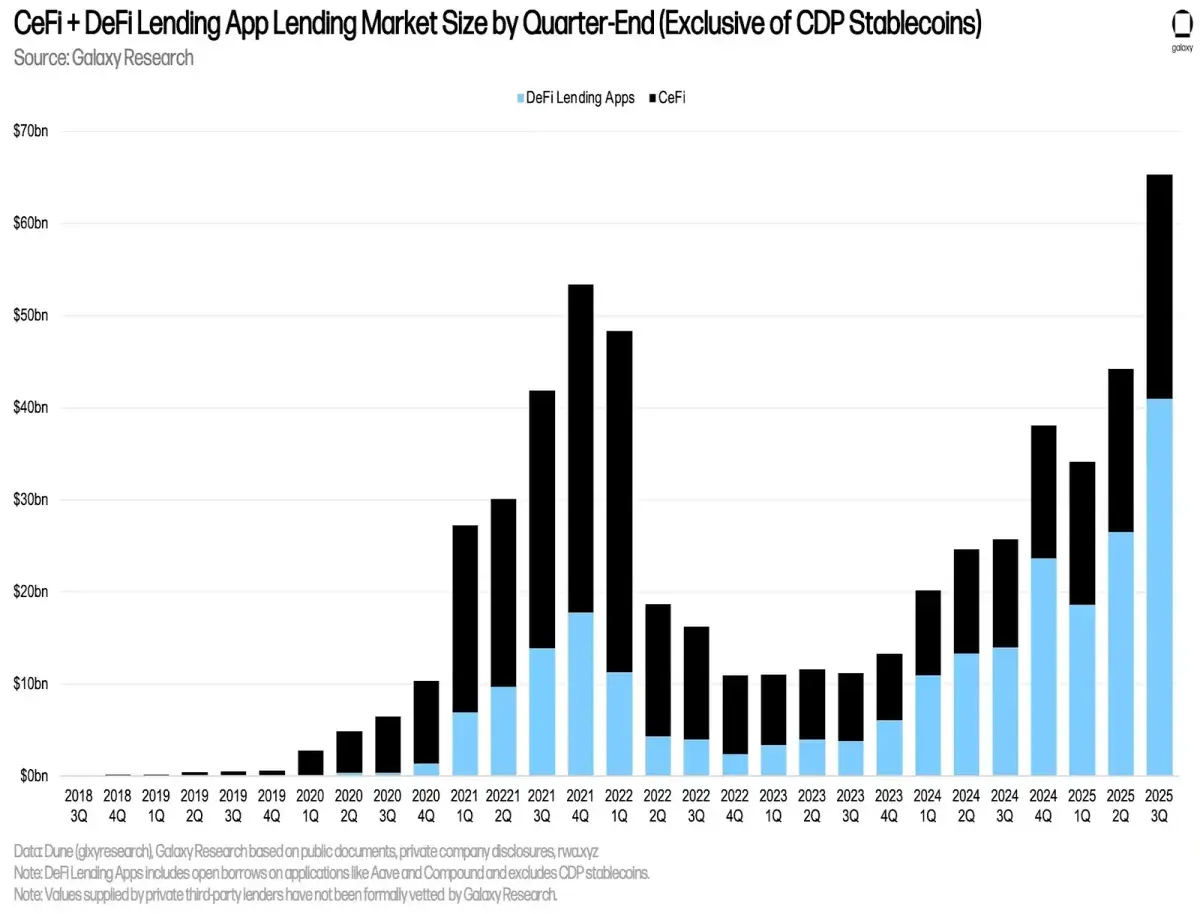
Source: https://www.galaxy.com/insights/research/the-state-of-onchain-yield
The problem these trends create: Immense fragmentation
As this mega trend of onchain vaults, and key catalysts of tokenization, yield bearing stablecoins and DeFi borrowing / lending accelerate a serious problem is going to accelerate with it…fragmentation.
The explosion in onchain yield creates an explosion in complexity:
- Hundreds of protocols
- Thousands of markets
- Dozens of networks
- Constantly shifting risk/reward profiles
- Zero standardization
Source: Stablewatch , and The Rollup






