
Introduction
Last month in April, COVID cases in India began to sharply rise. By late April, daily cases surged past 200,000 deaths. As the case count kept rising and the healthcare system became overwhelmed, India tried a variety of treatments to combat the virus including remdesivir, 2-deoxy-d-glucose (2-DG), and ivermectin as the country was shorthanded on the vaccines.
According to this aggregate of studies on remdesivir, cumulatively the drug will lead to a 24% improvement. The caveat is that the number of studies was limited (15) and all of them investigated remdesivir's efficacy during late treatment. Some studies found no statistical significance in clinical outcomes like Mahajan et al. (2021).
As for 2-DG, initial clinical trials showed optimistic results, but it is not in the market yet.
That leaves us with ivermectin. Notably five states, Delhi, Uttar Pradesh, Goa, Uttarakhand, and Karnataka, used the anti-parasitic drug to treat COVID symptoms. As I covered in this post, the drug can inhibit the virus's ability to replicate. In multiple studies, they showed that administering ivermectin led to lower cases in Brazil (Chamie, 2020) and lower progression and death rates among Egyptian patients (Elgazzar et al., 2020). There was even a paper published in February 2021 that showed ivermectin reducing infection by 73% among Indian healthcare workers.
The thing with science is that you need to show repeatability of results in order to prove that the outcome was not a fluke. So what happened after ivermectin was distributed in these five Indian states?
Ivermectin's Effect on Case Count
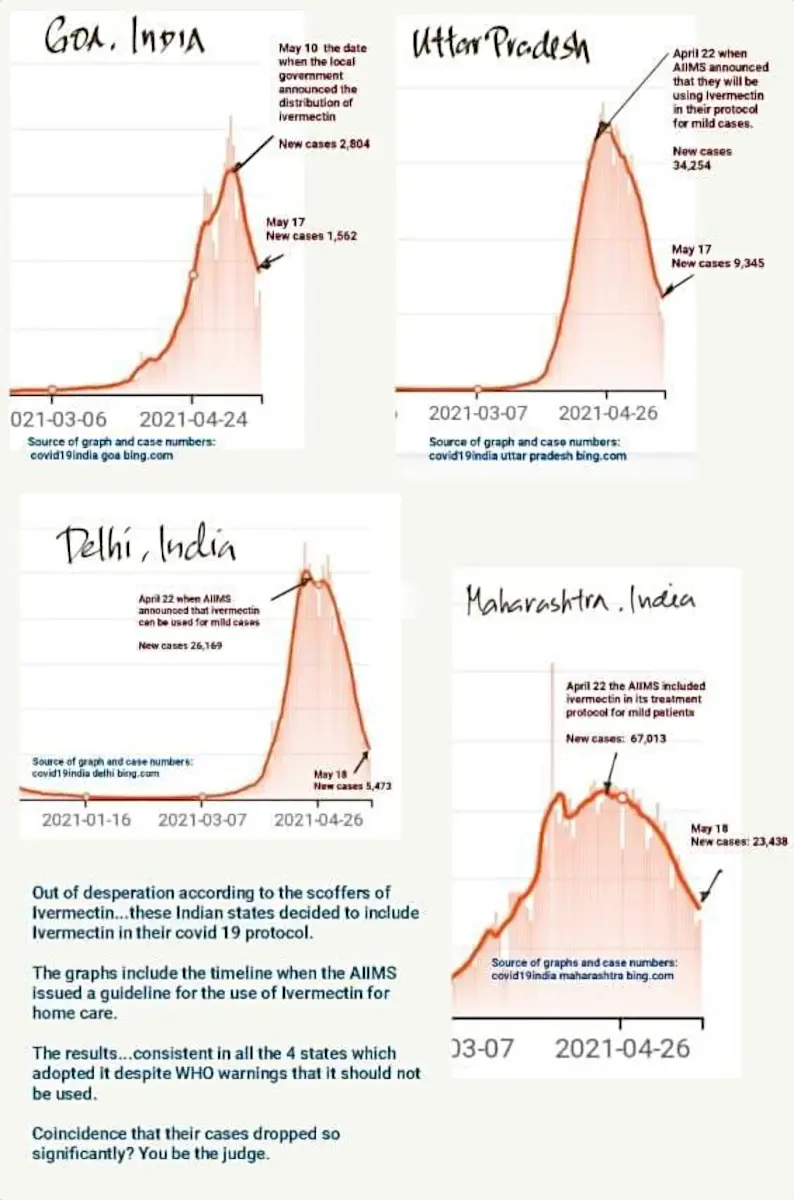
As noted by this editorial from The Desert Review, all five states oversaw a massive reduction in cases. In Delhi, cases dropped from 28,395 in April 22 to 2,260 on May 22. Uttar Pradesh saw its cases drop from 37,944 on April 24 to 5,964 on May 22. Goa's cases fell from 4,195 to 1,647; Uttarakhand's fell from 9,624 to 2,903; and Karnataka's from 50,112 to 31,183.
The editorial also mentioned how the state of Tamil Nadu outlawed ivermectin on May 14 in favor for remdesivir. From April 20 to May 22, it saw its cases more than triple, from 10,986 to 35,873.
Similar to what happened in Brazil (Chamie, 2020), the Indian states who used ivermectin as a treatment option saw from a 57.7% reduction in cases to up to an astonishing 92% reduction. For a more visual representation of what happened, CountryoverParty made a pretty handy graphic to showcase the big drop in cases post-ivermectin:
Closing Thoughts: Take Ivermectin Seriously and Stop Politicizing It
As I shown in my previous post about the drug and big reduction in cases in these five Indian states, the medical field needs to take ivermectin seriously as a treatment option. It is rather unfortunate that like with hydroxychloroquine, this drug has been politicized, too.
For instance, this article from Healio claims that there is a lack of strong data that proves ivermectin's effectiveness against COVID. It cites a study from Lopez-Medina (2021) to show the flaws of certain studies. But the thing is that people who have been following scientific literature on ivermectin already knew about this long ago. The article from Healio was just recently published in May 28. However, this May 18 archive this aggregate site of all ivermectin COVID studies, showed that the people putting all the data together already knew about the flawed Lopez-Medina (2021) study.
In addition, the aggregate includes over 100 other studies that showed major improvements under prophylaxis (i.e. preventative care), early treatment, and late treatment. All of the 17 randomized controlled trials (RCT) for early treatment and prophylaxis showed positive effects. It's easy to pick on the low hanging fruit like Lopez-Medina (2021), but to take that single study and extrapolate the conclusion to "there's a lack of strong data" is disingenuous.
There was also a May 14 article from Medscape/Reuters that sort of downplayed Goa and Uttarakhand's shift to ivermectin. It shows a clear slant by only citing the WHO's skepticism against the drug's effectiveness. Not once did it mention that Delhi and Uttar Pradesh already began to use ivermectin back in April and both states oversaw a substantial reduction in cases. This is a gross display of bad journalism.
Overall, health organizations should take ivermectin as a serious treatment option for COVID symptoms and COVID prevention. Not everyone is willing to take the vaccines or in India's case, sometimes the vaccines are not available. Figuring out other ways that can effectively mitigate COVID symptoms and reduce transmission rates is the proper course of action. If the results are proven to be statistically significant and repeatable, then they must be taken seriously, not dismissed.






