
The word blockchain technology is used by people to mean various things and can be confusing. Sometimes people tend to misinterpret it as Bitcoin blockchain, Etherium blockchain, and any other digital asset.
Most of the time they're talking about distributed ledger a list of transactions that is replicated across a number of computers (rather than being stored on a central server) and which acts as the ultimate books and records.
Blockchain was created to solve the trust problem between unknown parties. It is the technology that supports cryptocurrencies like Bitcoin.
In short, blockchain is an underlying technology while cryptocurrencies are it's applications.
Basic Blockchain Process
We can describe the basic blocking process with a payment example between party A and party B.
Party A wants to send a sum of money to party B. An algorithm transforms the transaction into a hash value, called data, in the form of encrypted data. The data code will become a data block after adding a timestamp. He will then be broadcast to participants in the network such as A's and B's friends and colleagues. And once they have checked the transaction's validity. In other words reach a consensus. The data block will be attached to the chain and the movement of funds from A to B is permanently registered. And once it is permanently registered, both Party A and Party B will not be able to deny the transaction.
Let's define and differentiate between two basic terms Cryptocurrency and blockchain.
Cryptocurrency are digital assets and on the other hand, blockchain is responsible for the transfer of these digital assets from one person to another.
To understand applications of block chain it is important to distinguish between the main forms of Blockchain
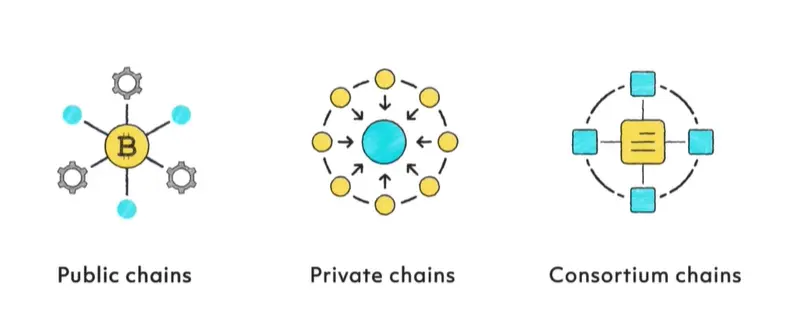
Public chains
are truly decentralized and distributed block chains. The participants are often anonymous and each can read, write and verify a transaction. They also have complete ledger and may review transactions.
The security of public chains is guaranteed by consensus mechanisms such as roof of work or proof of stake. Application delivery is fairly easy and allows global access. Also as the data volumes increases, Operational issues are needed to be considered such as Longer time and Higher maintenance cost.
Private chains
are featured with distributed ledgers with decentralisation, the network manager decides who is eligible for and confirms transactions and Private chain members do not earn virtual currencies.
Consortium chains
are blockchains between public and private chains. They have characteristics. They introduce such forms of decentralization through institutions and practice. Participants are specified by default according to their requirements. It also allows easy control of permission and as a blockchain intermediate type reduce the cost of participation as a node for a individual and facilitate the establishment of the system.
As you can see, block chain technology as a bag of technologies. Like Lego, various pieces can be taken from this bag and be combined together to achieve different results.
Cryptocurrency are digital assets you can buy it and send them to someone else. A quick way of thinking about it is by seeing digital assets as the Internet currency. You transfer it from your account to the account of someone else when you transact. This takes place on a peer-by-peer basis, i.e. it does not have to go through a central 3rd party, your transfer is recognized in seconds and may settle within hours. The price of Cryptocurrency is expressed in US dollars or other fiat currencies. The price depends on the supply and demand of market traders. Nothing very different from how the price of oil and gold is calculated.
To summarize things
1. Blockchain is a distributed ledger technology that supports cryptocurrencies like bitcoin.
2. it was developed for the purpose of solving the issue of trust between unknown parties.
3. The basic blockchain process
4. Crytocurrency are digital assets and Blockchain is the one responsible for the transfer.
3. Main forms of blockchain are Public, Private, and Consortium Chains.
4. Cryptocurrency are digital assets and one key application of blockchain.
5. Cryptocurrency transact on a peer-to-peer basis without needing to involve a central third party.
Coming soon! Part 2...
Key risks and Security Considerations
Potential use for Blockchain Technology
Features and Benefits of Blockchain
The future of blockchain
Next steps





