
What if there’s a platform which allows you to stake any asset (crypto, digital fiat, stablecoins and NFTs) and earn revenue and trade ? The answer is Kira network.
Kira network is an upcoming DeFi project allows you to utilize 100% of your liquidity with Kira’s staking derivatives. This is a positive feedback loop that encourages more assets being stake, the more secure and liquid Kira becomes, which is the opposite of other PoS projects, so you can stake and trade in the most secure and scalable manner.
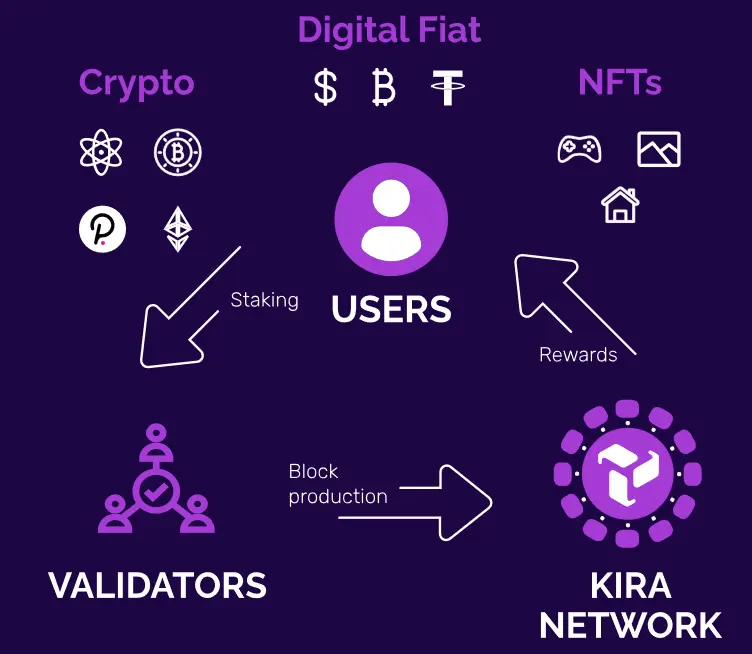
Kira network has it’s own consensus mechanism called Multi Bonded Proof of Stake (MBPoS). The concept is to use the staking multiple assets to secure the network and induce capital flow to the dApp deployed on top.
It aims to resolves issues of insufficient “trust” and “value” at stake by enabling staking of multiple assets. Since not all assets are valued the same as the market price, thus a governance curated registry is used to assign subjective “value” to foreign tokens measured in units of a native token. For example staking of 1 BTC could be equivalent to staking 10'000 XYZ (native tokens).
In certain situation, it may be profitable for a network to allow multi-staking of tokens which have no market value however their presence could generate higher network fees which would translate as a higher intrinsic value for the native staking asset. In other cases, a network governance could undervalue multi-staking assets such as Tether if there is no sufficient evidence that those assets are 1:1 backed by the equivalent USD value or if their market price is suspected to be manipulated.
Kira Network is using 2 protocols to interconnect with networks. Cosmos and Polkadot.
Why theses 2 protocols and not ethereum ? These protocols are the most mature and most well suited for the interchain use case – permissionless and trustless. They have pegging mechanisms -> to transfer coins on one ledger to another coins are locked on one chain in verifiable manner and issued on another.
Every network needs way to bootstrap, Kira wants the network to be decentralized but also ensure that development effort is also decentralized and no single centralized party is the only contributor to the codebase. Kira is also creating a governance system that can self-evolve as well as building up on-chain contracting system so that network itself can self evolve and hire developers on-chain.
Kira also uses sharding to archive high throughput by the subset of validators operating a shard – those validator can be interchain-slashed if they misbehave. Thanks to the MBPoS consensus, Kira network can ensure that there is always more value at stake than the value deposited to the shard which means they do not have cap in terms how much Kira can scale out and there is close to zero overhead while settling balances on the hub (relay-chain).
The Kira token is called KEX , among the use case, it is use for staking which is the most efficient way to earn block and fee rewards. It is also use for governance of the system and is use for voting.
KEX is also using unique type of funding called Initial Validator Offering (IVO).
It is a new way of crowdfunding to propel network to the next paradigm, but without exposing retail to all the risks that that ICO’s were bringing. IVO comes with the pure DeFi spirit of yield farming, instead of spending your money to buy a token, you stake your coins to interchain-mine new coins projects that deploy IVO’s earn commission fees while delegators earn new tokens.
Kira is having contest (8/Oct/20 – 15/Oct/20) for one hundred lucky winners to win an allocation spot in the public round, allowing each winner to acquire up to 1 ETH worth of KEX tokens . Read more about it here






