
Part of the Ethereum Foundation’s plan to make Ethereum more private and scalable is to introduce a new virtual machine, with leanISA and RISC-V among the top candidates.
Ethereum co-founder Vitalik Buterin has named quantum resistance, scalability and privacy as three of Ethereum's top priorities under a new "Lean Ethereum" strawmap, which lays out the network's technical direction for the remainder of the decade.
In a post to X on Saturday, Buterin said the collection of upgrades will roll out over the next three to four years, touching nearly every layer of Ethereum in a transformation he compared in scale to the September 2022 Merge, which shifted the network away from energy-intensive mining.
“Quantum safety has shifted up a LOT in priority,” he said, adding that finalizing a quantum-safe solution for blobs has “become urgent.” Enhancing privacy is another priority, Buterin said, stating that it has become a “first class goal.”
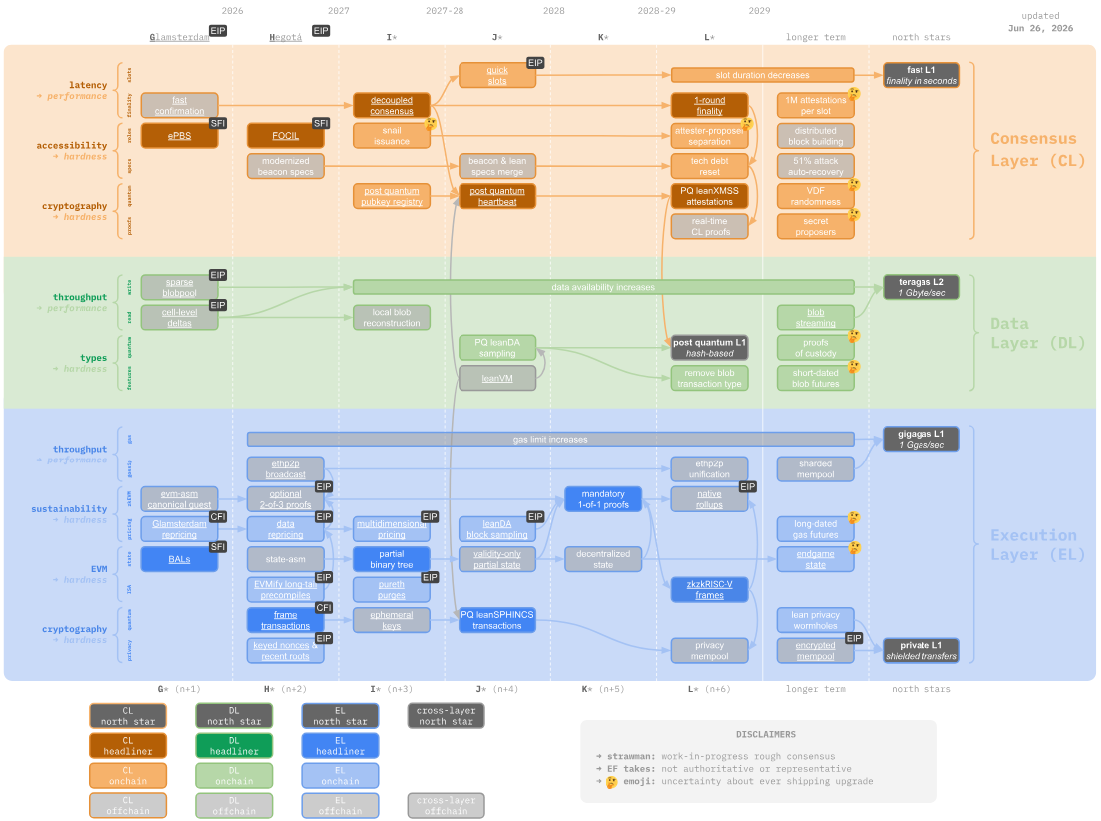
The “Lean Ethereum” strawmap timeline from 2026 through to 2029. Source: Strawmap.org
The change in roadmap comes amid a series of changes at the Ethereum Foundation, which laid off roughly 20% of its staff last month in a bid to become leaner and reduce its budget by 40%.
The leaner structure comes on top of several executive departures in recent months, including Hsiao-Wei Wang and Tomasz Stańczak, while protocol contributors Tim Beiko and Barnabé Monnot also left in May.
Buterin is also pushing for the development of a new virtual machine like leanISA or RISC-V to support programmable privacy and better scalability.
Questions remain over Buterin’s timeline
Dankrad Feist, a researcher behind the payments-focused layer-1 Tempo blockchain, praised the new plan but argued the 3-4 year timeline is too slow, stating that AI could help developers ship the upgrades within a year.
Crypto analyst Ignas Fiodorovas was also in favor of the plan but cast doubt on the Ethereum Foundation's ability to deliver the upgrades within the stated timeline, citing the organization's history of missing deadlines.
Fiodorovas said the only key feature missing from the roadmap was improved tokenomics for Ether (ETH), which has continued to slide in price amid a broader market downturn.
Vitalik Buterin says obfuscation could unlock private onchain crypto voting
Vitalik Buterin said indistinguishability obfuscation could eventually support private, collusion-resistant onchain voting without trusted committees, though the technology remains impractical.
Ethereum co-founder Vitalik Buterin published a technical essay outlining how cryptography could one day enable people to vote privately onchain without relying on a trusted group to manage ballots or reveal the result.
In a blog post on Monday, Buterin said a cryptographic approach called indistinguishability obfuscation (iO), combined with blockchain infrastructure, could support private and collusion-resistant voting with “almost no trust assumption.” The approach would replace threshold committees, which jointly decrypt voting data, with protected programs designed only to reveal the outcome.
Private onchain voting remains dependent on groups of operators safeguarding information and behaving honestly. Removing that dependency could make decentralized governance harder to manipulate, reduce the risk of insider interference and allow voters to participate without exposing how they voted, according to Buterin.
However, Buterin said the technology remains impractical. He said the most conservative constructions require what he described as “galactic” amounts of computation. He said faster approaches rely on less-tested security assumptions, which means that the idea presents a more long-term research direction rather than a deployment-ready system.
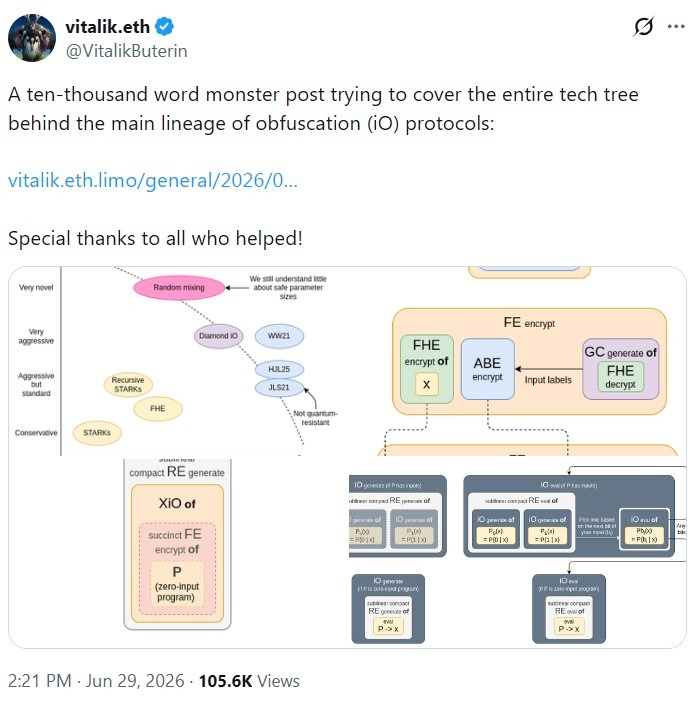
Source: Vitalik Buterin
How indistinguishability obfuscation could protect onchain votes
According to Buterin, iO is a form of cryptography that turns software into a protected program. People can run the program and receive the intended output, but they cannot inspect its internal code or extract the data stored inside it. Buterin described the concept as hiding the code rather than the information being processed.
For onchain voting, Buterin said an obfuscated program could contain the logic needed to process encrypted ballots and reveal the final tally without exposing individual votes, essentially removing the need for a threshold committee whose members collectively hold the keys required to decrypt the result.
Buterin said blockchains would still play a key role because an obfuscated program cannot prevent itself from being copied or independently maintain changing information.
Buterin’s broader privacy push
Buterin previously connected iO with private voting in his Ethereum roadmap published in October 2024. He said the approach could provide stronger privacy and resistance to coercion. His latest essay expands on that earlier proposal by examining how the underlying cryptography could be constructed, the security assumptions it requires and the technical barriers preventing it from becoming practical.
In April 2025, Buterin proposed a more immediate privacy roadmap for Ethereum, calling for privacy tools to be integrated into existing wallets. The proposal also advocated for stronger protections against data collection by infrastructure providers that wallets use to access Ethereum.
Buterin also drew funding from his personal holdings to fund privacy-preserving technologies. On Jan. 30, he earmarked 16,384 Ether (ETH), worth about $45 million at the time, to fund initiatives focused on privacy, open infrastructure and self-sovereign tools.





