
Binance reported net outflows of $1.23 billion this week, up 207% from the previous period, while Ethereum withdrawals hit their highest level in three years.
Binance, the world's largest cryptocurrency exchange by trading volume, recorded a sharp increase in weekly withdrawals, with Ethereum withdrawal activity reaching its highest level in several years.
According to data from DefiLlama consulted by Cointelegraph on Sunday, Binance recorded net outflows of $1.23 billion in the week beginning June 29, a 207% increase compared to the approximately $400 million of the previous week , while monthly net outflows totaled approximately $3.2 billion.
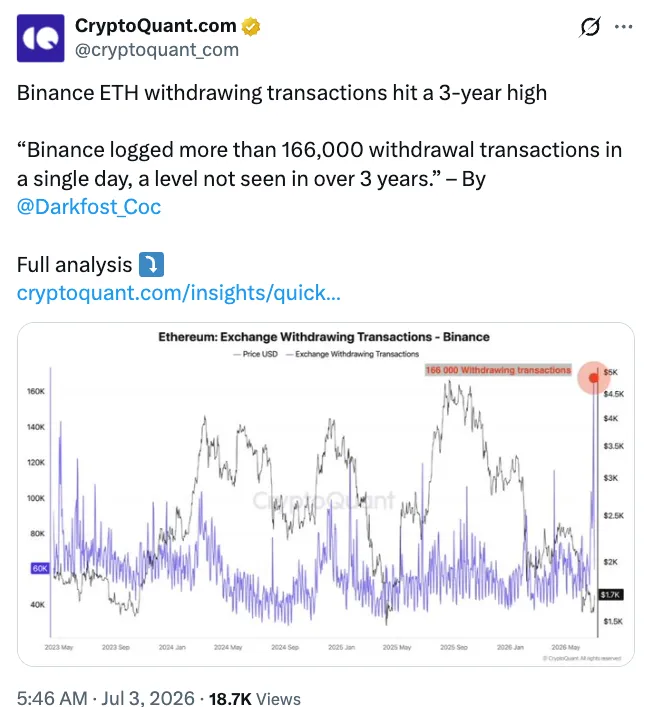
In other news, CryptoQuant community analyst Darkfost reported on Friday that Ethereum withdrawal transactions on Binance reached their highest level in over three years, with more than 166,000 withdrawal transactions in a single day.
Although some of this movement may reflect accumulation behavior, Darkfost pointed to regulatory uncertainty stemming from the European Union's Markets in Cryptoassets Regulation (MiCA) and short-term market positioning as possible determining factors.
ETH outflows versus price recovery
ETH withdrawals on Binance marked the largest increase in withdrawal transactions recorded on Binance since March 2023, coinciding with a modest recovery of Ether of around 10% in two days, according to data from CryptoQuant.
“This sudden increase in withdrawals may reflect genuine demand around the $1,500 level, with investors opting to increase their exposure and withdraw their funds from the brokerage, a pattern that typically indicates long-term accumulation rather than short-term trading,” Darkfost said.
Source: CryptoQuant
Ether prices have seen a broader recovery over the past week. According to data from Coingecko, ETH has risen approximately 12.5% in the last seven days, trading at $1,766 at the time of publication.
Bitcoin, the largest cryptocurrency by market capitalization, also rose 4.3% during the same period, trading at $62,925 at the time of publication.
Outflows predominate in CEXs, while inflows remain fragmented.
Besides Binance, several other centralized exchanges (CEXs) also reported capital outflows last week.
Bitfinex recorded outflows of $407.5 million, followed by Gate with $214.3 million. OKX recorded outflows of $87.1 million, while Bybit accounted for $78.4 million, according to data from DefiLlama.
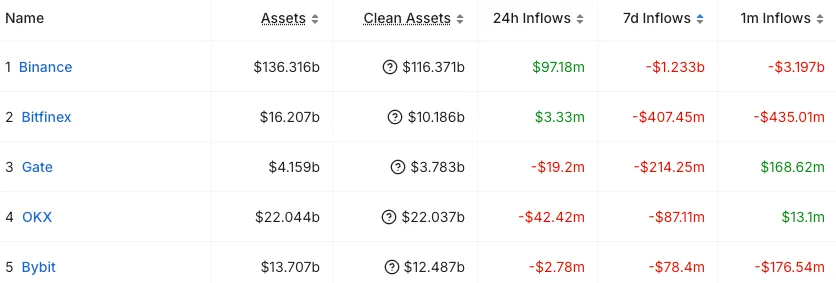
The top five brokerages, ranked by weekly net inflow. Source: DefiLlama
Regarding inflows, Crypto.com and HashKey Exchange led the gains last week, registering approximately $63 million and $53.3 million in net inflows, respectively.
Smaller inflows were also observed in KuCoin, with US$22.1 million, in Gemini, with US$17.4 million, and in Bitvavo, with US$15.8 million, during the same period.
Outflows from Ethereum ETFs exceed purchases from Bitmine, raising the risk of a drop below $1,500.
Despite the advancement of tokenization and the growth of TVL in the ecosystem, the stagnation of DApps and redemptions in spot ETFs continue to put pressure on the price of Ether.
Ether (ETH) has failed to hold prices above $1,600 since Thursday, mirroring the overall downward trend in the cryptocurrency market. The drop in oil prices has created a positive climate that has fueled investor hopes for a more expansionary monetary policy. This scenario favors stocks and raises bond yields.
Investors now fear that ETH will not be able to hold above the $1,500 support level for much longer. Spot outflows from Ether ETFs negate the impact of accumulation from Ether treasury firms.
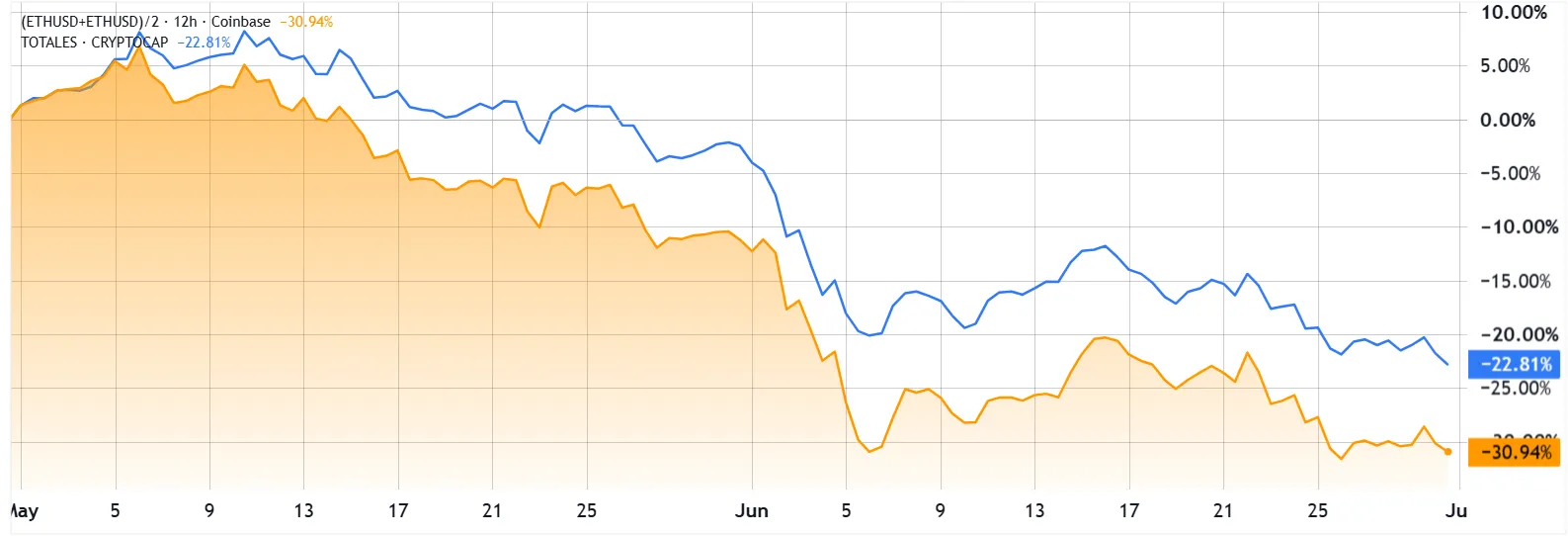
ETH/USD (orange) vs. Total cryptocurrency market capitalization (blue). Source: TradingView
The price of Ether has fallen 31% since May and has underperformed the total cryptocurrency market capitalization by 8% during that period. US-listed Ether ETFs have seen net outflows of $345 million since June 17, which more than offset the $182 million in ETH inflows from BitMine Immersion (BMNR US) and Sharplink (SBET US) during the same period.
Regulatory hurdles, AI competition, and weak on-chain metrics for Ethereum.
Several factors appear to have dampened investor appetite, including regulatory uncertainty in the United States. Meanwhile, the stock market continues to attract attention thanks to strong financial results and lower inflation expectations.
The Digital Asset Markets CLARITY bill has been awaiting a vote in the Senate since May 15. The bill aims to end regulation through oversight and clarify which tokens are considered securities. However, it faces resistance from lawmakers regarding provisions related to stablecoin yields and anti-money laundering standards.
Democratic lawmakers have expressed ethical concerns about the Trump family's ties to cryptocurrencies and their role in the World Liberty Financial platform . Most consider the CLARITY Act a positive catalyst for the decentralized finance (DeFi) sector. Therefore, the continued uncertainty surrounding its approval is harming institutional demand for ETH.
The artificial intelligence sector is now competing with blockchain in data processing, as cloud providers offer services through agent architectures. SAP (SAP DE), a leader in enterprise software, has integrated autonomous and modular AI agents natively into multi-vendor clouds, enabling peer-to-peer collaboration.
Ether investors are also disappointed by the stagnation of Ethereum network fees and decentralized application (DApp) revenues. As a result, the supply of ETH becomes inflationary, staking yields remain limited, and there are fewer incentives for ecosystem growth, since a portion of DApp revenue returns to users.
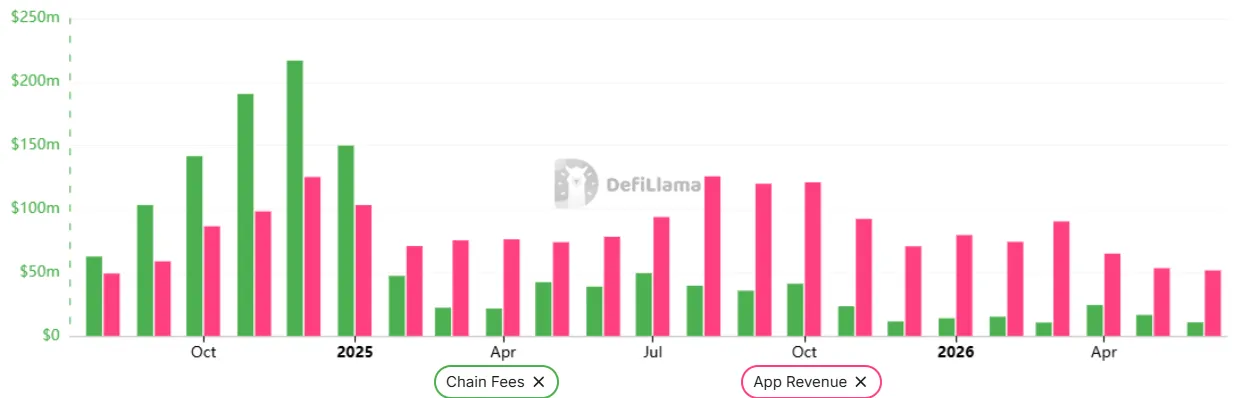
Monthly Ethereum blockchain fees versus DApp revenue, in USD. Source: DefiLlama
Ethereum network fees reached just $10.7 million in June, a drop from $24.4 million in April. DApp revenue reached $51.7 million in June, compared to $64.8 million two months earlier. Top contributors include Sky (formerly Maker) with $12.7 million, Titan Builder with $7.2 million, and Chainlink with $4.6 million.
Ethereum proponents argue that tokenization is still in its early stages. The long-term growth potential should create sufficient demand for blockchain to support a much greater appreciation of ETH.
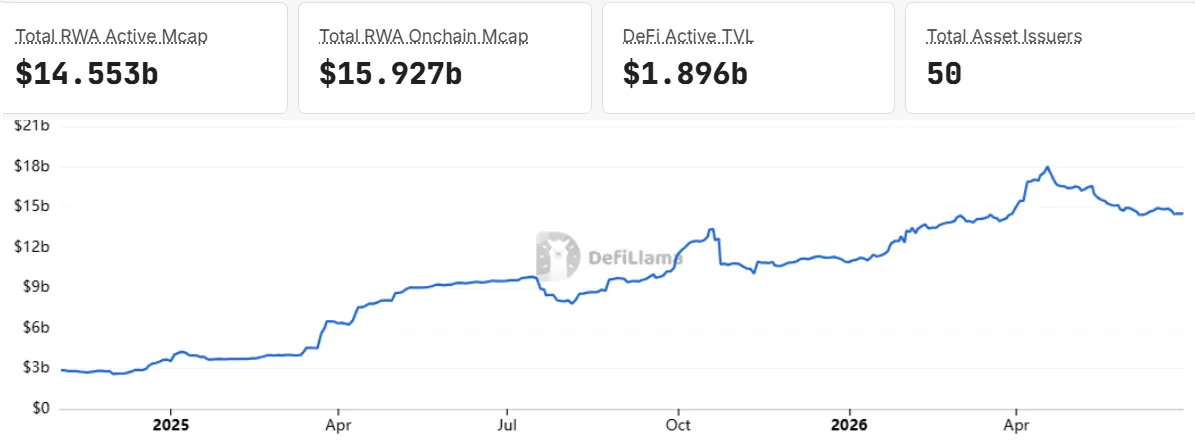
Ethereum's active real-world asset (RWA) market capitalization in USD. Source: DefiLlama
Although real-world assets (RWA) show real potential, Ethereum's tokenized market capitalization of $14.5 billion has yet to generate significant DeFi activity. With a staking yield of 2.7% and weak on-chain metrics, the chances of ETH falling below $1,500 remain open.





