
The miner's chances were 1 in 17,000 years.
Fighting against a billion-dollar industry, a small Bitcoin miner earned over R$1 million last Friday (10) after solving block number 957,382.
As revealed by Public Pool, the miner was using a single Bitaxe, a homemade mining rig with little power.
Although it is statistically rare for this to happen, to the point that solo mining is called a lottery, it helps Bitcoin maintain its decentralization.
Earn US$10 in Bitcoin directly into your account. Open your account at Mynt and receive cashback. Use the coupon: LIVE50 Mynt.com.br
The miner had a one in 17,000 year chance.
On-chain data shows that the miner received a reward of 3.14 bitcoins for mining block 957,382. This amount is valued at over R$1 million at the current exchange rate.
"Second block found in the Public-Pool hosted by a single Bitaxe."
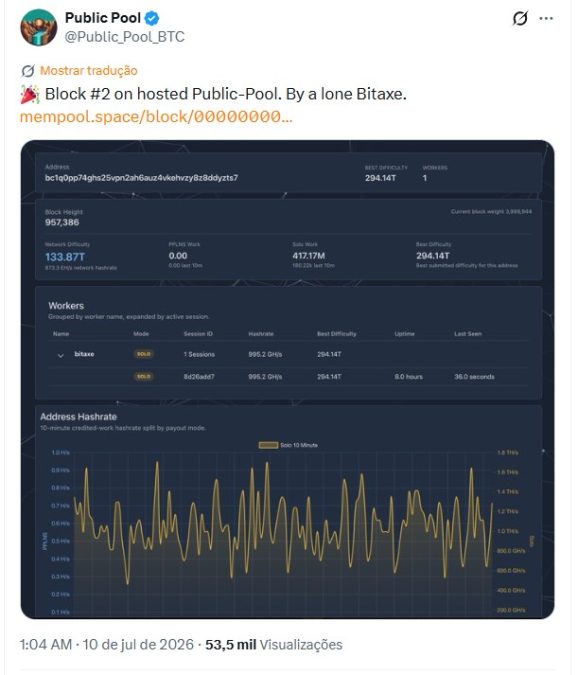 Miner managed to beat major mining companies using homemade equipment. Source: Public Pool/X.
As can be seen in the image above, the processing power of the lucky miner is around 1 TH/s (terahash per second).
Given that the Bitcoin network has a total hashrate of around 900 EH/s (exahash per second), this means that your chances were 1 in 17,000 years.
At the time of writing, the miner is keeping the coins stored at his address, indicating that he is in no hurry to sell them.
What is a Bitaxe?
In short, a Bitaxe is a small mining machine that uses the same chip seen in high-end ASICs. The difference is that it uses a single chip, while machines used by large mining companies have hundreds working in parallel.
Although there are several Bitaxe models, a 1.3 TH/s model can be found for around 139 euros (R$ 815, not including taxes and other import costs) on specialized websites.
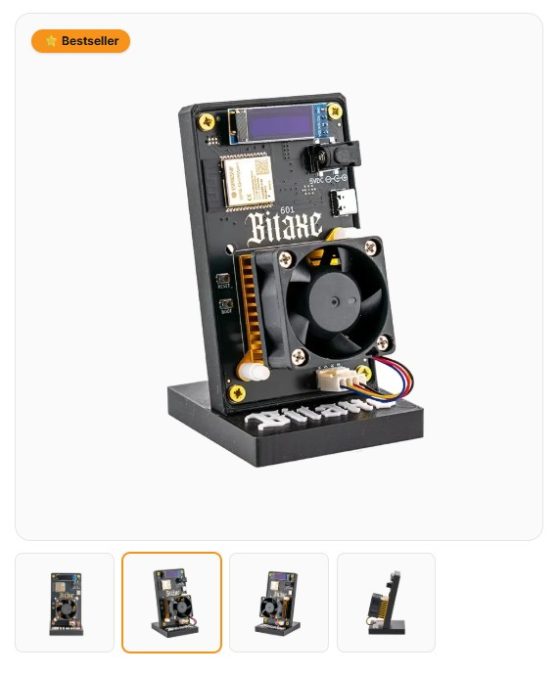 The model used by the lucky miner may have been a Bitaxe Gamma 601 with a power of 1.3 TH/s. Source: Open Source Miners/Reproduction.
In addition to that, the miner also needs to bear the energy costs. Since it's a low-powered piece of equipment, these expenses are around R$15 per month, considering a price of R$1 per kWh.
In 2025, two Brazilian twin brothers conducted an experiment to find out how much a Bitaxe HEX (a more powerful model than the one above) would yield when mining in a pool . The result was disappointing, not even covering the energy costs.
Therefore, this explains why these home miners opt for solo mining, which ends up being a complete lottery due to the minuscule chances of beating other miners on the network.
Earn US$10 in Bitcoin directly into your account. Open your account at Mynt and receive cashback. Use the coupon: LIVE50 Mynt.com.br






