
In crypto, there's one rule that is always true: once sent, no coming back. No undo, no customer service call center you can call. Blockchain transfers are permanent — and that's the reason why some people call them "one-way tickets."
But what does that really mean? And why is it worth seeing it not as threat or warning, but as knowledge — as a part of how the new world we live in works?
This isn't about risk, but about structure. We're accustomed to having the potential for a mistake to be corrected in traditional finance. Sent the money to the wrong account? Call the bank. Got the number wrong? It can still be reversed before it's processed. The system has room for making mistakes, and there's an "emergency brake."
But crypto doesn't.
Transactions on a network like Bitcoin, Ethereum, or BCH are irreversible—they cannot be reversed. Not that the system is heartless. It's that that's the brilliance of a network without mediators: no centralizing power, no body which has the authority to hold onto or wipe out your trail.
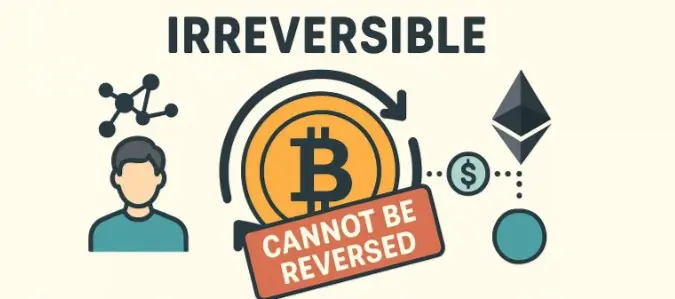
Every transaction is recorded, sealed into a block, sent to thousands of nodes, and becomes a part of the network's history. This isn't just risk. It's structure and design—about how trust isn't established by human entities, but by mathematics.
And out of this, we finally get a Memorable Comparison. Imagining buying an airplane ticket. One way to another country. Once you leave, there's no going back—unless you buy a new ticket, or choose to remain in the new nation.
That's roughly what a crypto transaction is.
When you pay someone coins, the system assumes on your behalf that that is what you intended. No approval, no judgment, just logic: sender pays, recipient gets, and the network keeps a record. That is it.
Contrast this to classical systems full of permissions, conditions, verification, authority, and sometimes—drama.
Although we already know what Not a World Without Errors is, this is a learning experience in a World Without Reason to Blame and an appreciation of the value of honesty. A one-way ticket does not imply that we will make no mistakes at all. But this system forces us to learn to be more careful, more meticulous, and more mature. Even if we make some mistakes, honesty prevails here. For there is no room for blaming others.
If you send something incorrectly, it's not the fault of the network. If you get swindled, it's not the fault of the blockchain. Crypto makes us look in the mirror, not out the window.
Why Is This Important to Know?
Because everyone comes into the world of crypto with the old mindset: waiting for a "gatekeeper," waiting for a refund, waiting for an empathetic call center. But the world of crypto is not about ease—it's about liberty and responsibility.

And every time we press the "Send" button, we're making an unspoken agreement: that we're making a choice to move forward, without looking over our shoulders. That we're ready to see what happens from the one small choice.
As a Final Word from me, Not a One-Way Ticket, But a Gateway to a New Awareness. A one-way ticket is not fear, but knowledge. It is not a trap, but a gateway. A gateway to a new world where all individuals are in control of their money, without permission, without censorship, without interference.
But that door only opens once, and as you enter. you're not the same anymore. Because in crypto, bad trades can be costly, but new realizations that come out of them are much more valuable.






