
Everyone knows the mythical number i. There is a certain level of mystery associated with this number, and it does not help that the word "imaginary" is in its literal title. After all, imaginary things are not real. Your imaginary friend is a figment of your imagination. They are defined as √(-1) which is confusing as hell. What two numbers, if multiplied together, would give you a negative value?
So does that mean complex numbers (numbers that have imaginary parts) are just a figment of mathematicians' imaginations? No. Imaginary numbers are not imaginary. They are very real, just as real as real numbers. In this article, I want to give you a different definition of the number i. By the end, you'll see that √(-1) it does not have to be the definition of it, but rather a consequence of it.
Rotation
The number i is closely related to rotation. Specifically, it represents a 90˚ rotation in the counter-clock direction (to be even more specific, it is the rotation in the x-y plane around the z-axis, but this nuance is not important).
Let us now redefine i: it is an operation that when you multiple a number by it, it rotates it 90˚ in the counter-clock direction.
Let's do an example to see how this all fits together. Note: Due to the limitations of this website, I'm going to use the letter a to represent an "x-hat" or a unit-vector in the x-direction and b to represent a "y-hat" or a unit-vector in the y-direction.
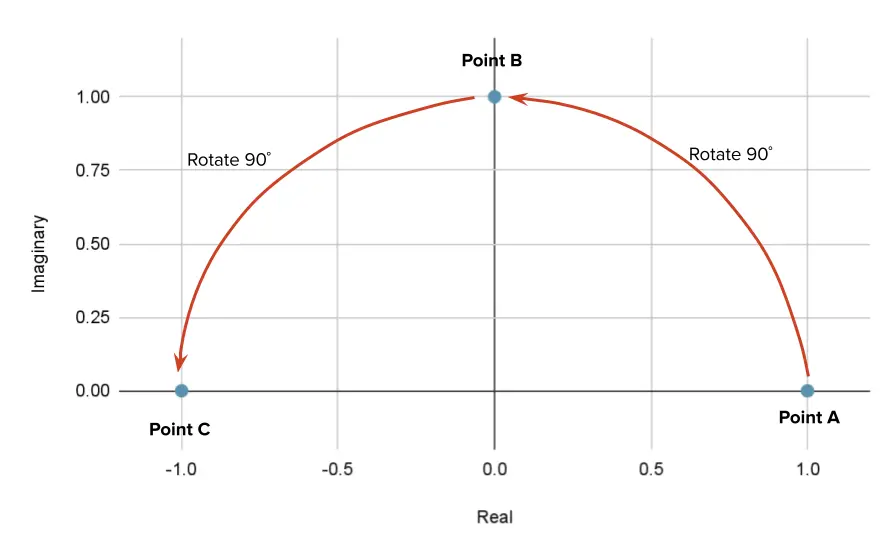
Now, let's start with a point on the x-axis at position 1 (Point A from the image). This point is defined at (1,0) or 1a. Let's multiply this number by our newly defined rotation operator i to get 1ai. But we also know in the Cartesian system (fancy term for the 3-dimensional world we live in), that a 90˚ rotation of 1a gives us Point B. In other words, 1ai = 1b.
Okay, let's repeat this rotation operator, but this time on Point B. Multiplying 1b with i gives us 1bi. Again, visually we can see that a 90˚ rotation of 1b gives us Point C. In other words, 1bi = -1a.
We just observed that if we start with Point A (point 1 on the x-axis) and rotate 90˚ counter-clockwise twice, we get a full 180˚ rotation and end up at -1. This is trivial - that is what a 180˚ rotation means.
So now, let's get mathematical with it. If we start with 1a and multiply with i twice (to get 180˚ rotation), we get -1a, or 1ai*i = -1a. We can cancel like terms, and we get the original definition: i*i = i^2 = -1 or i = √(-1).
Summary
Hopefully, this clarifies the mystery behind i. I think it is a mistake to define it as the √(-1). i is just a 90˚ rotation counter-clockwise. The fact that it equals to √(-1) is a consequence of the Cartesian coordinate system.






