
What is governance?
In a decentralized organization, such as blockchain platform, a governance method is used to make decisions about changes or updates to the platform’s operational rules. In a centralized organization, the executive leadership does the governance role. A governance method includes:
- how proposals for changes are made, collected, and told to stakeholders
- what stakeholders are permitted to vote for the changes
- how the results for the vote are told to stakeholders
- how the changes are to be obeyed
- crisis governance.
MakerDAO governance method
The primary stakeholders of the MakerDAO blockchain platform are MKR token holders. These token holders use the Maker Protocol's on-chain governance system to vote. In the Maker protocol, each MKR token holder can vote, and one MKR token equals one vote, click here for more information.
The governance method is a two-step procedure as follows:
- An MKR token holder makes proposal for a change and a Governance Poll is used to find if the community agrees to the change.
- If the Governance Poll shows that in general that the community agrees to the proposed change, an Executive Vote by the MKR token holders about the change is done.
Here are some examples of changes that have been made:
- use for a new collateral type
- selection of an oracle feeds for the market price of a collateral asset
- a change to the Stability Fee or Dai Savings Rate
- a change to the Emergency Shutdown procedure
MKR token holders
The are 1 million KMR tokens. At this time, there are 20,894 MKR token holders. Here is the list for the top seven MKR token holders as given by Etherscan.
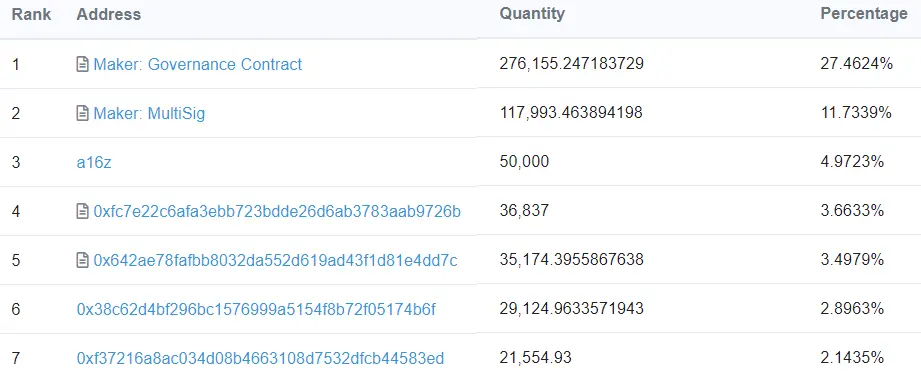
The two important facts shown in this table are:
- the top two MKR token holders each have more than 10% of the total quantity of MKR tokens
- the top six MKR token holders each have more than 2.5% of the total quantity of MKR tokens.
MakerDAO Vote results
The MakerDOA website has a list of all the votes made for changes to the MakerDAO, click here to see the list. There list shows the results for 146 agreed changes. The change that has the largest number of votes is 9.67%. The median number of votes shown to make a change is 2.40%. Thus, all the changes made to the MakerDAO platform could have been made by one of six different stakeholders.
Governance Security Module example
The Governance Security Module (GSM) lets the MKR token holders review changes for the system and to stop a change if it is thought to be malicious. Since the launch of MakerDAO, the time interval to do this review has been set to 0. It was thought that a 0 delay lets the MakerDAO the community to take immediate action to mitigate technical errors, oracle malfunctions, or outlier cases like a market panic or an economic attack.
But, in December 2019 Micah Zoltu wrote a blog post where he showed that an attacker could get control of governance with as little as 40,000 MKR tokens, click here to see the post.
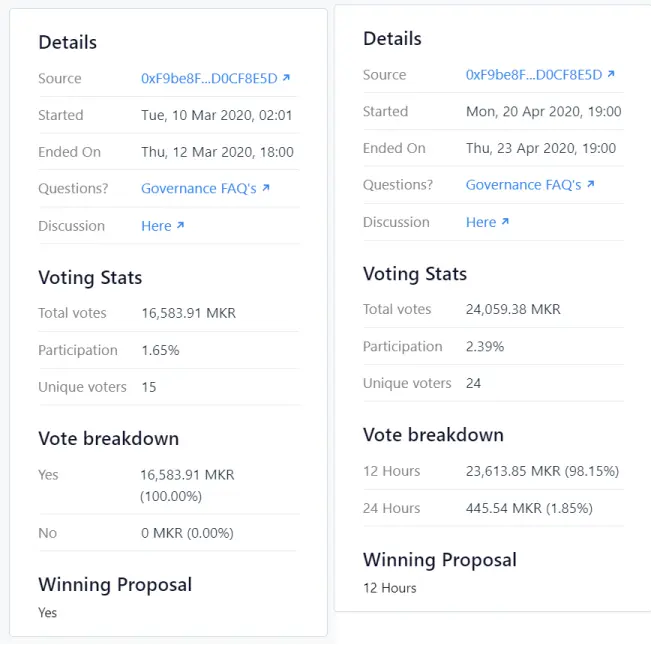
In March 2019, MakerDAO changed the GSM delay to 24 hours. But this proposal was agreed to with only 1.65% of the MKR token holders, click here to see the vote results. In April 2019, the time interval was reduced to 12 hours. Again, this proposal was agreed to by a small number of MKR token holders. This time 2.39% of the MKR token holders voted, click here to see the vote results.
Conclusion
Only a small number of votes is necessary to make a change in the MakerDAO platform. Thus, the MakerDAO governance method does not work satisfactorily.






